


About myeloma
Myeloma is a blood cancer that starts in the plasma cells of the bone marrow. Plasma cells normally produce proteins called immunoglobulins, which help fight infection. In myeloma, abnormal plasma cells accumulate in the bone marrow, leaving little room to produce healthy blood cells.
Myeloma plasma cells produce an abnormal immunoglobulin called paraprotein (also known as M-protein, M-spike or myeloma protein). This protein has no useful function. It is found in the blood and/or urine of most people with myeloma. It can build up in the kidneys and other organs, causing damage.
An exception is non secretory myeloma, which does not produce paraprotein and is monitored using imaging and bone marrow biopsies.
Myeloma cells also stimulate osteoclasts, the cells that break down bone. This causes bone to be broken down faster than it can be rebuilt, increasing the risk of:
- bone fractures
- bone pain, particularly in the spine, where weakened bones may compress nerves
- lytic lesions – small holes in the bone that weaken its structure
- hypercalcaemia – too much calcium in the blood.
Understanding immunoglobulins, paraproteins and myeloma
Knowing about immunoglobulins and paraproteins in myeloma helps you to understand your type of myeloma.
Immunoglobulins (Ig) (also called antibodies) are made by plasma cells. These are made in the bone marrow. Immunoglobulins protect you from and help fight infection. In myeloma, lots of abnormal plasma cells are produced. These cells make abnormal immunoglobulins called paraproteins.
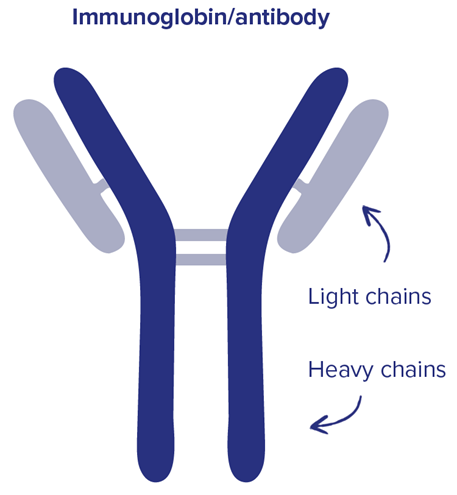
Each immunoglobulin is made up of:
- 2 heavy chains which are long protein chains
- 2 light chains which are shorter protein chains.
There are different types of heavy and light chains including:
- 5 types of heavy chains called G, A, D, E and M
- 2 types of light chains called kappa and lambda.
Your myeloma cells will produce a specific, single combination of one heavy chain type and one light chain type. For example, IgG kappa myeloma is the most common type of myeloma. It has 2 IgG heavy chains bound to 2 kappa light chains.
Some types of myeloma, like light chain myeloma (also known as Bence Jones myeloma), only produce the light chain part of the paraprotein. These are called free light chains.
Symptoms of myeloma
The symptoms of myeloma depend on how advanced the disease is. In the early stages, you may have no symptoms, and myeloma may be found during a routine blood test. As the disease progresses, symptoms are more likely to develop.
Common symptoms include:
- bone pain usually in the back, ribs, hips or skull
- easily broken bones
- frequent infections or fevers
- tiredness
- rapid heart rate
- shortness of breath
- pale skin
- bruising and bleeding easily
- feeling sick, drowsy or confused
- changes to your urine amounts and frequency.
Causes of myeloma
In most cases, there is no cause of myeloma. Some factors that can increase your risk of developing myeloma include:
- a history of monoclonal gammopathy of undetermined significance (MGUS)
- family history of myeloma
- some viruses and autoimmune diseases
- previous radiation therapy or high levels of environmental radiation exposure
- exposure to high levels of environmental chemicals.
Stages of myeloma
To work out the stage of your myeloma, your haematologist will look at the results of your tests. Your myeloma will be staged as low, medium or high risk.
Low risk myeloma:
- Beta-2 microglobulin is less than 3.5.
- Albumin is greater than or equal to 3.5.
- Lactate dehydrogenase (LDH) level is normal.
- No high risk chromosomes present.
Low to intermediate risk myeloma:
- Tests results are higher than stage 1 and lower than stage 3.
High risk myeloma:
- Beta-2 microglobulin is less than 5.5.
- Lactate dehydrogenase (LDH) level is high.
- High risk chromosomes present.
Types of myeloma
Types of myeloma are classified based on the type of paraprotein produced by the myeloma cells.
Typical myeloma is the most common type of myeloma. It is often referred to as just myeloma. It is classified by the paraprotein it produces. They are made up of one type of heavy chain and one type of light chain.
There are 5 types of heavy chain immunoglobulins (Ig):
- IgG
- IgA
- IgD
- IgE
- IgM.
There are 2 types of light chain immunoglobulins:
- kappa
- lamba.
In typical myeloma, the heavy chain is bound to the light chain to form the paraprotein. It is often present in the blood but not the urine. Blood tests are a good way to monitor this type of myeloma.
When the myeloma is active, there will be a rise in paraprotein levels. When the myeloma responds to treatment, there will be a decrease in paraprotein levels. It is normal for paraprotein to fluctuate a little bit. A small rise does not always mean that more or different treatment is needed.
Light chain myeloma occurs in about 15% of people with myeloma. It is also known as Bence Jones myeloma.
In light chain myeloma, myeloma cells only produce the light chain part of immunoglobulin. Not the heavy chain part. This is mostly detected in the urine.
Small increases in the number of light chains in the blood can be detected through a blood test. This is called a serum free light chain test. This test can be used to see how you are responding to treatment. It is also used to look at the kappa and lamba light chain ratio.
Non-secretory myeloma occurs in about 3% of people with myeloma. This type of myeloma produces no measurable paraprotein, so it cannot be detected in blood or urine tests, making it difficult to diagnose and monitor. Therefore, bone marrow biopsies and PET scans are used to diagnose and monitor this type of myeloma.
Precancerous conditions that can lead to myeloma
Some people develop early, precancerous conditions that can increase the risk of myeloma. However, most people with these conditions never develop myeloma.
MGUS is a condition that affects plasma cells, which are part of the immune system. People with MGUS make an abnormal protein called an M-protein instead of normal antibodies. This protein can build up in the blood and urine and may reduce the body’s ability to fight infections.
MGUS does not usually need treatment, but regular monitoring is recommended to check for any changes.
About 20% of people with MGUS develop myeloma.
Smouldering myeloma is an early form of myeloma that may develop into active myeloma over time. It usually does not cause noticeable symptoms and is often found through a blood test.
Around 10% of people with smouldering myeloma may develop active myeloma within 5 years of being diagnosed
Solitary plasmacytoma is a condition that occurs when plasma cells become abnormal, multiply uncontrollably and form a tumour that affects the bones. Unlike some other conditions, it usually appears in only one specific area of the body.
Around 50% of people with solitary plasmacytoma may later develop myeloma.
Extramedullary plasmacytoma occurs when plasma cells become abnormal, multiply uncontrollably and form a tumour in soft tissues outside of the bones. It most commonly affects the tissues of the upper respiratory tract, such as the nose, throat and nearby areas.
Approximately 15% of people with extramedullary plasmacytoma may later develop myeloma.
Diagnosis of myeloma
Myeloma is diagnosed with a number of tests:
A bone marrow biopsy is the best test to diagnose myeloma.
A bone marrow biopsy uses a needle to take a sample of bone marrow, usually from the back of the hip. A small amount of liquid bone marrow is removed and sent to the lab for testing. Often, a tiny piece of the bone itself is also taken to be examined.
Blood tests can detect abnormal proteins made by myeloma cells and show how the disease is affecting the body. Different types of blood tests include:
- full blood count (FBC)
- biochemistry tests including liver function, electrolytes and kidney function
- lactate dehydrogenase (LDH)
- cytogenetics
- beta-2 microglobulin
- serum free light chain assay.
Other tests you may have include:
- medical history and physical exam
- urine tests
- genetic tests
- computed tomography (CT) scan
- positron emission tomography (PET) scan
- magnetic resonance imaging (MRI).
Fertility and myeloma
Treatments for myeloma can affect fertility.
For women some treatments can cause damage to the ovaries.
For men it is possible to have low or abnormal sperm production.
Your fertility may become normal again in the future, but it is difficult to predict.
It is important to ask your doctor about your risk of infertility as early as possible. There are some options for preserving fertility. Decisions about what options might be right for you usually need to be made before you start treatment.
You can read more about fertility on our webpage.
Treatment for myeloma
Your haematologist will consider many factors when discussing a treatment plan with you, including:
- your subtype of myeloma
- your overall health
- your age
- your wishes.
The SLiM-CRAB criteria are used by your treatment team to help determine whether you have active myeloma that may need treatment. The criteria looks at different signs of the disease, including changes in plasma cells, blood tests, MRI results, kidney function, red blood cell levels and bone health.
The criteria are:
- S – 60% or more abnormal plasma cells in the bone marrow
- Li – high levels of light chains in the blood
- M – MRI with more than one bone abnormality
- C – high levels of calcium in the blood
- R – kidney damage
- A – low red blood cell count
- B – bone lesions or fractures.
Treatments for myeloma include:
Active monitoring (also known as watch and wait) involves regular blood tests and general health checks. No intervention is needed unless you develop signs and symptoms to suggest the myeloma is progressing.
People with smouldering myeloma and MGUS are generally actively monitored.
Supportive care controls symptoms of myeloma and side effects of treatment. It aims to improve your quality of life but does not intend to treat the disease. It can help with symptoms such as tiredness, breathlessness, bruising or bleeding and high blood calcium levels.
Supportive care may include:
- blood transfusions
- bisphosphonates – medications to strengthen bones
- supportive medications.
You can read more on our supportive care webpage.
Most myeloma treatment plans include steroids. They can be used on their own, but they are usually given with other treatments such as chemotherapy, targeted therapy or immunotherapy.
Steroids can:
- actively kill myeloma cells
- help other myeloma treatments be more effective
- act as an anti-inflammatory for people with myeloma bone disease
- act as an anti-nausea medication
- manage allergic type reactions to other myeloma medications.
Dexamethasone and prednisolone are 2 commonly used steroids. You can read more about them and their side effects on our corticosteroids webpage.
Targeted therapy is a cancer treatment that finds and blocks parts of cancer cells that help them grow and spread.
Proteasome inhibitors are an example of targeted therapy used to treat myeloma. They work by blocking the proteasomes inside myeloma cells. Proteasomes are structures that help cells break down and recycle proteins. When proteasomes are blocked, proteins build up inside the myeloma cells, causing stress and eventually destroying the cells.
Bortezomib, ixazomib and carfilzomib are examples of proteasome inhibitors.
You can read more about proteasome inhibitors and their side effects on our immunotherapy and targeted therapy webpage.
Immunotherapy is a type of biological therapy. It uses the immune system to recognise cancer cells and destroy them. Your treatment team will give this to you via a drip into a vein (intravenous) or a needle under the skin (subcutaneous).
Immunotherapy works by:
- stimulating the immune system to find and attack cancer cells
- removing barriers that are stopping the immune system killing cancer cells.
Daratumumab is a type of immunotherapy called a monoclonal antibody. It is used to treat myeloma. It damages cancer cells and causes them to die by attaching to a protein called CD38 on the blood cancer cell. It is given as an injection under the skin (subcutaneous), usually in an outpatient unit.
Immune system modulators are also a type of immunotherapy used to treat myeloma. They stimulate the immune system to attack and destroy cancer cells. They can also stop their blood supply and directly destroy cancer cells.
Thalidomide, lenalidomide and pomalidomide are examples of immune system modulators used to treat myeloma.
You can read more about immunotherapy and their side effects on our immunotherapy and targeted therapy webpage.
Chemotherapy (often called chemo) is used to treat myeloma. Chemotherapy destroys cancer cells and stops them from growing. It also damages healthy cells and causes side effects. There is information on chemotherapy side effects and how to manage them on our chemotherapy webpage.
The type of chemotherapy recommended will depend on your stage of myeloma, the treatment goal, your age and medical history. Chemotherapy can be given in combination with targeted therapy or immunotherapy.
Treatment plans for myeloma are shortened to letters like CyBorD. The letters represent the name of the medicines in that plan. Your haematologist will provide you with information on your plan, including when and how often you will have it.
There are several treatment plans for myeloma. They can be found on the Cancer Institute NSW website.
Radiation therapy, also called radiotherapy, is a type of treatment that:
- uses high energy x-rays to kill cancer cells
- is a local therapy because it only destroys cancer cells in the area it treats.
Radiation therapy is used in myeloma to:
- relieve and reduce bone pain
- shrink the amount of myeloma cells in the bones to slow down bone damage
- target specific growths, lumps or areas that need treatment without affecting the whole body
- treat in combination with other treatment
- prevent complications like further bone damage.
You can read more on our radiation therapy webpage.
A bone marrow or blood stem cell transplant is a treatment that restores stem cells after high dose chemotherapy. Your treatment team might suggest a transplant if your myeloma is aggressive, difficult to treat or has come back after a period of remission. There are 2 types of transplants:
- An autologous stem cell transplant is when your own stem cells are collected and then given back to you after high dose chemotherapy.
- An allogeneic stem cell transplant is when you receive stem cells from a donor, often a blood relative.
It is more common to receive an autologous transplant for myeloma. There are some situations where an allogeneic transplant may be recommended.
CAR T-cell therapy is a type of treatment that uses your own immune cells to fight cancer. Your T cells are collected from your blood and changed in a laboratory so they can find and attack your blood cancer cells. After you have chemotherapy to prepare your body, the CAR T-cells are returned to you through a drip into a vein.
Your treatment team may recommend CAR T-cell therapy if your myeloma has relapsed or is refractory. Not everyone is eligible for CAR T-cell therapy. Your treatment team will discuss whether this treatment is suitable for you.
You can read more on our CAR T-cell therapy webpage.
Clinical trials may be available for some types of myeloma. They often compare new or combination therapies with current treatments, including side effects.
Many are randomised, meaning some patients receive the new treatment, and others receive standard care. Trials help improve future treatments and may offer access to costly new therapies not on the Pharmaceutical Benefits Scheme (PBS) in Australia.
If you are considering a clinical trial, your doctor will explain:
- the possible risks and benefits
- how it compares to standard treatment
- what is involved.
You will need to give informed consent before taking part. Read more on our clinical trials webpage.
Survival rate for myeloma
The survival rate of myeloma is approximately 60%, 5 years from diagnosis. Survival rate is a population-based measure. Whereas your individual prognosis takes into account factors that can impact survival rate.
Your prognosis is estimated by your haematologist. It is a prediction of the likely course and outcome of your disease. The factors considered when discussing your prognosis include:
- your subtype and stage
- your overall health
- your age.
Your prognosis might change if your myeloma comes back or does not respond to treatment. Myeloma is a serious disease with no current cure. However, treatments can control the disease, manage symptoms and help people live well for many years.
Follow up care for myeloma
Follow up care for myeloma includes regular checkups with your treatment team. This is to monitor your health and check for long term side effects. You will also have regular tests and scans to make sure the myeloma isn’t becoming worse or has not returned (known as relapsed/recurred).
If the myeloma comes back or progresses, you may need further treatment.
Living with myeloma
Life after a blood cancer diagnosis can be different. Regular appointments, including follow-up care and tests, may be tiring or stressful. Your priorities and everyday life may also change.
You may need support with your:
- physical and emotional wellbeing
- relationships
- exercise and nutrition
- finances and returning to work or study.
Everyone responds differently to cancer and treatment. There is no right or wrong way to cope. There are some helpful resources and information to guide you on our Living well with blood cancer webpage.
Caring for someone with myeloma
We have a range of information and resources that may help when you are caring for someone with myeloma.
Resources for myeloma
Booklet to download:
Optimal Care Pathway for myeloma
An Optimal Care Pathway for myeloma has been developed in association with the Cancer Council, Australia and you can access it below.
Your Guide to Best Cancer Care – for multiple myeloma patients
A guide to help you, your family, and friends as you navigate through the healthcare system
References
- Multiple myeloma: 2022 update on diagnosis, risk stratification, and management, American Journal of Hematology
- Impact of HIV on clinical presentation and outcomes of individuals with multiple myeloma, Blood
- International Myeloma Working Group criteria for the diagnosis of multiple myeloma, International Myeloma Foundation
- Monoclonal gammopathy of undetermined significance, StatPearls
- Multiple myeloma clinical practice guideline, Myeloma Australia
- Multiple myeloma: EHA-ESMO clinical practice guidelines for diagnosis, treatment and follow-up, Annals of Oncology
- Multiple myeloma: 2022 update on diagnosis, risk-stratification and management, American Journal of Hematology
- SLiM-CRAB Criteria, Multiple myeloma clinical trials
- Second revision of the international staging system (R2-ISS) for overall survival in multiple myeloma: A European myeloma network (EMN) report within the HARMONY project, Journal of Clinical Oncology


