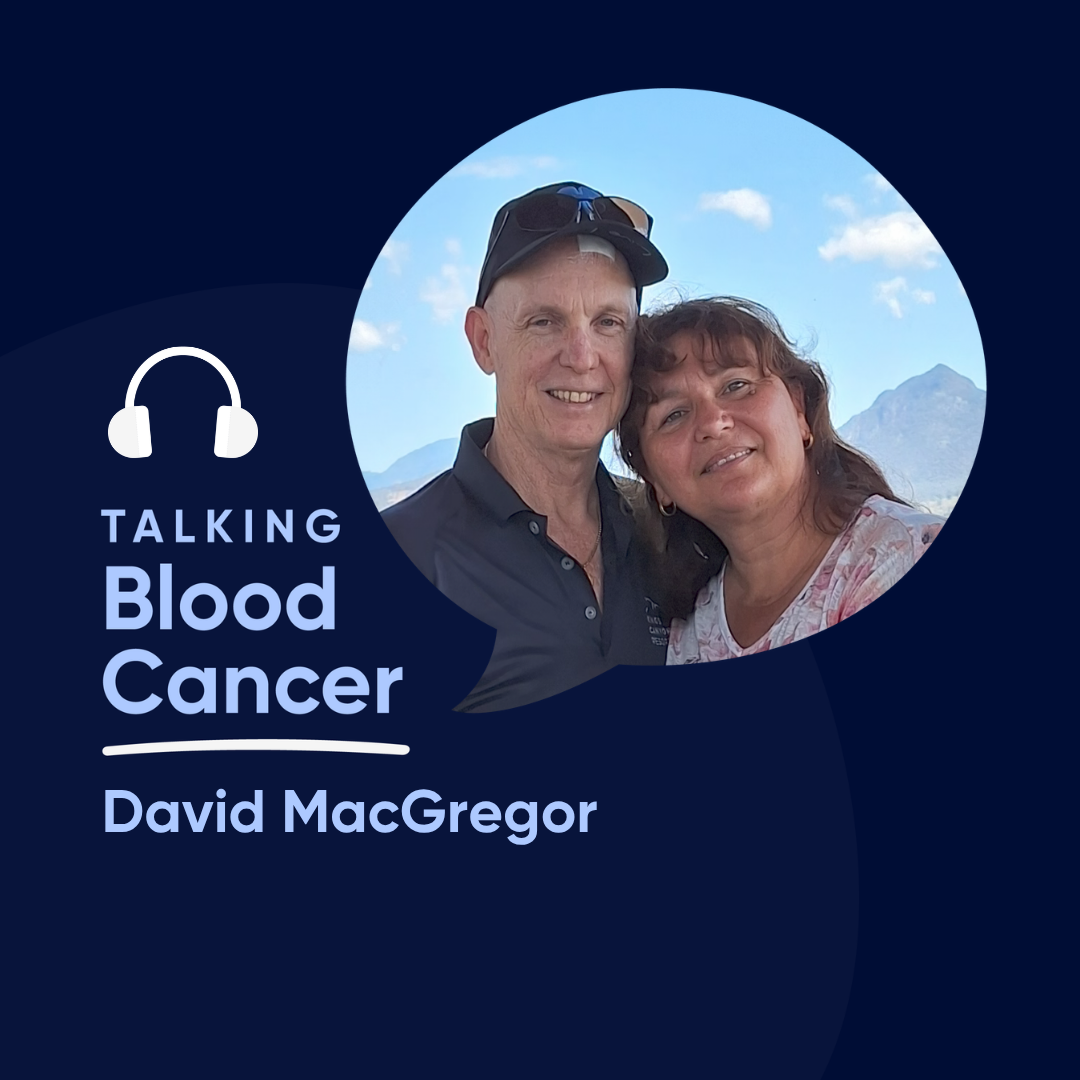
In this episode of the Talking Blood Cancer podcast, host Maryanne Skarparis sits down with David MacGregor to explore his personal journey following an unexpected diagnosis of acute myeloid leukaemia. David MacGregor shares how his busy lifestyle led him to delay routine medical checks, which ultimately resulted in a shocking diagnosis after a routine blood test.
David MacGregor discusses the days following his diagnosis, including the immediate need to travel for treatment, the impact on his family, and adapting to the uncertainty of what lay ahead. He explains how his background in NLP (neurolinguistic programming), hypnosis, and life coaching provided him with tools to manage the emotional challenges of diagnosis and treatment. Delving into the mindset strategies he used to reframe difficult experiences, the support he received from loved ones and health professionals, and the practical challenges encountered during hospital stays and treatment.
They talked about his treatment path, including intensive chemotherapy, the support received from the Leukaemia Foundation, and the experience of a stem cell transplant with his brother as donor. David MacGregor reflects on the unexpected hurdles during his recovery and how a focus on family, community support, and daily health routines helped him cope. He offers insights for others undergoing a similar journey and finding moments of gratitude even during difficult times.
[00:00:00] Intro
[00:02:36] Maryanne: Hello, my name is Maryanne Skarparis. Welcome to Talking Blood Cancer. Today in the studio with me, I have Dave MacGregor. Hi David, thank you for joining us.
[00:02:47] David: Good morning. I’m looking forward to a great conversation with you today.
[00:02:52] Maryanne: Good. Now, what we usually do is, because I think the listeners need to hear a little bit about you. Like who you are, where you live in Australia because we’re a national organisation, and a little bit about when you were diagnosed, what was happening with you that led you to the doctor in the first place, ‘cause I think that helps shape the whole story of why we’re here.
[00:03:15] David: Yeah, it certainly does. And it brings out a very important point that we’ll talk about. I was living a fairly busy life, working a normal job, 60 or 70 hours a week at the local power station in Central Queensland where I live, and doing some coaching, doing some property development stuff, and I kept pushing off my medical for my work, and weeks went by. Yep, still busy. I, I took the opportunity, it was Saturday morning, I wasn’t working. I went and had a blood test for my annual medical…,
[00:03:50] Maryanne: Mm-hmm.
[00:03:50] David: …, and the next day, I got a phone call from a doctor that worked for my doctor, said, “You need to go and get another blood test.” I went, “Oh, okay. This is strange. It’s lunchtime Sunday, and okay, Monday’s a public holiday here, I’ll do it on Tuesday, alright.” It didn’t say it was really urgent…,
[00:04:09] Maryanne: Mm-hmm.
[00:04:09] David: …, just something wasn’t quite right. And about 10 o’clock the next morning, I got a phone call from him again saying, “You need to report to the local emergency department at the hospital. You’ve got leukaemia.”
[00:04:22] Maryanne: Oh my goodness. What was your reaction to that?
[00:04:27] David: I was a bit numb.
[00:04:28] Maryanne: Yes. No…, no night sweats? No exhaustion? No…?
[00:04:34] David: I get asked about the feeling tired…,
[00:04:37] Maryanne: Mm-hmm.
[00:04:37] David: But if you’re doing the things that I just described before, you are tired.
[00:04:41] Maryanne: Yeah, that’s right.
[00:04:42] David: And that had become a normal part of my life. The only thing that I did notice coming up to…, and I knew I had to get my medical done. I had a few bruises. That was it.
[00:04:52] Maryanne: Yep. That was it. That news, you have leukaemia would have absolutely shocked you, I’m sure.
[00:05:00] David: Yeah. Very much so.
[00:05:01] Maryanne: Were you with someone at the time you were told, or were you on your own?
[00:05:05] David: I was on my own. About three weeks after we were told, we were due to go to Canada for a holiday.
[00:05:11] Maryanne: Oh.
[00:05:12] David: And my wife had gone to Rockhampton to grab some things for our holiday. So I immediately phoned her, and said, “I think you need to get back here. This is what’s happening, and I’ll meet you at the hospital.”
[00:05:25] Maryanne: Wow. I’m sure that would’ve been a surreal drive for her from wherever she was back to be beside you.
[00:05:31] David: Yeah.
[00:05:32] Maryanne: So next steps from there, David. What did that look like?
[00:05:35] David: Went to the hospital. They did more blood tests again…,
[00:05:38] Maryanne: Mm-hmm.
[00:05:39] David: …, to confirm the stuff that the doctor wanted to do, and there was lots of discussions around that I probably wasn’t well, and I didn’t really know. And they were fussing, monitoring me, trying to organise for me to fly to Brisbane…,
[00:05:58] Maryanne: Mm-hmm.
[00:05:59] David: …, to the Royal Brisbane to get there as soon as I could. And unfortunately, the helicopter wasn’t flying at that time because it was just too windy.
[00:06:07] Maryanne: Right.
[00:06:08] David: And my wife Rosemary, she was there. And I’ll book a flight for the next morning ’cause that’s the next time that I can get on. And by the time we left the hospital at about eight o’clock at night, I found out I was booked on the same flight the next morning.
[00:06:23] Maryanne: Oh, wow. Okay.
[00:06:25] David: From there, we went to, called an Uber on the way to the hospital, and the hospital’s ringing me, “Are you on your way? Are you okay? Everything going all right?” “Yeah, yeah.” They’re really concerned about what’s going on for me.
[00:06:39] Maryanne: Wow, what a surreal time, an absolutely surreal time. What did you lean in on? What did you draw strength from? ‘Cause that would’ve been quite numbing. Having to think of the practical things of organising a suitcase, organising your things. I’m sure you weren’t told how long you would be in Brisbane.
[00:06:58] David: We were told we’d be 3 or 4 days by the local hospital. We just grabbed a few things…,
[00:07:04] Maryanne: Mm-hmm.
[00:07:04] David: …, and packed for a week and, yeah, flew down. A lot of it was just numbness and not knowing what was happening, what was going to happen. Like we turned up at the hospital and one of the things that I’m very grateful for the Leukaemia Foundation, that one of the social worker that was there said, to Rosemary and myself, “So have you got somewhere to stay?” “Oh, we were only told we’re gonna be here for a few days.”
[00:07:30] Maryanne: Mm.
[00:07:31] David: “You’ll be here for a bit longer than that.” An unknown time as we all are, for this journey.
[00:07:36] Maryanne: Mm-hmm.
[00:07:37] David: And we were told that the Herston Road one was full.
[00:07:42] Maryanne: Mm.
[00:07:42] David: “Okay. Alright.” But they did more blood tests for me, and gave me a, a platelet infusion because, if they didn’t, I was gonna bleed out because…, for fear of not clotting. And while all this is going on, I get my bone marrow tested, and we come back, and sort of, “There’s a spot for you there now.” “Thank you very, very much.” And we’re being looked after in many ways.
[00:08:08] Maryanne: Yes. Absolutely. So that was quite a shocking time for you. Do you and Rosemary have children?
[00:08:14] David: Yes, we’ve got three adult children, and two of them live locally around us…, one in Brisbane.
[00:08:22] Maryanne: So how’s the news for them when you told them?
[00:08:25] David: I’m sure it was a bit of a shock, and I can’t remember ’cause there’s so much went on at that time that I think Rosemary told them. But the response that I remember from conversations afterwards was, “Okay, he’s already done all this work…” because prior to that I’ve done NLP (neuro‑linguistic programming), right up to Prac…, master Prac training. I’ve done hypnosis, I’ve done life coaching, all these sort of things, and all those tools came into place, into that need for me right then.
[00:09:00] Maryanne: Okay. Can we talk, deep dive a little bit into that, David? ‘Cause I just want for the listeners, some people don’t know what NLP is. And certainly, let’s look at spending some time talking through where you drew your strength from. Because when you do have a diagnosis of something that’s life-threatening and you are transferred to this reality that seems a little bit surreal, a little bit unreal. We all have to lean in on something, and I would love to…, if you’re happy to, spend time on just breaking down those three things that you mentioned that you were able to…, you called it your toolbox. You were able to just reach into that toolbox, and it helped you. Can we just look at them one at a time just to explain?
[00:09:51] David: Yeah, just to throw an overall picture on that as well, if we can…, is because of all those, and I’ll step back on what they are.
[00:09:59] Maryanne: Mm-hmm.
[00:10:00] David: My mindset was probably not the same as most people going into these sort of things. I saw it there and then that all this was happening for a reason for me, and to be able to take this forward, and those lessons that I learned, and the things that I saw going on for myself, and everybody else going around there, I could use that going forward for many things to help many other people.
[00:10:27] Maryanne: Oh, good for you. Good for you. We’d love to hear a little bit more about those things because it’s never too late, is it, David?
[00:10:36] David: No.
[00:10:36] Maryanne: It’s never too late to embrace something new. It’s never too late to learn something new. So we’d love to hear a little bit more about your mindset, and what led you to coping the way you did.
[00:10:47] David: Yeah, I look back in those first couple of days, and I had a look at some text messages that I’d sent to a friend that I was working with in the property development space where I said to him that, “I’m going to come through this. On the ‘other side’”, I call it…,
[00:11:05] Maryanne: Mm-hmm.
[00:11:05] David: …, as a much stronger, better person that…, as I was talking about before, I’m here to help other people going forward on their journey and that the NLP is neuro-linguistic programming, and basically it is how we learn our information. What part of it we store in there, what it means to us, and then what we do with that learned information and how it pitches how we view life.
[00:11:35] Maryanne: Okay. Are you able to give like a bit of a…, an example of how that would work?
[00:11:42] David: We’re having a conversation here right now, and I hear your words for us, for the moment, I can see your face and all those different aspects that are going on. Whether it’s the physical, whether it’s the verbal, whether the words and the sounds that you make and how you’re speaking the speech, how strong it is or how quick you’re talking, all those sort of things mean different things to different people at different times, if that makes sense. Our verbal part of our conversation is only about 7% of what we take in. By the time we take those in, as we’re having this conversation, I take a meaning out of it. But on the other side of that, they always say that when you’re talking to somebody, the meaning that they get is their interpretation, and it’s what it actually means, so that you need to communicate things in a way that people understand your message. And deep down, that’s what that’s about.
[00:12:43] Maryanne: Okay. Was that then in your interactions with the medical team? Was it with your family?
[00:12:49] David: Yeah, that goes into everything that went on where I was because of those sort of things and different tools that I used along the way.
[00:12:59] Maryanne: Mmm.
[00:12:59] David: I used things like Solfeggio Frequencies, where we were just talking about those sounds that are taking in for your body and calming your body. Crowding those atmospheres in the hospital room, and it became a place of calmness for the nurses, and even the doctors when they come through. The other patients that were in the room when I wasn’t by myself. It just changed the environment that you’re actually healing in.
[00:13:27] Maryanne: So was that music…?
[00:13:29] David: Yes.
[00:13:29] Maryanne: … did you use?
[00:13:30] David: Yeah.
[00:13:31] Maryanne: Yeah. And what did you call it again?
[00:13:32] David: Solfeggio frequencies, and there’s different ones. One I used was 528 hertz, and it…, one particularly targeted about DNA repair. So there’s four different things you wanna do, whether there’s stuff for abundance, stuff for blocks that you’ve got going on, things that you can’t move forward from. There’s all sorts of things there if people wanna look that up.
[00:13:56] Maryanne: Oh, so how do you spell that? Because sometimes, people will be rewinding. What is it?
[00:14:02] David: Yeah. No. Fair enough. S-O-L-F-E- double G-I-O.
[00:14:09] Maryanne: Lovely. Okay. So you know, that’s because…, always, people are open-minded. From my experience, walking alongside people who are faced with trauma, faced with change, faced with things that they haven’t chosen for themselves in life, they’re more open to looking at exploring what’s around that can give me calm, that can bring some clarity or help me when I’m feeling emotionally overloaded.
[00:14:37] David: Yeah. In that moment of chaos, yeah, there was thinking about for me, what I was taking in every day.
[00:14:45] Maryanne: Mm-hmm.
[00:14:45] David: Whether those conversations that I talk about with the hospital staff, the nurses, the warders, the doctors, even the lady or the gentleman coming, delivering your food. Listening to what they’re saying and taking the good part of it from those conversations, and to the point where the doctors were calling the chemo…, from my last chemo that took me a long time…. They called it poison, but I chose to see that as something that was going into me, healing me. And I chose that for everything. Whether it was a blood, whether it was a platelet, whether it was the medicines that they were giving me in the morning, whether it was something that I was looking at…, maybe an inspiring movie, or I was listening to stuff I followed a lot of Dr Joe Dispenza’s work as well, doing meditations, sitting there at sunrise, just taking that time to be calm, relax, and let the body heal.
[00:15:46] Maryanne: Yeah. You know, it’s that surrender, isn’t it?
[00:15:49] David: Yes, very much so.
[00:15:51] Maryanne: Yeah, it’s that moment of surrender. And a couple of other people have shared with me as well, that connection to Mother Earth where you draw that energy…,
[00:16:01] David: Yeah.
[00:16:01] Maryanne: …, in for healing and it’s letting go of things that are distressing, things that overwhelm, that sort of thing. So what were the other two things that you chose during that time of adaptation, really, to your new life?
[00:16:17] David: One that comes to mind straight away with what you’re talking about…,
[00:16:21] Maryanne: Mm-hmm.
[00:16:21] David: …, is that surrender.
[00:16:23] Maryanne: Mm-hmm.
[00:16:23] David: It’s that belief that it’s all happening for a reason, and it’s gonna be okay. The belief and surrendering that what I’m doing here now is gonna be for a higher purpose. And the reason I go back to that again is for myself particularly, I saw that as a…, dare I say it, a carrot, something leading me through this journey that…, not to let go, not to let it be too overwhelmed, not to let it just totally get you down. And I won’t say that I didn’t have any of those times emotionally because I am human.
[00:17:00] Maryanne: Mm, yeah.
[00:17:00] David: That overall thing that, “Yep, we’re gonna come through this, and it’s gonna be great at the other end, despite the pain, the infections, all those other things, the thousand needles that you get put into you.” Yeah.
[00:17:15] Maryanne: Can we just retrace, David, because what we know in this conversation is your initial diagnosis, and you were diagnosed with acute myeloid leukaemia. So your treatment pathway, what did it require? ‘Cause we haven’t touched on what you needed.
[00:17:32] David: No. And I didn’t know to start with because they took that…, the bone marrow aspiration or sample, however you wanna put it. And I had to wait a week in hospital going, “What’s going on here?” But there’s other things I could talk about there, but that gave me the first lot of chemo, and I’m not good with the chemo names, but basically I was on chemo 24 hours a day, for eight days with a bag attached to me. And just went around doing what you needed to do. And I’ll say that I got through there relatively unscathed. Yes, it’s chemo, all those things are going on, viewing it from that mindset. But within a few hours, I ended up with a lower intestine infection with that. But with some good pain medication, intravenous antibiotics, all these things that you have on these journeys. But at the end of that, I started to see some things again that I could control how my mind was working, and what I could see for where my journey was going.
[00:18:39] Maryanne: Okay. Can you talk a little bit more about that?
[00:18:42] David: Yeah. For me, I stopped that pain medication and people have said, “Yep, various people get different reactions,” those sort of things. But I actually saw…, I’ll say an entity, and it wasn’t when I was asleep, it was just when I closed my eyes and it wasn’t something I like and I really didn’t want to close my eyes, and I was so tired, and this was the early hours of the morning getting through. But within 12 hours, I changed this into…, instead of my unconscious mind trying to protect me, to getting it to help me on my journey there, and I could see myself as a blood cell running around in my body, repairing it.
[00:19:29] Maryanne: Oh.
[00:19:29] David: And that was within 12 hours, going from scared as anything to, “Yes, I’m in control,” and I will say that I had a lot of assistance. I look at all sorts of things that help guide me. Whether it’s God, whether it’s spirit…, the universe, all those sort of things, helping me change that moment into things have gone from chaotic to…, we have some, dare I say, normality and control. And this journey really is gonna be good along the way.
[00:20:00] Maryanne: So at that point when you were really fearful, and there would’ve been a choice point, there would’ve been a fork in the road where you could have maintained that element of fear, but you chose in yourself into a blood cell that was a…, that was working to help get you better. Do you think anything contributed to you embracing that second pathway?
[00:20:26] David: Yeah, there’s a whole lot of things. One of the things that I remember, and it was another phone calls that I had from people who were looking out for me along the way with their work colleagues, with their friends, all those sort of things. I said to them when they ask, “How are you going?” I said, “No, I’m going pretty good. Yep…, for the journey, but I’m not going anywhere.” And there’s moments that…, that lead up to that…,
[00:20:54] Maryanne: Mm.
[00:20:54] David: …, to say, “Look, I really am not going anywhere.” And back to the point that I said before, I’m going to come through this, the other side better, stronger, and be able to help other people on their journey as well.
[00:21:09] Maryanne: So you made a cognitive decision to always reframe whatever negative thought that you may have had into one that confirm…, which that…, yes, you’re gonna stay here, and you have an idea of where you wanna place your energy in the future, and you made that your overriding belief system.
[00:21:31] David: Yeah, and it’s about having that to the point where it becomes functioning as part of your unconscious mind by repeating those sort of things to yourself again and again until you feel it and believe it.
[00:21:44] Maryanne: Okay.
[00:21:44] David: And that’s…, you’re talking about the reframe, that’s one of the NLP processes. If you dig deeper in…, of reframing things to make it that deep and to make it part of your identity,
[00:21:55] Maryanne: Yeah. Very good. So with your treatment, going back to your treatment regime, did you have any moments of, like you had your chemotherapy treatment, what was next for you? What was in plan for you?
[00:22:08] David: There’s some really good moments that come up along the way.
[00:22:10] Maryanne: Mmm.
[00:22:10] David: And it’s about those things came, I believe, because of the surrendering and having the faith in what’s going on for me, where I went into remission. And that…, and I can’t remember the exact timeline. It was about seven or 10 days, and they had done another blood test, and the cells had started to accumulate again, the blasts. So they went, “Oh, so you are not going back into another lot of chemo to maintain you, to get you along to your bone marrow transplant. We need to actually whack this thing harder.” So instead of having two lots of chemo, I had four lots of chemo and the original chemo that I had over eight days, I had over five days.
[00:22:53] Maryanne: And did you manage that physically okay?
[00:22:56] David: Yeah. Yeah. That’s a whole ‘nother thing that I spent a lot of time. Whether it was when my immune system allowed me, I’d walk outside, but when I wasn’t able to, I’d be doing lap after lap of the ward in the hospital. And whether that was after they took my blood at 4:00 AM or whenever it was that I felt physically and mentally capable of it, but I had a goal of doing 10,000 steps a day.
[00:22:24] Maryanne: Okay, good for you.
[00:23:25] David: And having that physical movement is part of that healing process as well.
[00:23:30] Maryanne: It’s a commitment too, a commitment to self, isn’t it?
[00:23:34] David: Yes.
[00:23:34] Maryanne: So you mentioned you had a transplant, is that correct?
[00:23:38] David: Yeah.
[00:23:38] Maryanne: Who was your donor? And how was that experience for you?
[00:23:42] David: Yeah. And that was a really nice surprise, a real gift. After that lot of chemo, I went into remission, and that was great. And we’d been having conversations with the transplant team, and they’d done blood tests, and both of my brothers were a hundred percent match.
[00:24:00] Maryanne: Oh. That would have been real comfort for you.
[00:24:03] David: Oh, that’s a gift. And I got a phone call, and they talked about, “Who are you gonna choose?” And yada, yada. yada. You don’t wanna choose one of your brothers or not.
[00:24:12] Maryanne: No.
[00:24:12] David: But I got a phone call from my eldest brother, and he’d been told that, yep, he’s the donor.
[00:24:18] Maryanne: Okay. Right.
[00:24:19] David: And that was a very teary moment.
[00:24:21] Maryanne: Yeah, it would’ve been a very teary moment because it’s, you know, some siblings, they don’t feel comfortable about being that person. So it’s a…, again, a gift. You use the word ‘gift’. I love that word.
[00:24:34] David: Oh, yeah.
[00:24:35] Maryanne: Yeah. And are you close?
[00:24:36] David: Reasonably, yes.
[00:24:38] Maryanne: Yeah.
[00:24:38] David: So we talk on and off, and different things going on in our lives. Yeah.
[00:24:42] Maryanne: So you’ve had your transplant. What was recovery like for you, David?
[00:24:46] David: Well, that was another interesting story too. So the transplant itself was…, I’ll say that there’s nothing that sort of jumps outta that I’m very grateful of just like a blood transfusion with the stem cells. And I stayed in hospital for about 18 days from there, and everything went along fairly well. I will say from a week before my transplant and the chemo leading up to that, I became quite fatigued.
[00:25:17] Maryanne: Right.
[00:25:18] David: But going from, yeah, outta hospital, then to the Leukaemia Foundation accommodation to take me up to the day 100. And doing the exercises, spending time in the local park, walking, all these sort of things. Getting the rest, having twice-weekly visits to the hospital. Those blood tests, just keeping an eye on things going on. Everything was relatively good until I got to day 99. Where I, uh, didn’t feel well and this horrible pain, and “No, I need to go to the toilet. Okay. Yep. Alright.” But no I, I ended up vomiting and the pain was so strong went up to the emergency department, and within two hours they were so great. They’d done more blood tests, they’d done scans, they sorted out, knew exactly what was going on, and I had two kidney stones that they needed to sort out, and they were organising surgery for me to have a stent put in so that…, because if that didn’t happen, my kidney wasn’t draining and I couldn’t take my medications for my anti-rejection medications, for cyclosporine, all those things. So it was urgent.
[00:26:29] Maryanne: Yeah. Did it cross your mind at that time, with that extreme pain, that fear of cancer recurrence, when you didn’t know it was kidney stones?
[00:26:38] David: Yes.
[00:26:38] Maryanne: Because that’s a real fear for people, isn’t it?
[00:26:41] David: Yeah.
[00:26:42] Maryanne: Yeah. Again, what did you lean in on to get you through that time? Or were you so consumed with pain?
[00:26:47] David: Oh, it…, there was only the couple of really bad bouts of pain. One back at the unit and one in the hospital. But from that, it was more about focusing on getting better. And getting that rest, moving when I could. All those sort of things to keep my body as well as I could with what was going on.
[00:27:10] Maryanne: Yeah. So that process of operation and putting the stent in so that your kidneys could pass the fluid, did that go well or were there complications?
[00:27:19] David: Yeah. No, that was all good. But there were other hiccups leading to the next surgery because it’s no longer classed as urgent because things are not shutting down, I’ll say, at that time. And we waited for a few weeks. Yep. Organised the surgery and you get to the day, “Oh, the machine’s broken down.” “Okay. Alright. We’ll try again tomorrow”. And get dressed, and you go, and you’re fasted, and you’re sitting there waiting, and the doctor comes up to you and says “It’s broken again, we got halfway through the last surgery.” My thoughts then was…, I don’t want to downplay what was going on for the other patient that was having the surgery, but I thought, “Oh, I’ve been looked after. I’m not in the middle of this surgery, and things just didn’t go well.” And went home back to the Leukaemia Foundation and accommodation and it gave me an opportunity to ask for help and to surrender again there, believing that everything was gonna be okay and it’ll turn out for the better. So within two hours I got a phone call from the hospital. The surgery was back on, but not only…, it wasn’t with that machine, it was with the sister hospital beside it. It starts with a new…, I’ll say much more powerful laser to do the surgery on it.
[00:28:38] Maryanne: Perfect.
[00:28:39] David: “Wow. Okay. I’m being looked after again”. And just things went on from there.
[00:28:44] Maryanne: Oh, that overwhelming comfort of knowing that you, you know, you’ve placed your trust, and there it is. It’s delivered. So now you are post-transplant, and you are back into immersing yourselves in things that you enjoy. What…, do you have any complications post-transplant? How do you choose to spend time? What would you say to, you know, as golden nuggets, what would you say to those who are starting out on this journey?
[00:29:12] David: For me, I’ve spent a lot of time focusing on my own health and wellness and my mental health, talking to people when I need to, asking for advice. I’ve joined other coaching and speaking communities, that’s my choice, where I saw this as that opportunity to carry that message forward to help others along the way. That’s helped me so much. Last weekend, I did a book-writing challenge with one of the speaking groups, so I’m writing a book to help people on this journey as well.
[00:29:53] Maryanne: Oh, fantastic, David. So if you had…, some people may choose a quote or a song or words or what have you, that can plant the seed that then just anchors them into a place of comfort, a place of trust. Are you able to share anything that you’ve taken on or that you say that is that stepping stone towards your attribution of being able to accept and be still in the moment?
[00:30:23] David: There’s a song called Rise Up by Andra Day…,
[00:30:28] Maryanne: Mm-hmm.
[00:30:29] David: …., that I’ve played many times.
[00:30:31] Maryanne: Yep.
[00:30:32] David: And one that I used on my journey itself was a song called Amen by King and Country, and they’re about that faith that I talked about and believing that things are gonna be okay, and we’ll get through this very well, not just get through this.
[00:30:54] Maryanne: I love that. And I think we all choose what speaks to us, what we draw strength on, but I love that suggestion and contribution just for those that might be a little bit lost. Even…, they might have the opportunity to have a listen to both of those, and they might take that on board themselves. But what you’ve planted is a seed to anchor yourself into something that can give you that inner strength that can…,
[00:31:20] David: Yeah,
[00:31:21] Maryanne: …, help you face each day moving forward.
[00:31:23] David: And that’s really important.
[00:31:25] Maryanne: Yeah. Are there any other aspects of your journey, David, that you think you’d like to say to people or share your…, you and Rosemary, had the privilege of knowing the two of you on that, on your time during transplant. And relationships are something that I think are a strength.
[00:31:43] David: They are, and one of the first things when we first got to the hospital. It was a question that kept going through my mind…,
[00:31:51] Maryanne: Mmm.
[00:31:51] David: …, was, “What’s important now?” And the first thing that came up, yes, it was family and yep, firstly my wife and then our three children. And about just making sure that you spend time with them, making sure that they were focusing on me, but that I also gave them some help that they needed as well. Just being there and present as much as you can despite everything else that’s going on for you.
[00:32:23] Maryanne: Yeah.
[00:32:23] David: It was an opportunity, particularly for our child that was in Brisbane to build a much closer relationship with everything that was going on and renewing it because they’d been away from home for quite a few years.
[00:32:38] Maryanne: Mmm.
[00:32:38] David: And we don’t get to spend as much time, and those sort of things. That was a great opportunity for us as a family to spend time together that really mattered. And yes, I had the thoughts at times. Spend it now, I may not be here later, but…
[00:32:54] Maryanne: Yeah. You know, with those what-ifs…, ’cause I do think that you’re right, they are little…, those floating thoughts that pass through everybody’s mind when they’re faced with a cancer of any sort, really. Those what-ifs. Do you feel that it’s a strength to talk about those what-ifs out loud? Or how do you manage those moments where you had that all-consuming fear of ‘what if’?
[00:33:17] David: It depends on the sort of person that you’re talking about. For me, yes, definitely about talking is just talking with somebody, but it’s not about getting all upset about it and making it the most dramatic moment for what’s going on. It’s just letting those moments flow, letting those thoughts happen, acknowledging them, “Yep, they’re real, but that doesn’t have to be my reality.”
[00:33:43] Maryanne: Mm-hmm.
[00:33:44] David: So just spend a little bit of time there, and it allows your mind to process those.
[00:33:51] Maryanne: Mmm.
[00:33:51] David: Rather than pushing down, otherwise, I was filled with…, and this is what I believe led to me to…, going through this journey, not dealing with things emotionally by pushing them under the carpet. Eventually, that becomes a big lump that you can’t not fall over. But allowing those to talk to people about it, even if you’re just talking out loud.
[00:34:13] Maryanne: Mm-hmm.
[00:34:13] David: For some, it might be just talking to God. It could be anything there that helps you on that journey.
[00:34:21] Maryanne: Yeah. Yeah, they’re all wonderful suggestions, David. ‘Cause each of our…, you know, we’re all individuals.
[00:34:28] David: Yeah.
[00:34:28] Maryanne: We choose what pathways will work for us as individuals. But it…, I do think it’s powerful to listen to how other people, what choices they made because they might be prompts or seeds that can lead people if they’re feeling a little bit lost.
[00:34:42] David: Yeah, very much. And to me, that’s an important time for you to acknowledge that, embrace it, and get the help that you need.
[00:34:51] Maryanne: Yeah. So we thank you for sharing all of the wonderful things that you’ve chosen for yourself, David. Just to summarise, would you like to give just a summary of the key things that you feel have been the strongest, things that have attributed to where you’re at today and what drives you into what you’re immersing yourself in today as well?
[00:35:15] David: For me, it’s really is about that trust that everything’s happening for a higher purpose. It’s about acknowledging what’s going on for you in those different parts of the journey, whether it’s when you’re having the chemo, whether it’s waiting for the blood results so that, “I can have a break outta hospital after I’ve been there for 30 days,” or just making that calm space so that be there for yourself so that you can heal. I find they’re very important things to help carry me. And I see that for other people through their journey so that they fare very well. Making sure that you get that exercise that I talked about. Making sure that, for me, again, about that grounding that you spoke about, acknowledging that there is better times coming. There is better things happening for you. It may not be in this very instant, but there’s always joys outta that journey and gifts and wins. Even if they are…, my blood results changed one point today or that my cannula flowed well today.
[00:36:25] Maryanne: Yeah…,
[00:36:26] David: Or whatever’s going on for you.
[00:36:28] Maryanne: Mm. See it as a win.
[00:36:29] David: Yeah.
[00:36:30] Maryanne: Yeah. It’s that you’ve got behind you the mindset reset, and it is, it’s making a commitment to your mindset. Yes, some days may present a negative, but what is it…, what’s the silver lining in today? And trying to search for that.
[00:36:45] David: Exactly.
[00:36:46] Maryanne: And you embraced that.
[00:36:47] David: Yeah, there was…, before I answer the second part of that question, there was something there, another book that a friend gave me while I was waiting for that first week in the hospital, was The Resilience Project, and that changed my look to a look of gratitude for what we have going on, for what the people were doing all around me, and carried that forward. And I’ll say that connects very well. And you said about, “Where am I going today?” And these sort of things. I still see life in that light, and I know I’ve mentioned this many times along the way…,
[00:37:24] Maryanne: Mmm.
[00:37:24] David: …, but I’m coaching people with cancer, enable them to do that mindset reset that you spoke about…,
[00:37:32] Maryanne: Yep.
[00:37:32] David …, enable them to reframe.
[00:37:34] Maryanne: Yes.
[00:37:35] David: And that for me, is also healing me as well.
[00:37:38] Maryanne: Well, it’s reinforcing your beliefs and your values, isn’t it?
[00:37:43] David: Yes.
[00:37:43] Maryanne: It’s by sharing with someone else, you are reinforcing for yourself in that teachings what you wanna believe and embrace yourself.
[00:37:52] David: Yeah.
[00:37:53] Maryanne: Well, I love that. I love that. Hmm.
[00:37:54] David: Over the last…, since I left Brisbane in March last year, whether it’s virtually or on stage, I’ve spoken to over a thousand people already. And spreading that message of what we’ve talked about here today saves lives.
[00:38:12] Maryanne: Yeah, it does. And it enriches lives, doesn’t it, David?
[00:38:16] David: Yeah, yeah.
[00:38:17] Maryanne: Yeah. Thank you. I’ve really loved our conversation. Thank you for joining us for talking Blood Cancer. I know that it’s a…, it’s an opportunity to connect with many people, so thank you, David.
[00:38:27] David: No, thank you very much for having me on. Thank you. Really appreciate it.
[00:38:27] Outro.