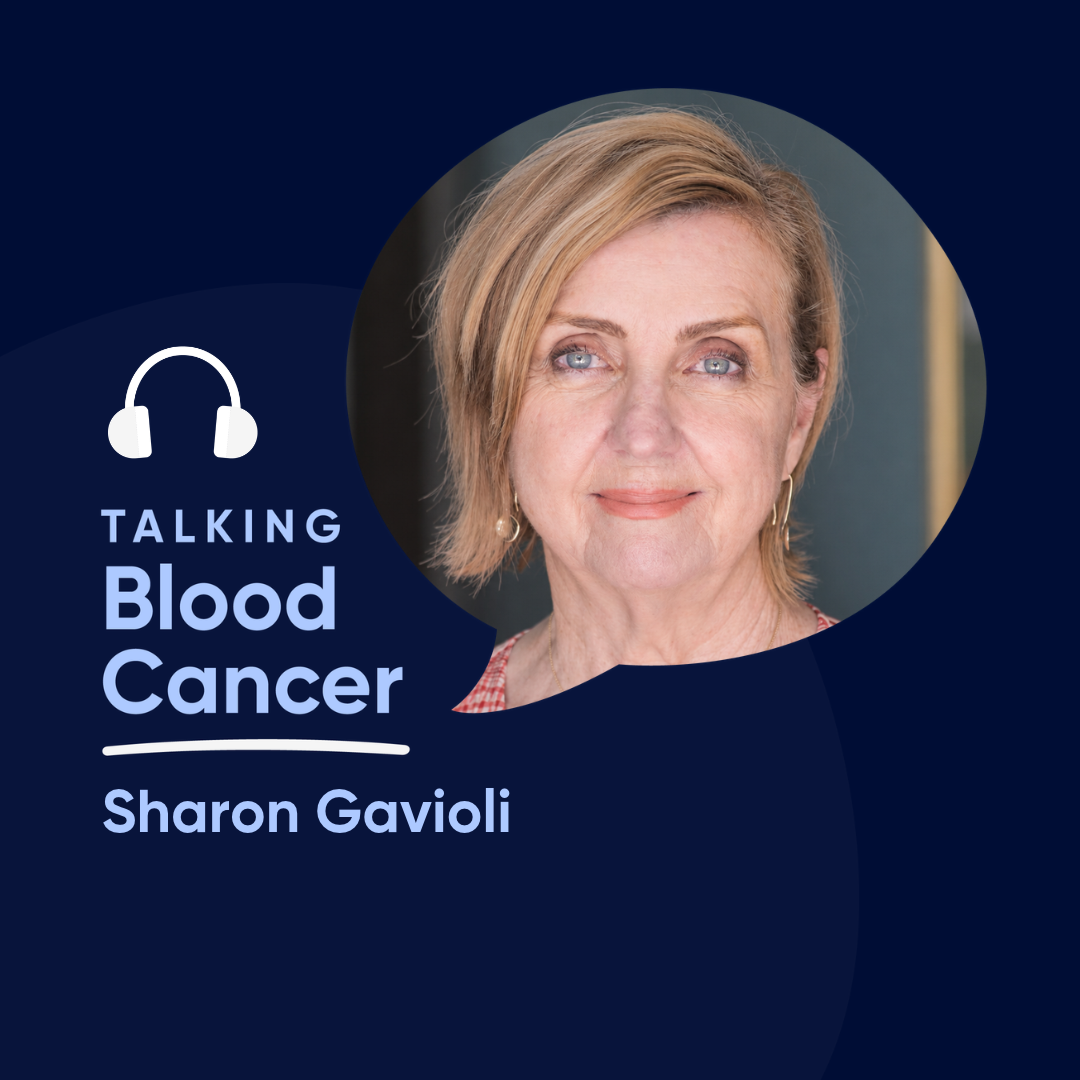
In this episode of the Talking Blood Cancer podcast, host Kate Arkadieff hears from Sharon Gavioli, who shares her experience as both a carer for her family members and as a stem cell donor. Sharon’s story highlights the profound impact that a blood cancer diagnosis can have not just on the patient, but also on their loved ones and support networks.
Sharon’s family encountered blood cancer in a deeply personal way when both her younger sister and her mother were diagnosed with different forms of leukaemia within months of each other. As someone with a nursing background, Sharon played a significant role in supporting her family, and later becoming the only suitable stem cell donor for her sister. She reflects on the complexities of being both a healthcare professional and a family member, sharing what she learned about honouring each person’s individual way of coping with illness.
Exploring the emotional journey of caring for someone through intensive treatment, as Sharon’s sister underwent a stem cell transplant while her mother, after considering her options, chose palliative care. Sharon discusses the need to balance her own feelings with the needs of those she cared for and offers insight into the long-term effects that such experiences have had on her personally and professionally.
Listeners will hear about the importance of psychosocial support, the emotional impact of being a stem cell donor, and the value of honest communication with medical teams. Sharon’s story provides practical insights for other carers, patients, and donors facing similar challenges, and underlines the importance of compassionate, individualised care.
[00:00:00] Intro
[00:02:37] Kate: Hi there, and welcome to Talking Blood Cancer. I am your host, Kate Arkadieff, and today we have a really special episode that I’m excited to share with you all. It is a little different to the ones that we usually host. Today we have a carer and a sister on as well. So what I will do, as we always do, is ask the guest to introduce themselves, let us listeners know who we are speaking with, what was happening around the time of diagnosis, who they were caring for, and where they’re living in Australia. So I will hand over to you.
[00:03:09] Sharon: Thanks Kate, and thank you so much for the opportunity to share as well.
[00:03:14] Kate: No, my pleasure.
[00:03:15] Sharon: So in 2013, so quite a while ago now, my much younger sister, she was 10 years younger than me, was diagnosed with AML, acute myeloid leukaemia, at 43. And obviously it was quite a shock because she was quite a robust… She was the head of a union, and she was a very robust, healthy sort of woman. So it was quite a shock to, obviously, to her, and to the family. And then subsequently, my mother actually got diagnosed with leukaemia a couple of months later. She had been unwell for a little while, and no one knew exactly what was going on for her. It was a very rare leukaemia, and I can’t even tell you the name of it…, it was so long. But I looked it up at the time, and one in five people actually had that leukaemia. So we had two people with leukaemia at the same time with quite different trajectories, which I’ll share. And I currently live in Brisbane, in Queensland.
[00:04:15] Kate: Yeah, and were your sister and mother in Brisbane at the same time?
[00:04:20] Sharon: Exactly, Kate. Yes.
[00:04:22] Kate: Yeah, so they’re both living in Brisbane.
[00:04:24] Sharon: Yes.
[00:04:25] Kate: Yeah. But also the wonderful, and really, kind of full circle moment, which we might get to a bit at the end, is that you actually now work at the Leukaemia Foundation.
[00:04:33] Sharon: I do, I’ve worked here for 18 months now, and it was always on my horizon. Potentially one day… I worked in a lot of cancer care at different organisations, but it was always something in me to come back and potentially be part of serving people with blood cancer. Actually, my son-in-law also has leukaemia. He has chronic myeloid leukaemia, and he got diagnosed when he’s 17, and he’s now 34. Very well, he’s on a targeted therapy, so he’s doing really, really well. So, lots of leukaemia experiences in our family.
[00:05:16] Kate: Yeah, and I imagine, though, hearing the news though of your sister being diagnosed, was she your younger or older sister?
[00:05:24] Sharon: She’s 10 years younger than me. So yes, I come from a really big family. She was the second youngest, yes. So…, and in some ways, growing up…, was sort of a mother figure to her as well. She was a single mum for a long time, and her son basically was like part of our family. Yeah. Um, still even now as a grown man, he’s very close to a couple of my kids, and so there was quite a close connection in how our lives intertwined.
[00:05:56] Kate: And when she received that diagnosis, did that closeness continue? Were you involved in appointments, or did you help navigate her into the health system being of that nursing background?
[00:06:11] Sharon: Very, very involved, Kate. I was working at Cancer Council at the time, supporting people with their cancer diagnosis.
[00:06:19] Kate: Wow.
[00:06:19] Sharon: An interesting thing was, I thought I knew what she needed.
[00:06:23] Kate: Talk to me about that.
[00:06:25] Sharon: Yeah, it was very interesting. So, you know, I even came to talks at Leukaemia Foundation because I wanted to understand more about leukaemia. I understood to a level, but I wanted to understand more. I, uh, got all booklets. I got information about how to access the support services. But when I presented that all to her, she said, “No, I don’t need any of that, Sharon.” And she was a very…, like I said, she was the head of a union. She was really smart, clever lady. And she said to me, “I’ve got leukaemia, and I’ve got to have the treatment, and I don’t want to know anything more than that.” And she felt so supported by her family. So, one of the things we started, Kate, when she was first diagnosed, and as you know, leukaemia treatment is so intense. The induction therapy and…, it’s a very up-and-down journey.
[00:07:17] Kate: Instant too.
[00:07:19] Sharon: Oh, it’s extremely intense, and I remember her ringing me at work, Kate, and saying that, “There’s something wrong with my blood. They’re thinking I might have a blood cancer.” And she just couldn’t believe it. And she was in Melbourne at the time, so it was a bit tricky to try and get her home because they didn’t want her to travel alone. But in the end, I was going to go up to Melbourne to bring her back. But in the end, we got her home without doing that. And obviously, she had a bone marrow biopsy and was diagnosed really quickly. But one of the things the family put in place is cooking for her. So I did nearly all the cooking for her meals just to support her more nutritionally at the time, just to maximise that part.
[00:08:02] Kate: Yeah.
[00:08:03] Sharon: I also had a friend who did…, like massage and different therapies. And then we organised her to come up and support her as well. And yeah, we were there a lot. We felt like we lived up there, between going to work, of course. I did go to work part-time at the time.
[00:08:21] Kate: As you said, you thought you knew what she needed, you had all this information, you delivered it, and then being a sister or…, and a support person, to then hear them say back, “Oh no, I actually don’t need that” or, “I don’t want that.” How did you balance between finding what you wanted to give and offer versus what they wanted to receive?
[00:08:41] Sharon: Yeah, that wasn’t a problem for me at all. It was just a huge learning moment for me. It was like I learned that everyone’s different in what…, how they’re going to react and what they’ll need, and it just probably … I was always fairly client-centred in how I was with people, but when you come from a health professional background you sometimes do think you know better…,
[00:09:03] Kate: Yeah.
[00:09:04] Sharon: …, and it really humbled me. It made me realise, “No, I don’t know”, and we have to ask, and we have to check in. So I wasn’t offended. I wasn’t upset. It was more… She taught me something. Yeah. It was really lovely, actually. And I’ve taken that on since 2013 to now.
[00:09:22] Kate: Yeah. And then how was the experience for her being in hospital? As you said, you’ve…, being a nurse and being au fait with the medical system.
[00:09:31] Sharon: It was like she surrendered very much to what was needed, and she was a funny lady. And so she built some really great relationships with the staff. She loved the staff. She just was so grateful for everything they did. Because, you know, once you get past induction, you’ll drop your white blood cells, you’ll have a episode of being septic, and you have to go back again, and all that sort of thing. So she was in and out of hospital, obviously, for a long time. But she, yeah, she really embraced the care that was on offer. Yeah, it was incredible. And as I said, she had incredible support from the family. So yeah, we really supported her being there a lot. But her workplace too really supported her. They uh, raised money for her because having a blood cancer or any cancer diagnosis…, it’s very expensive with parking, and so she helped pay for some of that, contributed to the food. Yeah, she was… we did what was needed to support her.
[00:10:31] Kate: Yeah. Incredible. And you’re right, it is really expensive. And life does go on, even though…, once a cancer diagnosis walks into that door, and it’s never welcomed, but once it walks through that door, you realise as to how much continues on around you or actually goes on in day-to-day. And while sometimes you’re stuck there in a paused position while life continues on.
[00:10:55] Sharon: Yes.
[00:10:56] Kate: You mentioned that she had to progress into a transplant. Was that always on the cards at the very beginning or…?
[00:11:04] Sharon: Well, I think the great thing, even back in 2013, they were doing gene testing on the particular leukaemia she had, and she had a particular version that was very likely to reoccur. So they did get her into remission. You have to be in remission even to do a stem cell transplant. So she got into remission, had a period of being quite well…,
[00:11:29] Kate: Mm-hmm.
[00:11:29] Sharon: …, not too bad. She looked gorgeous with no hair. I can’t ta…, you know, some people can rock it. She looked just fabulous with no hair.
[00:11:36] Kate: Aww.
[00:11:36] Sharon: Never wore a wig.
[00:11:37] Kate: Amazing!
[00:11:37] Sharon: She just rocked it. And they just advised her to increase her chance of survival, to go through with a stem cell transplant.
[00:11:47] Kate: Mm-hmm.
[00:11:48] Sharon: Yeah, so then we had…, as I said, I’m one of…, I think there’s a few who have passed away since, but there was eight of us at the time, and I think five of us tested.
[00:11:57] Kate: Yep.
[00:11:58] Sharon: And I was the only match.
[00:11:59] Kate: Wow. You do hear of that. I have… that you can have…, doesn’t matter how many family members you have, you can have many, you can all be a match, or you can have just the one or none.
[00:12:10] Sharon: Yes, I was the only match. And it’s interesting, when I look at it, we looked sort of most similar in the family as well, so I don’t know if that’s, yeah…,
[00:12:19] Kate: That’s so…
[00:12:19] Sharon: I mean, more gene? I don’t know. We’re different blood types…,
[00:12:24] Kate: Yeah.
[00:12:24] Sharon: …, but we were very similar, yeah.
[00:12:26] Kate: And how was it when you received that news that you were the match?
[00:12:30] Sharon: Oh, wow. Yeah, I, I just went, “Yeah well, if that’s what’s needed, that’s what I’m going to do.” Yeah. She was thrilled it was me because probably in about 2009, I had some health stuff present, and I’d really cleaned up my life. Not that I was…,
[00:12:48] Kate: Yup.
[00:12:48] Sharon: …, I never really drank or smoked or anything like that, but I didn’t drink, I didn’t smoke, I ate a diet that was very whole foods. I think for her, she thought I was the healthiest anyway, and so she thought she was onto a winner, basically. I think she felt that. And I suppose we had that connection as well, having supported her to bring up her son. Yeah, she was very happy to have me as her donor, and I was happy to do it as well, yeah.
[00:13:18] Kate: And obviously, this is a bit of a different story considering you did have a nursing background and had worked in cancer before. But did you understand what the process was like? What would be asked of you or required of you to donate your stem cells?
[00:13:35] Sharon: I understood to a level, Kate, but not in the detail. I suppose I’d never worked specifically in blood cancer, so I didn’t have that expertise in blood cancer, and so I was on a learning curve with that. There’s a whole “workup”, for the want of a better word, that you’ve got to come to hospital, have a lot of blood tests and things like that to make sure there’s nothing in the way that…,
[00:14:01] Kate: The donor.
[00:14:02] Sharon: Yeah, for both of us that we’re in a state. So we went through all of that. Obviously you have an injection, I can’t remember what it was, but where they stimulate the stem cells. And so you have that for a week, and that’s an interesting process ’cause you, you feel it. You actually feel chockered and a bit sore.
[00:14:19] Kate: Yeah, tell me about that. For the people that are listening, ’cause people always go, “What is it like? What happens?” And I think a lot of the time people think that it’s maybe what it was back in the early ’90s, ’80s, where it’s the extraction from the bone.
[00:14:32] Sharon: No, it’s not. It’s actually just taken through your blood.
[00:14:36] Kate: Yeah?
[00:14:37] Sharon: So you do these…,
[00:14:38] Kate: Stimulant… It’s called G-CSF, I think.
[00:14:40] Sharon: Oh, it is too, G-CSF, that’s right.
[00:14:42] Kate: Yeah.
[00:14:41] Sharon: Yeah, so that’s given, you give yourself an injection every day. I think it’s for about a week, I did that. And that’s to stimulate your stem cell production, so you’ve got a really nice level. And then you go in, to the unit where they collect all the stem cells. And you basically have this needle. And you sit on the machine for about six hours with your arm straight. And when you watch your blood go through, and they extract the stem cells from your blood. So your blood’s basically going through the machine, and then they’re collecting what they need, ’cause it’s only, like, when you see it, it’s, you know, I saw it on the day she had it. It’s only a small amount of stem cells that they have. And yeah, the blood just goes back into you. You know, I felt a bit affected the next day. It took me a few days to recover from that. But, yeah.
[00:15:42] Kate: You said you could feel the side effects leading up. What was that aches and pain? Like, could you work through it?
[00:15:46] Sharon: Oh, yes, I worked. Yes. I was working part-time at the time, Kate I think it was three days a week? Can’t remember, something like that. But yeah, you can feel it. You can feel it in your bones basically, that it’s being stimulated. You know, nothing a little Panadol or something can’t help. ‘
[00:16:04] Kate: ‘Cause I’ve heard people say…, I mean, you’ve been through it, so you correct me if I’m wrong, but it’s kinda like flu-like. You feel a bit like that achy bone type.
[00:16:13] Sharon: Yeah, it’s a little bit like that, but I wouldn’t have said… I think with the flu I can feel a bit miserable and a bit… It wasn’t like that for me.
[00:16:21] Kate: Mm-hmm.
[00:16:21] Sharon: It was more…, I could feel my bone marrow doing its work to produce those stem cells. So I didn’t feel unwell, yeah.
[00:16:28] Kate: Yeah.
[00:16:29] Sharon: I didn’t feel unwell at all. And after you have it, you know, it is a bit of a toll on your body, so you just have to be deeply caring with yourself. But at that time, my mother was actually in palliative care ’cause she’d been diagnosed.
[00:16:43] Kate: At the time you were donating.
[00:16:45] Sharon: So we were straddling…, the family.
[00:16:48] Kate: So at, at what point did she get diagnosed? Was this all the lead up to?
[00:16:52] Sharon: Katherine got diagnosed in the June, and Mum probably didn’t get diagnosed till maybe beginning of October, something like that. I can’t remember the details. And as I said, it was a very rare cancer. My mom was 81.
[00:17:07] Kate: And what was mum’s name?
[00:17:08] Sharon: Maureen, yeah.
[00:17:10] Kate: Maureen. Yeah.
[00:17:10] Sharon: But not an 81 that have a lot of illness. She was really well. If you looked at her, you would not have known she was 81. You would’ve thought she was in her early 70s. She lived on her own. She was a really well person, yeah?
[00:17:25] Kate: So that would have been shocking to hear that.
[00:17:28] Sharon: It was interesting. She was also the type of person to…, she’d always have her colonoscopies, and she’d take vitamins, and she’d always be on the lookout, because her brother had a chronic leukaemia as well. So she was always on the lookout. So when she…, I think it started with back pain, actually, the whole thing that she had. But I remember going to her bone marrow biopsy and looking at her bone marrow, and I went, “Oh my God.” It was all not right. And I went, “Oh, that is not good.” But she was in the private system. Kathy was in the public system. And her haematologist really wanted her to have treatment. And it was so rare, this leukaemia as well. He said six months’ worth of treatment, and there’d be no stem cell at that age, but it’d be induction and all the rest of the intense chemo.
[00:18:18] Kate: Eighty-one?
[00:18:19] Sharon: A good eighty-one, though. I could understand it in a way. Like, she was a very well eighty-one. For another six months of life. And my mother had watched my sister going through all the chemo and, and obviously the lead-up to the stem cell transplant, Kate, that you wouldn’t wish that on anybody. It was… That probably could bring me to tears around.. Do full-body radiation. They do this whole chemo. It’s horrific. I’ve never seen anything so horrific in my life as a nurse.
[00:18:47] Kate: I’ve heard some people say it’s almost like they bring you to the very edge of death to pull you straight back.
[00:18:52] Sharon: To be honest, it felt like that, Kate. She was… their whole gastrointestinal system breaks down. It’s not pleasant and…,
[00:19:00] Kate: Mm-hmm.
[00:19:01] Sharon: But it’s life-saving in the end, I suppose. It’s the means, you know, the, the thing you have to go through to actually prepare the body to receive the stem cells. But, ‘course, Mum had seen everything Katherine had gone through. There was no part of her that wanted to be treated.
[00:19:17] Kate: Yeah.
[00:19:18] Sharon: And do you know what, Kate? My mother, and this is not a criticism, but she was quite a passive lady in life.
[00:19:24] Kate: Mm-hmm.
[00:19:25] Sharon: And when she told that doctor that she wanted to go to palliative care, this’ll probably make me cry…,
[00:19:32] Kate: Mmm, yeah.
[00:19:33] Sharon: Because it was such an empowering moment for her.
[00:19:36] Kate: Aww.
[00:19:36] Sharon: To actually stand up and say, “No, this is what’s true for me.” And he didn’t like it. He treated her like a naughty little girl, and it wasn’t pleasant to see that we can’t stand up to what feels true for us to do. She had the whole backing of all her kids that’s what she wanted to do, so she knew we had her back as well.
[00:19:56] Kate: Yeah.
[00:19:57] Sharon: And she’d been a nurse as well, Kate, and she had worked at what was originally called Mount Oliver at Kangaroo Point, and it’s now St Vincent’s. And I said to her, “I’ll look after you at home, Mum.” I said we’d all look after her. There’s a few nurses in the family. But no, she wanted to go to St Vincent’s, so that’s where she used to work. And so she went there, and then we’re on a 24-hour vigil with her, and then we had Kathy doing the stem cell transplant at the same time.
[00:20:25] Kate: That’s a lot in that, and I think it is so beautiful and powerful to hear your mum be so true in her knowing.
[00:20:34] Sharon: Absolutely.
[00:20:35] Kate: And to speak to it, ’cause it is a really scary thing to go, “I choose palliative care. This is how I want my quality over quantity.” And it can be really scary to accept that for some people or to hear that from others. And for your family to give your mum that space and that backing to make that decision and support…,
[00:21:01] Sharon: It was a beautiful experience.
[00:21:04] Kate: Despite the doctor.
[00:21:05] Sharon: Despite that, we got…, well, she just needed to hold what she felt was true. So it didn’t matter what the doctor said, she knew what was true. So that’s why it was so empowering.
[00:21:15] Kate: Yeah.
[00:21:16] Sharon: Because she was getting a little bit of pushback, and she’s going, “No, this is what I’m doing.” And I got to know my mother in a whole new light in the seven weeks she lived. She was funny, and I hadn’t seen her like that in life. It gave her permission to let go of the stuff in life, I think, that can sometimes almost mask who we are.
[00:21:38] Kate: Yeah. It will… You can get caught up, and it can create knots in you.
[00:21:42] Sharon: Yeah, exactly. And she, I don’t know, had this freedom in her and, she was… Oh, it was just a really beautiful experience to be part of, to be honest.
[00:21:55] Kate: Yeah.
[00:21:55] Sharon: The palliative care…, mmm…, I wasn’t so keen on but I’m a nurse, and maybe I’ve got very high standards around how that should be. But we provided a lot of the care. We did a lot of the cares for mum. Yeah, we did.
[00:22:07] Kate: Mmm.
[00:22:07] Sharon: So we literally go from one shift with Kathy, and we go to another shift with mum.
[00:22:12] Kate: That was gonna be my question to you is, you were straddling, as you said, both the surviving and fighting flight mode, to then holding that sacred space for your mum to enter into eternal life. So how did you go between that? ‘Cause A, that’s exhausting, whatever which one you’re holding, but to hold both at the same time…,
[00:22:36] Sharon: Oh, I don’t know, Kate, really. I don’t know how to answer that other than my husband really held the fortress at home, with the kids. ‘Cause my youngest child at the time would’ve been 12. She would’ve been 12. And to add a little bit more complexity to this, my eldest son’s partner had taken her own life a week after Kathy was diagnosed.
[00:23:01] Kate: Oh, wow.
[00:23:01] Sharon: So there, there was a holding of my son as well to support him in his grief, yeah? And everything that comes up when someone takes their own life, and the feelings you can be left with.
[00:23:13] Kate: Absolutely. Yeah.
[00:23:15] Sharon: So we had a lot going on that year.
[00:23:17] Kate: You did.
[00:23:17] Sharon: We absolutely did. But I had a lot of, you know, as I said, Mark, my partner, really looked after the home. And I suppose I just felt it was what was needed, and I wouldn’t say I was in survival mode, ’cause some people would say that. I don’t feel I was. I had some really good friends who were supporting me and who I could talk to. I cried when I needed to cry. I just allowed my own process at the same time without that interfering with their process, yeah? ‘Cause I didn’t want to … I think what I’ve seen as a nurse, people can put their own stuff on the person, and I was very aware of that, Kate, so I supported myself outside, you know, to actually be able to be there for both of them. Yeah.
[00:24:06] Kate: You surrendered in a way. To go…, surrendered to the moment as to whatever moment you were in, that’s the emotion and the support you gave in that moment, and then…,
[00:24:15] Sharon: Absolutely. Yeah, yeah. So, Mum passed away after seven weeks. Kathy then had developed graft-versus-host, unfortunately. And she was in and out of hospital with that, yeah.
[00:24:30] Kate: So, can I ask, when your mother passed, did Kathy’s transplant or anything have to get delayed or had it already…?
[00:24:37] Sharon: No. So the transplant had happened at the beginning of November, and Mum passed away at the end of November.
[00:24:45] Kate: Yeah.
[00:24:46] Sharon: So there’s about four weeks. Kathy did manage to… She wasn’t well, but she did come to the funeral.
[00:24:53] Kate: Yeah.
[00:24:53] Sharon: From hospital ’cause she really wanted to. Because during that period, she hadn’t seen mum very much, obviously,
[00:25:00] Kate: That was gonna be my question. Did they connect? I mean, 2013 is not far away, but technology has certainly leaped in that time.
[00:25:08] Sharon: I think they did connect. Kathy was…, before her stem cell transplant, she was relatively well…,
[00:25:15] Kate: Mm-hmm.
[00:25:15] Sharon: ‘Cause she was in remission before she started the workup.
[00:25:18] Kate: Yes.
[00:25:18] Sharon: So she’d spent a little bit, a few weeks with mum. But then she had to go into hospital, obviously, for the workup and everything like that. So I think they did stay connected. They obviously had a unique connection in a way because, like, both had leukaemia. And that Kathy did very much want to … She wasn’t well, but as I said, she did come to the funeral. It was important they allowed her, which was, I think that’s great that when hospitals can see that despite where someone may be at…, if they feel they can do it and are supported to do it, to allow that for their own emotional wellbeing as well, not just the physical part. Yeah, so they allowed that.
[00:25:56] Kate: ‘Cause as you and I…, and I’m sure you and I both agree that the mental health is healing, and I guess medication of whether that’s going out is so important.
[00:26:07] Sharon: Absolutely. You can’t separate…,
[00:26:10] Kate: Nope.
[00:26:10] Sharon: …, the physical from the mental and the emotional. We think we can, but it all impacts everything. Yes.
[00:26:16] Kate: Mm-hmm.
[00:26:16] Sharon: So yeah, it was very important to her, yeah.
[00:26:17] Kate: Yeah. And how did you go during that time? You say you guys in your family held a bedside vigil, but then when your mum passed, I mean, I don’t care how old you are, your mum is your mum, and that is your person for a lot of people is… Once that moment happened, how were you? How did you look after yourself during that time?
[00:26:37] Sharon: Kate, I feel because I had the blessing of that seven weeks with my mother, and I would’ve seen her. I think the only day I didn’t see her in that seven weeks is when I did the donation.
[00:26:49] Kate: Yeah, amazing.
[00:26:50] Sharon: And I’d see Kathy nearly every day as well. I probably didn’t see Kathy…, at one point, she was so…, in so much pain. She’s on ketamine, and she wasn’t with it, in that lead-up period to the…, so I wasn’t as…, because when I was there she didn’t register I was there anyway, so I didn’t see her as much then. But I think because I got to know mum in a new light, I said everything I wanted to say. I’m not saying stuff…, some stuff did come up to be dealt with as well during that period that I felt, yeah, that was unresolved in me. I got support with that. So yes, obviously there was a sadness, but I wasn’t overcome with grief or anything like that. I felt mum’s, making that decision was such a…, I don’t know, it was just life-transforming, to see her so empowered. And people saying, “What? You’re…, we’re a weirdo, she’s about to die.” But if you spend a life being passive and you’re suddenly standing up for what’s true for you, it just, I don’t know, it did something to me around things, and just getting to know her in a different light. Yeah, there was some tears, but there wasn’t extensive grief, to be honest.
[00:28:02] Kate: Mm-hmm.
[00:28:03] Sharon: Yeah, not like my father died few years…, quite a few years, and he wasn’t generally open to conversations around him dying or anything like that, so I felt a bit more unresolved with him, and there was more grief because I felt unresolved. And I feel because I was more resolved with Mum, I don’t know. And I also have deep beliefs about things as well. It’s…, I have a belief system that holds me, and, yeah, it wasn’t…, it was a gentle period, but not an overwhelmingly hard period or anything like that for me.
[00:28:36] Kate: Yeah. ‘Cause as you said, as much as you can in that time, and as time sometimes is never enough. We think when we lose someone, we really learn the lesson of forever and that meaning of what forever means. And it sounds like you got some beautiful time and sacred time to say what you needed to help hand her over to the next chapter of…,
[00:29:01] Sharon: That’s exactly how I felt, Kate. And I suppose our attention then just refocused back on Kathy because she was…, the graft-versus-host was really becoming a lot more intense.
[00:29:15] Kate: And was that in… How did that present itself? ‘Cause it can come through in so many different ways.
[00:29:19] Sharon: So initially it was mainly through gastrointestinal. She was having problems there. Yeah, so that’s mainly where it presented. She was out of hospital, then she had diarrhea and things like that, and then she’s back into hospital…, and so that went on and off for a few months, actually. Until March, I think, the following year, she became much more acutely unwell.
[00:29:46] Kate: Yeah.
[00:29:46] Sharon: And, I remember going in to visit her, Kate, and I think just…, being a nurse of many years, I just went, “Oh my God, she’s dying.” I just received this sort of…, “Oh, she’s not coming back from this.” And I spoke to my sister, and she was also a nurse, and she felt the same thing. But at this stage, she was turning 44 in the April, but she’d got engaged to her partner, and they were planning a wedding, and the medical system were trying everything. I can’t remember all the different things, but they were trying everything to try and arrest this graft-versus-host.
[00:30:23] Kate: Mm-hmm.
[00:30:24] Sharon: And in the end, it actually went into her brain, and she ended up in ICU.
[00:30:30] Kate: And did she know that…, obviously she would’ve known that she was physically unwell.
[00:30:34] Sharon: Kate, this is the saddest part that I’m gonna tell you.
[00:30:37] Kate: Mm-hmm.
[00:30:38] Sharon: My sister, you know, the reality is this is a truth that, that maybe some people don’t wanna hear that…, but when you do get any cancer, there is the potential you may die from that cancer.
[00:30:50] Kate: Mmm, absolutely.
[00:30:50] Sharon: Yeah. It is just a reality that we can’t ignore.
[00:30:54] Kate: Yeah.
[00:30:54] Sharon: And Kathy’s way of being was to ignore that a little bit.
[00:30:58] Kate: Yeah.
[00:30:59] Sharon: Um, she didn’t wanna die, of course she didn’t. She was 43.
[00:31:03] Kate: She had a baby.
[00:31:04] Sharon: Oh, no, her…, he was 18.
[00:31:05] Kate: Oh, but it doesn’t matter how old you are, you’re always… your mum’s baby.
[00:31:09] Sharon: He just turned 18, but she actually was trying for a baby before she was diagnosed…,
[00:31:12] Kate: Oh.
[00:31:13] Sharon: …, with her new partner, a partner she’d had for a long time. But it wasn’t working, and obviously this was brewing in her body. But there was no conversations with her from the medical system that was getting to a stage. So when she was in ICU, they obviously got to the point…, they realised there was nothing more they could do, and so they brought her back to the ward, which is 5C. Everyone will know 5C in Brisbane. Her doctor, who she just adored, she adored her doctor…, came in and told her there was nothing more and that… Basically nothing more. She just let out a swear word, to be honest. But I think the saddest thing, Kate, was by the time she heard that the graft-versus-host had got her to a level that she couldn’t really process it. She was so weak. She didn’t get to say what she wanted to say to her son, to her partner. I think there’s a real gap in when we hold… I’m not saying we don’t try different things, but I think sometimes we need to, as health professionals, actually say, let that person know ahead of time when they’re still able to take it on. Her will wasn’t even really in a state that it needed to be in ’cause she didn’t think she’d die. When I gave her stem cells, I remember she said she was happy it was me. She got this bracelet for me, said, “Thank you for the gift of life.” And oh my God, it was intense because another thing…, when you’re a stem cell donor, when they do get graft-versus-host, you can feel a little bit…, not so great about that because they’re reacting to your cells. But I really feel it would’ve been great if she’d known earlier, ’cause her partner and her son really had what I would call “not resolved grief”. It was very difficult for them.
[00:33:10] Kate: ‘Cause you’re right. It’s…, how do you feel when you hear that the cells that you gave aren’t doing the job that it was hoped that they would do? It’s…, how did you feel with that news?
[00:33:22] Sharon: Yeah, I didn’t feel great, and I thought it was interesting there was no real support for that. That…, there’s a stem cell coordinator that you deal with…, assigned a stem cell coordinator that works between the two of you and everything. So I think she had a corridor conversation with her? I was going, “Oh, hang on, I think there needs to be a little bit more than that.” Because you do feel caged. You feel well…, if they hadn’t had my cells, they might not be in this situation. Yeah? So you’re balancing this sense of…, without it they may have died, but with it they’re dying anyway. So, yeah. Look, I had moments where I felt that, and I suppose what actually supported me to know this was her choice, this was what she wanted to do, and I was just playing my part in that. I was just saying yes to support the path she wanted to go down on. So because of that, I went, “Yeah, I wasn’t a decision-maker in that”. But you have feelings, definitely that…, “Oh, gee.”
[00:34:27] Kate: And I envision because in order to be a donor for someone you know, you have to be related. And there’s a cellular sibling bond, you know? So you can’t help but feel connected, and with that comes an emotional layer as well, and you can practically know what you know, that this was their decision, and it’s nothing that you could have done, and if they didn’t have it, they potentially would’ve died. And, but it is…, it’s that balance of trying to separate the two and go, “Well, I can hold my emotions, acknowledge it, but also know.”
[00:35:00] Sharon: Yeah, I feel it would’ve been lovely in that corridor conversation, and she was a lovely lady…, not saying anything, to pull me into a room and just give me a moment.
[00:35:10] Kate: Yeah.
[00:35:10] Sharon: Just to say how I was actually feeling in that moment. Because often it’s when we don’t express what’s there to be expressed or to be felt in that moment, that we push it back down again, and it’s sitting there anyway. And I probably did give it expression with other people, but I think from a healthcare perspective, it would’ve been a lovely opportunity just to sit me down and say…, just, “How are you feeling?” And just give me a moment to have the grace to have a few tears and you…, ’cause you can’t really do that in a corridor very well. Yeah, you don’t feel as… I think I did come to tears, ’cause I’m a bit like that. I’m a very sensitive sort of person, and I come to tears quite easily. You know, I’m not a person that take a lot to get to tears. But even joyful things can bring me to tears. Appreciation can bring me to tears. Yeah, I did have a few tears, but that was, you know…, move on.
[00:36:07] Kate: Yeah.
[00:36:07] Sharon: Yeah, so…, well maybe she didn’t feel equipped either, yeah.
[00:36:10] Kate: Maybe.
[00:36:11] Sharon: To…, to deal with that.
[00:36:10] Kate: But I think it’s really important for anyone listening who knows someone who has donated their stem cells, or themselves have donated, that you do help create that space for that person. So as you say, they can have their feelings of being heard or this space of being heard, and we here at the Leukaemia Foundation can offer that.
[00:36:31] Sharon: Yeah, absolutely. But you know, I don’t know. The stem cell donor doesn’t probably feel like they’re… I don’t know if it’s something I would call the Leukaemia Foundation about, because you think it’s for the people with the condition or…, yeah, I don’t know. It’s…, I suppose I felt, yeah, should just handle it myself. Yeah, in a way.
[00:36:55] Kate: Well, can I ask now, knowing that you are an employee and you know our service and health service very well, would you say that to a donor now, knowing what you know and being through what you know?
[00:37:07] Sharon: Absolutely, I would say that to a donor, ’cause I know the team are so…, like just so compassionate, so wonderful.
[00:37:15] Kate: Mmm.
[00:37:15] Sharon: At holding people, and where they’re at, and not wanting to change it. ‘Cause that’s a thing too, you know, sometimes people wanna change it because…, their own discomfort. And I think that person would have the space to be able to express and be held in that. Not to fix it…, just to hold them in that. That’s what their experience feels like. Yeah, I definitely would say that now, Kate. Yeah.
[00:37:38] Kate: I’m glad that you do. And I think that’s a beautiful message for people to hear. And I think that maybe our listeners now may have figured that your sister did, in fact, pass, and you said that they were such different experiences from your mum to your sister, and when that moment happened for you, and she did pass, was she aware that she was going to pass, or did it…,
[00:38:06] Sharon: Well, she heard the day before, but it quickly moved into a…, the dying piece…,
[00:38:11] Kate: Yeah.
[00:38:11] Sharon: …, to be honest. ‘Cause, remember I said a couple of weeks before I had realised that she was dying, so that was probably already happening even though they tried a couple of different interventions to try and support her. So she basically was in and out of consciousness, which it can be…, as you are passing, dying. But I don’t think she had enough space to process that. We went quickly into that. I was with her when she passed. Her partner and I were with her. I was, you know, just, you know, holding her and just being…,
[00:38:48] Kate: Okay. It’s a really sacred space to be with someone, isn’t it?
[00:38:54] Sharon: It is. It’s probably not crying from sadness, I’m crying from the um, privilege. It was a privilege to be there, Kate, and to be part… I missed my mother. I’d been with my mother, I had the morning shift, and I think I left about 2:00. And basically was going home to get something to eat to go and see Kathy, and that’s how it was. We just did this thing. And I got a call from my sister saying, “Come back quickly.” So I’d missed my mother passing. So I felt that left me with a…, I would have liked to have been there for her passing. Well, my other…, some other sisters were there, and there was some family tension with some siblings, and anyway, that other sibling was with my mum, and I would have liked to have been there, but it was very beautiful to be with Kathy. And then I was the one that went out and, ’cause we had the whole family outside, Kate, basically. So I went out and told everybody and helped organise the funeral because her partner was really great, but he was shocked, yeah. He couldn’t… So I went with him to organise things, and did all that with him to get it all happening. And I was working at Cancer Council and, you know, you get two days compassionate leave. Let me tell you, two days compassionate leave after your sister’s just passed is not enough. So they allowed me a few more days, which was…, I was very grateful for.
[00:40:20] Kate: And it, it sounds like, you mentioned earlier in the podcast that you really had a mothering role in…, with your sister Kathy, and it sounded like the God, the universe, whoever you wanna refer to, gave you and your sister that moment.
[00:40:35] Sharon: Yeah, that’s very true, Kate. I haven’t…, I had never thought of it like that, but yeah…,
[00:40:40] Kate: Yeah.
[00:40:40] Sharon: …, that’s very true. Yeah, to be there. Really beautiful to be there, and then to be part of preparing her send-off. Yeah, it was…
[00:40:49] Kate: And honouring her, and that’s… And I think that it’s sometimes hard that when you do lose someone and you are in such grief that…, to be present sometimes it does just feel like such an out-of-body experience you just go through it, which is maybe what her partner did.
[00:41:06] Sharon: Absolutely, and I can relate to that when my dad died. We were very involved in organis…, and I did feel a bit out, and a few days later I’m like, “Oh my God, I’m more here.”
[00:41:15] Kate: Yeah, more in your body.
[00:41:17] Sharon: Yeah, more in my body. I didn’t feel that with Kathy or Mum. I felt very present, very with it. Yeah, I really felt that a big part of my role was to be that support, to hold that strength for other people without ignoring my own vulnerability at the same time.
[00:41:35] Kate: Yeah.
[00:41:35] Sharon: Yeah. I didn’t ignore that, that I was able to hold that space for other people as well. As they were grieving in their own way.
[00:41:44] Kate: What a balance of it all and, you know, as you say, you had your own family, you had your own grief, and then the practicalities that go along when someone passes as well. There is a lot that goes into it.
[00:41:56] Sharon: Oh, there’s an immense amount that people don’t… well, obviously we’d had…, Kathy was our third funeral in less than 12 months.
[00:42:04] Kate: Gosh.
[00:42:04] Sharon: My youngest daughter has this thing…, she’s now 25, but she has this thing…, saying, she’s got friends who have never been to a funeral.
[00:42:14] Kate: Mm-hmm.
[00:42:15] Sharon: She has been to, ’cause I had another sister that died a few years later, and she’d lost all her grandparents, my sister, this girlfriend of my son, like she was a very seasoned “funeral-goer”. But it really matured her, yeah.
[00:42:32] Kate: And some people, they really have that fear around children of grief and funerals. And I think we as a society, I think it’s particularly in Australia, we don’t do grief great and funerals well. Whereas other cultures, they embrace it. It’s a part of…, doesn’t matter how old you are, that you’re along for the journey and the rituals. And I think it’s to never shy away from including children in that phase of life.
[00:43:00] Sharon: Yeah, I would completely agree with you, Kate. She was fragile in it, obviously, depending…, she was very close to my sister Kathy. Not as close to my mother. My mum wasn’t a grandmummy. She’d had nine children. I think she was over…, she’d had, had enough.
[00:43:17] Kate: And you had a lot too.
[00:43:18] Sharon: Yeah, I did have a lot, I did have a lot. But she was very close to my sister, and my sister Kathy adored her as well, absolutely adored her, ’cause I think the daughter she never had, basically.
[00:43:30] Kate: Mm-hmm.
[00:43:30] Sharon: So yeah, it was quite difficult. But my daughter wrote books about it. That’s part of the way she processed it.
[00:43:39] Kate: Yep.
[00:43:40] Sharon: She wrote books at school about it.
[00:43:43] Kate: Mm-hmm.
[00:43:43] Sharon: So she brought it up as a topic, basically, that we don’t shy away from this. Yeah. And she’s a midwife now, and she’s a fabulous midwife. And of course, they encounter death there of very young, you know. She rang me recently around…, baby dying, and she cried, of course.
[00:44:04] Kate: Yeah. Yep.
[00:44:05] Sharon: She has a maturity around it that most people her age would not have from her experience.
[00:44:12] Kate: Absolutely. You’re right, some people at that age haven’t even been to a funeral yet…, not that anyone ever wants to go.
[00:44:19] Sharon: Of course not, but Kate, it is part of life. That’s what you’re saying. None of us get out of here alive.
[00:44:26] Kate: It is the one thing that we can guarantee is that we will pass.
[00:44:28]Sharon: Absolutely. We sort of do pretend it’s not going to happen.
[00:44:32] Kate: Mmm.
[00:44:32]Sharon: And it is going to happen, and sometimes, it’s earlier than we would like or had expected, and that’s difficult for people to understand why…, of that. But I’ve also…, over the years, deepened my understanding of not always understanding the why, but at the same time knowing there’s a greater plan at play that I don’t have to be part of…, understand necessarily. And that very much holds me. And I would say another thing from experiencing all this, it really changed me as a clinician. I was working on the Cancer Council helpline when all this happened, and I went back and was able to do my job, but I did it with so much more compassion, so much more understanding, and so much more not imposing what I think should happen.
[00:45:31] Kate: Did it allow you to feel more comfortable in just holding space? I always say to my staff, “Never underestimate sitting in the mud with someone.” And it can be really uncomfortable for you, but what that gives is liquid gold to someone else.
[00:45:49] Sharon: I so agree with you, Kate, ’cause I’ve led clinical teams in the past, and that’s… They would say, “Oh, I haven’t done enough this,” or, “I haven’t done enough that, and I didn’t…” And I said, “Did you connect with that person? Did you actually hold the space with them to give them the feeling that they’re being heard and acknowledged and seen…,
[00:46:09] Kate: Mmm.
[00:46:09] Sharon: …, for who they are? If you’ve done that,” I say, “Tick.” The other things are all things, yes, that might need to be done, but they would sometimes feel like they haven’t done enough, and I think clinicians can get into that ’cause they’re about doing instead of just beholding. And I would say exact same thing in a way, Kate, to them, how important…, do not underestimate that. Also, as being transformational for people as well.
[00:46:38] Kate: Well, look at your mum.
[00:46:40] Sharon: Yeah.
[00:46:41] Kate: The moment she had a space, whether she had to kind of fight against the doctor a little bit, but the moment she had her voice and knew her truth and was allowed to be free in what she wanted.
[00:46:52] Sharon: I don’t think she even fought, Kate, she just held. She just didn’t go, she didn’t go enter in anything with him. She just held, “No, this is my decision.” And I remember talking to her about it afterwards, and I was just telling her how proud I was of her, just saying that. ‘Cause she was going, ’cause you’ve been passive most of your life, when you do that, you start questioning yourself, “Was that too much? Or?” and I said, “No. No, it wasn’t too much.” It was absolutely spectacular to see. And you know, you also see older people accepting treatments and going on because the family wants it, not what they want. I used to see that a lot, Kate. I used to see that so much.
[00:47:34] Kate: And I even see it in, in younger people as well. They’ll go, “Oh, I’ll just do it.” But you can tell when, when you’ve given them the space, that they’re really tired, and they, they know their limit, but they do it for the family.
[00:47:49] Sharon: You don’t do it for anyone else, but what feels true for you is the message, isn’t it? Yeah. You don’t hang on for anybody. Yeah, do what’s true for you.
[00:47:58] Kate: Yeah, because it is your story and it is your path, and the path to death is the one we walk alone. We do have people that walk alongside us and help soften the road, but it is one that we have to walk ourselves.
[00:48:13] Sharon: But I suppose, Kate, even when your staff are supporting people, they’re walking alongside as well. They can’t do it for them. They can just be there for them, and be that backing and support. And yeah, we can’t do anything for anyone. It’s always ourselves, really, that have to do it for ourselves, don’t we? Yeah. But it’s good to have some people on the sides with us.
[00:48:41] Kate: Absolutely.
[00:48:41] Sharon: Yeah, knowing we’re not alone. Yeah.
[00:48:44] Kate: Well, I’m very aware of our time and we…, I really thank you for this conversation because it…, it is one that is heavy, and it is one that can feel… It, it unpacks a lot. But you and I have had some pre-conversation with that, and I know that you were so honoured to share your mother and your sister’s story, so I thank you for doing that with me.
[00:49:05] Sharon: Oh, no, it was a real pleasure, Kate. I know you can say it feels a lot heavy, but there was a lot of learning and a lot of times of joy in everything we experienced. Yeah, it wasn’t…, wasn’t missing a lot of that as well. Yeah. Because I think in those moments where there’s a lot of vulnerability and a lot of fragility, things allowed to come to the fore that are deeply important and touching to share with each other. Yeah, so there was a lot of…, don’t want to say benefits, but a lot of love and positives out of it as well. I don’t want you to walk away thinking this was a heavy story. It was really a story of what is possible.
[00:49:48] Kate: We always ask our guests for golden nuggets or some words of wisdom that they would share. You have beautifully shared that throughout the episode. But is there anything before we close that you would give to our listeners?
[00:40:01] Sharon: I suppose if the person who’s diagnosed who’s listening, I would say I know you, you sometimes want to know the “why”, and you don’t always understand the “why”. But the more we surrender to the process, whatever that may be, and the treatment, not fighting, just actually surrendering to what’s needed…, I feel that so the body’s not fighting the process; they’re surrendering to the process, which is completely different state of being. I’d say for the carers, the same thing. Don’t offer caring from…, you think you have to, or for recognition. You do it because it’s what’s needed to play your part in what’s being offered to you, and there’s learnings in that for you. I think there’s so much on offer for the carer. For the stem cell donor, if you happen to get the opportunity, sure, it’s a little bit uncomfortable, but absolutely do it. Even if it does result in the outcome that my sister had, she did have an opportunity for her leukaemia not to come back. It didn’t work out that for her, but I think there’s…, just go for it, and take deep care of you in that as well.
[00:51:16] Kate: Couldn’t have said it better myself. And I thank you for those words, and I’m sure that our listeners will absolutely take something away. And it doesn’t matter what role you play in this journey of a blood cancer; I think everyone will find something so valuable from our conversation today. So thank you so much.
[00:51:33] Sharon: My pleasure, Kate. Thanks so much for giving me the opportunity.
[00:51:37] Kate: Thank you.
[00:51:39] Outro