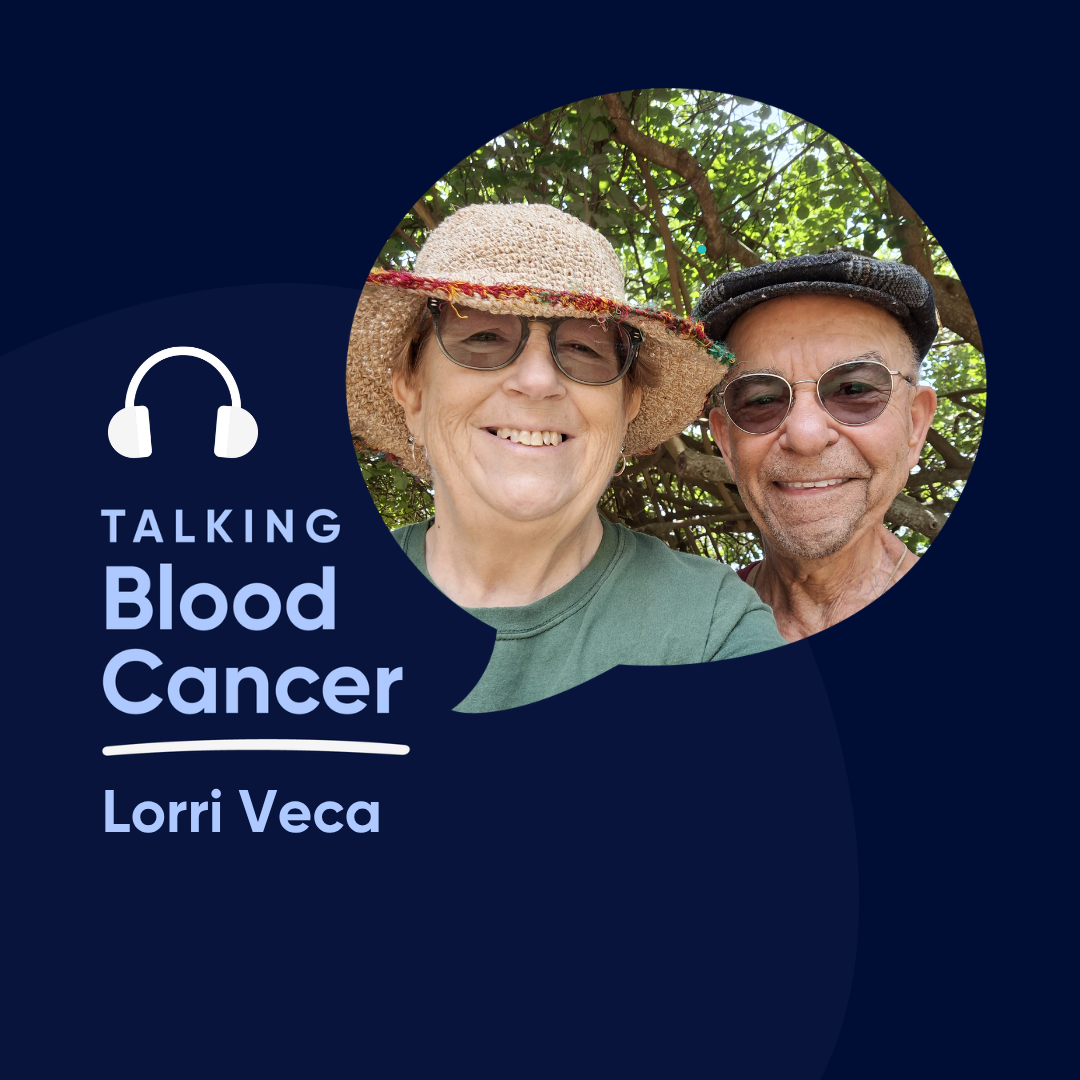
In this episode of the Talking Blood Cancer podcast, host Kate Arkadieff speaks with Lorri Veca, who shares her personal experience of being diagnosed with multiple myeloma at the age of 65. Lorri discusses the unexpected nature of her diagnosis, which was discovered during a routine blood donation when she had no obvious symptoms. She talks about the medical investigations that followed, and how quickly her life was changed by the need to start immediate treatment.
Lorri gives an honest account of the many challenges she faced following her diagnosis. The impact of cancer-related fatigue, the need to stop working in a role she loved at the Australian Red Cross, and the process of adjusting to a new normal. Lorri describes her experience navigating mental health challenges, the importance of acceptance, and finding practical strategies to cope, such as gentle exercise and using support networks.
Highlighting the importance of open communication with healthcare professionals, support organisations like the Leukemia Foundation, and loved ones. She also talks about the value of setting boundaries, preparing for unexpected changes, and focusing on the aspects of life that she can control. Lorri’s story provides advice and encouragement to others living with blood cancer. Showing that it is normal to experience grief and loss and highlights the role of social connections and mental health support.
[00:02:37] Intro
[00:02:37] Kate: So, hi there and welcome to Talking Blood Cancer. Today I am very excited to be having this conversation with a wonderful woman. I will let her introduce herself, and as we always do at this podcast, we ask the guest to let us know your name, where you’re located in Australia, how old you are, what you were diagnosed with, and who is in your support network.
[00:02:58] Lorri Veca: Hi, thank you for today. My name’s Lorri Veca. I’m currently living in Hervey Bay in Queensland, beautiful part of the country. I’m 65 years old. I was diagnosed with multiple myeloma in October 2023. I’m very blessed to have a great support team. I’ve got some very close friends who visit weekly. My husband, my stepchildren, my own children back in Ireland. So I’ve got a beautiful, big blended family, and we’re all from all different races and everything, so yes, very lucky to have my big family.
[00:03:34] Kate: Wow. And then can I ask, what is it that you were diagnosed with?
[00:03:40] Lorri Veca: So, multiple myeloma…,
[00:03:42] Kate: Mmm.
[00:03:42] Lorri Veca: Which is cancer of the plasma cells in the bone marrow. Quite often, a lot of people when they were initially diagnosed may have pain or bruising or fatigue. Some of the usual symptoms we look for. Unfortunately, I was asymptomatic. So I actually had no symptoms, and the first I knew of anything was when I went to donate blood at Lifeblood for the first time.
[00:04:06] Kate: Really?
[00:04:08] Lorri Veca: Yep. And when they did their initial testing, they said, ‘Oh, we can’t take your blood today. There’s something we are not quite happy with. We suggest you go back to GP.’ And at that point they thought it may have been haemochromatosis.
[00:04:24] Kate: Okay, and had you ever heard of at least that before?
[00:04:28] Lorri Veca: Yes, I’d heard of that ’cause a colleague’s husband actually had that issue. Multiple myeloma, never heard of. And then went to my GP as suggested, and they sent me for a gamut of urine tests, blood tests, all that sort of stuff. By the time they got all those done, the kidney doctor actually was the one who said, ‘I’ve got an idea what I think this could be, but I want to send you for a bone marrow test.’ So I had that done and the biopsy, and literally a week later they rang me and said, ‘Yep, it’s multiple myeloma. We need you in hospital today to start your treatment.’
[00:05:04] Kate: Wow.
[00:05:05] Lorri Veca: So it was pretty fast.
[00:05:07] Kate: Pretty fast, and considering you were going in to do a good deed of donating blood.
[00:05:13] Lorri Veca: Yep.
[00:05:13] Kate: How were you feeling all, in that? I imagine it almost would have felt like a bit like whiplash.
[00:05:19] Lorri Veca: It was a little bit, I wasn’t overly concerned when they said about haemochromatosis, ’cause it’s something you can live with and it’s manageable. And they spoke to me about it at Lifeblood and what they can do to help. So they said, if it does turn out to be that there are options for you. So I wasn’t overly concerned until I started getting the other tests done from the GP. So, as I say, I had to be sent to a kidney specialist because my tests there were low. Shown my kidney function was low. The blood tests, which I had to have several in succession, they showed that I was also anaemic. So yeah, that was where the concern started coming a little bit.
[00:06:00] Kate: Yeah.
[00:06:00] Lorri Veca: But I’m one of those people, I try not to worry about stuff until I know I’ve got something to worry about. So it’s always at the back of your mind, but I tried not to let it take over. I was working full time at the time, so that kind of stopped me fretting about stuff because I was very busy at work.
[00:06:18] Kate: You’re preoccupied, yeah. And what did you do for work?
[00:06:21] Lorri Veca: I worked for Australian Red Cross, and I worked with vulnerable young teenagers. So it was young people exiting child safety, they might be homeless. Absolutely loved my job. Very rewarding work, tough but rewarding.
[00:06:35] Kate: And I have no doubt that it also was something that gave you such a sense of purpose and passion that you worked full time. You gave yourself that…, to then get this diagnosis, and I envision all of that would’ve had to stop.
[00:06:50] Lorri Veca: Yes. The fatigue was probably the hardest thing for me that kicked in pretty much straight away. So that’s the cancer related fatigue and also the fatigue from the kidneys and the medication. So I took a couple of weeks off just to see how I was feeling. That just got worse as time went on. I spoke to my haematologist about possibly going back to work, but he was saying the nature of young people, unfortunately is they don’t always look after their health. So that could become a health risk for me because, obviously, once I started treatment, I became immunocompromised. So he suggested that I probably look for something alternative that’s a lot lighter work. But as I say, the fatigue just got worse and worse as the period of time went on. So I ended up…, and it’s a contract position, and it wasn’t fair to expect the company to hold onto that contract where they had targets to meet and things. So I spoke to my hubby, and we made the decision to finish work. So that was very hard choice to make.
[00:07:55] Kate: I envision. And it…, and not one that you wanted to make or chose to make.
[00:08:00] Lorri Veca: No, it was really made for me in a lot of ways. But these things happen…,
[00:08:06] Kate: Mmm.
[00:08:06] Lorri Veca: And I always think challenges always bring as much as they can be negative, they also bring a lot of positives. And it’s trying to see what positives this could bring for me in all this mess that I was trying to negotiate, navigate, understand, comprehend, take in all the above, that we all go through.
[00:08:25] Kate: Yeah, in the midst of you absolutely say all of that, and you go in the midst of having received a diagnosis that’s life threatening as well. It’s a whole lot of change in a very short amount of time, and all that isn’t within your control.
[00:08:41] Lorri Veca: Absolutely. It’s about acceptance of what will become our new normal. The hardest thing I think for any of us living with this kind of chronic disease, cancer, whatever words we want to use is coming to terms with…, we are not gonna go back. That’s never gonna happen. We’ve got a new normal, and it’s about coming to a point of acceptance with that. So it’s learning what our bodies can and can’t do anymore. Not beating ourselves up if we can’t do this or do that, which we used to be able to do. That’s only counterproductive, and I think that brings us down a rabbit hole we don’t need to go down. I did. I think we’ve all done it at some point, we all Google.
[00:09:25] Kate: I think it’s a part of it, isn’t it? Yeah.
[00:09:27] Lorri Veca: Yeah.
[00:09:27] Kate: You almost have to go, ‘Oh no, that’s actually not worth it.’
[00:09:30] Lorri Veca: Yeah. So when you start looking into those things, it’s not a good space. It’s not a healthy place. So I learned pretty quickly to ignore Dr Google and talk to the professionals. So people like Leukaemia Foundation, I actually spoke to one of the blood coordinators initially there. Because when I was given lots of information at the hospital when I was first diagnosed, they gave me a big list of organisations that I could reach out to, and the Leukaemia Foundation was one of those. And one of the amazing blood coordinators…, ’cause my head was just everywhere, as you can imagine.
[00:10:05] Kate: Yeah.
[00:10:06] Lorri Veca: Very emotional. You don’t know where to send that or how to come to terms with that. So I spoke to this beautiful lady who sat and listened. She just spoke to me very gently, very quietly, asked how I was feeling, had a few tears. That was good, Kate.
[00:10:25] Kate: Yeah.
[00:10:25] Lorri Veca: And then she said, ‘So what are your priorities? What is the information you need right now?’ And I said, ‘Oh, this, this, this, this.’ ‘Okay.’ She sent me a huge email after we’d finished talking with all these links and all this information of where I can get for what I needed at the time. And it was just amazing. Just even knowing that was just such a weight off my shoulders.
[00:10:51] Kate: Yeah.
[00:10:51] Lorri Veca: Because at first it feels so heavy carrying this. We are all human. The minute we hear this word ‘cancer’, I think we just blank. We go into this zone of, ‘Oh my God, what?’ It’s just fear, panic. We are human. That’s a natural response. So when you have somebody that can sit there and sift through what you are trying to feel, experience, say, voice, whatever it is. And they can make some sense of that. That’s…, what huge weight off your shoulders. So bit by bit I started going through that.
[00:11:26] Kate: Yeah, ‘cause it’s having that person say to you, ‘How can I help you? What is it that you need?’ And then someone producing what it is that you asked for and needed.
[00:11:38] Lorri Veca: Absolutely. And I got that email literally an hour after we’d finished talking on the phone.
[00:11:44] Kate: Mmm.
[00:11:45] Lorri Veca: So the response was amazing, and she rang me back a few weeks later as well to check on me. Beautiful. And I was very grateful for that. But it at least got me started on the right direction of where I wanted to look, what information I wanted for me. How I go about learning about this disease, what I can do for me. So things like making sure I do a little bit light exercise. As much as that sounds counterproductive when we’ve got the fatigue, it does help. It really does.
[00:12:15] Kate: And what did that look like for you? What were you able to achieve?
[00:12:18] Lorri Veca: So I started doing chair workouts
[00:12:21] Kate: Yeah.
[00:12:22] Lorri Veca: Because I’m struggling to stand with my mobility at the moment. I have to use a walker. So I started doing chair workouts. They’re easy, they’re not difficult. You can pace yourself as much as you want, and if you do research, I found loads on YouTube that are free. You don’t have to pay anybody. You don’t have to go outside your own home. You just literally search bar ‘chair workouts senior’ or ‘disability’ or whatever, and you’ll find they will be the gentler options rather than the full on cardio activities. And they will do weights as well, which is great. So first step was learning to try and manage the fatigue, making sure I’m eating right, making sure I’m trying to sleep as much as I need to, and making sure I’m listening to my body.
[00:13:09] Kate: Wonderful. And I think that’s such great advice, ’cause it is simple and it’s something that you…, when you’ve lost so much control, that you actually can control and take charge of. And as you said, it was as simple as searching in a search bar, ‘chair workouts’. You’re not asking yourself to walk around the block or run the block. You are doing what you are capable and able to achieve.
[00:13:35] Lorri Veca: Absolutely. And also I think when you’ve worked full time, most of your adult life, like I have, especially in the community sector. You feel…, to an extent, that identified who you were as a person.
[00:13:48] Kate: Yeah.
[00:13:49] Lorri Veca: So there’s also that sense of loss and grief. And that, again, is perfectly normal. We are grieving the loss of our potential, the loss of our job…,
[00:13:58] Kate: Mmm!
[00:13:58] Lorri Veca: …, whatever that looks like for each of us individually. So for me, it was the loss of my employment. Which I absolutely loved, and felt that identified who I am as a person. So it’s then, ‘Who am I now?’
[00:14:11] Kate: Yeah.
[00:14:11] Lorri Veca: What identifies who I am now? So there’s all these little things, and that obviously then starts to impact on our mental health and our mental wellbeing. So the second thing is then start looking at our mental health and how we can control or help that. And again, I really did experience quite a lot of anxiety and depression. And again, no shame, embarrassment. It’s human, and it’s perfectly normal given what we’ve experienced.
[00:14:41] Kate: Yep.
[00:14:42] Lorri Veca: So I spoke to my doctor. My husband had the courage to be very real with me and tell me how I was coming across to him, which I’m so grateful for.
[00:14:51] Kate: Mm-hmm.
[00:14:52] Lorri Veca: So because we’ve got that really good relationship, he could be totally honest without that accusation or pointing the finger, but just in a very loving way. He said, ‘Your behaviour and your language is not you, and I’m really worried about you.’
[00:15:07] Kate: Yeah.
[00:15:07] Lorri Veca: And that was the start of that.
[00:15:09] Kate: Can you identify, for somebody who is listening today that may be in a space that they’re not even truly aware of, can you identify or articulate what it was like, as in, was it the way you spoke? Was it not kind? Was it that you shut down or closed off or…, yeah.
[00:15:27] Lorri Veca: I think it’s a little bit of everything. I did shut down to some extent. You don’t wanna be a burden to people. So you…, first of all, you feel you’re the only one that can do this. You’re on your own.
[00:15:37] Kate: Hmm.
[00:15:37] Lorri Veca: That was the first part. He said I was getting quite snappy, which I’m not usually, I’m quite a chill person normally. So for me to change, to get that way is quite a drastic change. And he said I was getting quite aggressive at times with that. I didn’t realise that’s how I was going. Through his courage in speaking up to me and being so honest…, gave me the courage to speak to my GP. So I got a mental health plan, and I’m now seeing a psychologist, which has been probably the biggest support now for me because she’s helped unpack a lot of the emotions and the feelings, and that sense of loss and grief around everything to do with this disease. And we are now kind of unpacking and getting things back on track. So it’s now learning to become my own advocate, now learning to speak up for others. So I’m moving out of that self space, and it’s about now…, so, okay, I’ve now experienced this. I’ve now gone through this. How can I do something to help someone else not have to go through that?
[00:16:44] Kate: Yes, it’s so true.
[00:16:45] Lorri Veca: Yeah.
[00:16:45] Kate: That’s incredible. That’s really insightful, and thank you so much for sharing because I think so many people do experience those emotions and those feelings. And as you touched on, grief and loss, that’s something that’s correlated with a death, but an actual fact. It is in day-to-day life and experiences: grief and loss. So thank you for sharing that.
[00:17:09] Lorri Veca: You’re welcome. As I say, I think mental health has always had so much stigma attached to it. I remember my psychologist actually said to me, she said, ’In an ideal world, each of us have three practitioners. We would have an alternative practitioner to look after the holistic stuff. We would have our GP to look after the immediate medical stuff, and we would all have a psychologist to look after the mental health stuff.’ So in an ideal world, we should all have that, and that should become a normal, not an exception. Mental health is still so looked down upon. People are…, still have a lot of fear around it.
[00:17:47] Kate: Yeah, they do.
[00:17:48] Lorri Veca: It’s normal. It’s perfectly normal.
[00:17:51] Kate: It is, and we all go through it. And as you said previously, the challenges that we get thrown at us, and you know, how quickly they come into our lives. That it’s really jarring, and it takes a lot for the brain to…, the brain is incredibly powerful, but it can take such a long time to readjust, recalibrate, and accept as well.
[00:18:13] Lorri Veca: Yeah. So I’m very grateful. Now, I can say I am at that point of acceptance. I’m now accepted where I’m at, and this is my ‘normal’ from now on. And now I’m just learning to listen to my body. So it’s…, if my body needs rest, I don’t beat myself up. If I’m having a bad day, what people call it, ‘pity party’. So if I’m having a bad day and it’s not a good day, which I do have now and again. I don’t feel bad if I sit there and Netflix-binge for the day in my pyjamas, that’s okay. If the housework’s not done, it’s okay. If the kitchen’s not tidy, it’s okay. That’s what we all have to learn. It’s okay, not to be okay.
[00:19:00] Kate: Yup. It is not…, it is absolutely…,
[00:19:02] Lorri Veca: Yes.
[00:19:02] Kate: And I think it’s so important to be honest with your people, that if someone does say, ‘Hey, how you going?’ That you don’t just go, ‘Yeah, yeah, I’m good, thanks.’ That you can go, ‘Oh yeah, no, today’s not a great day’ or ‘No, I’m, I’m not great, thanks for asking though, but what else is…,’ you know? It’s so important to voice it because life is heavy enough, and you don’t need to carry that around. That weight around of trying when you just don’t feel like it, or you don’t have the energy
[00:19:33] Lorri Veca: Yep.
[00:19:34] Kate: Or you know, you’re not in the mental health space to continue to carry that.
[00:19:37] Lorri Veca: Yep, absolutely. And I think the other thing is, for people not to be upset when others walk away. Because I had a big team of…, at my job, I had a big team of colleagues, some of them have remained in contact with me and do to this day, and I’m very grateful to them for that. Other people have their own lives, their own challenges, whatever to go on with, and quite often people really genuinely do not know how to respond to someone living with cancer. They don’t know what to say. So instead of feeling they’re saying or doing the wrong thing, they’d rather not do anything and walk away. So rather than get hurt, I think if we just try and be a bit kind and remember people are in their own space, they’ve got their own challenges as well as what we are going through. And not to take it personally, it’s not their fault. It’s something that’s confronting them that they can’t deal with at the moment.
[00:20:35] Kate: Absolutely, and I think it’s also, you know, you’re right, some people, they really don’t know what to say, and it can be triggering for them for reasons that you may not even know. They may have had a loved one that lost…, was lost to cancer. It’s something. Everybody has a story and a why as to why we respond the way that we do. And I think that if you do really value that friendship and that connection with that person, and you have noticed that they aren’t showing up or they aren’t…, or they’re avoiding the conversation, there’s nothing wrong with saying, ‘Hey, because I haven’t heard from you, or because you haven’t avoided…, it’s, you’re avoiding me…, it’s hurting.’ or X, Y, Z. Talk about the elephant in the room, and then it’s amazing what that does, and it’s sometimes just that conversation that can change the trajectory of the connection that you have with that person.
[00:21:27] Lorri Veca: Absolutely, and I think what you said earlier, it’s just about being real, authentic and honest about…,
[00:21:34] Kate: Mmm.
[00:21:34] Lorri Veca: …, our life now. Because other people don’t understand it. Amount of people that I see, if I’m out with my hubby with shopping or whatever. And they go, ‘Oh my gosh, you look so well.’ And at first I’d go, ‘Oh, thank you.’ And just cringe a little bit inside.
[00:21:50] Kate: Yep.
[00:21:50] Lorri Veca: But then I started saying, ‘Oh, thank you. That’s really nice of you to say. But you wanna see me at two o’clock this afternoon when the energy levels drop, and I’m panned out on the couch.’
[00:22:00] Kate: Yeah. Absolutely. And people don’t understand, not especially, but with multiple myeloma, the complexities of it.
[00:22:09] Lorri Veca: Yup.
[00:22:09] Kate: That, as you say, you can, I’m doing quotation marks, ‘look well’. But then what internally is going on for you and the effort that you’ve had to expel to get to the shops, just to do your weekly grocery shop is huge. And we have to help change that conversation and to help change the knowledge around chronic disease and chronic illness and what it is like living with the blood cancer long term that I may look well on the outside, but what is happening for me internally and every day…,
[00:22:44] Lorri Veca: Yeah.
[00:22:44] Kate: …, is really a rollercoaster.
[00:22:46] Lorri Veca: Yep. And that’s…, I think because we always want people to feel good when we’re talking to them. So my go to was the normal obligatory response back in the early days of diagnosis was, ‘Oh, thank you. Yeah, I’m doing okay.’ That was it. Now, as I say, I get very honest. I go, ‘Oh, thank you, but this is my reality now.’
[00:23:09] Kate: And then how do people respond when you say that? Can you see a juxtaposition of how the response you used to give to people and their reaction to now?
[00:23:17] Lorri Veca: Yeah, there’s a certain level of…, not dismissal, but ‘Oh, I’ve heard what I wanted to hear now, so I’m happy.’ So when you give them that obligatory response, ‘Oh yeah, I’m fine.’ It’s almost, ‘Great. I don’t have to go into another conversation. So my job’s done.’ But now with friends, when they do genuinely ask, and I know when they’re genuine, coming from their heart, when they do ask those questions, and I say, ‘Today’s better. Yesterday was a really bad day. And this was my reality yesterday, blah, blah, blah, blah, blah.’ And they go, ‘Oh, crap. I didn’t realise, you know, that was a thing.’ And I went, ‘Yep.’ And we’ll talk about that a little bit. And they go, ‘And how do you feel having to do that all the time or live with that? That must be so hard.’ But it’s skin. It’s raising awareness. This is my reality now. This is how big this is, and this is what I live with. So if I have to turn down a coffee invite or if I have to say to you, ‘Actually, can you come to me for a cup instead of me coming out?’ You now know why.
[00:24:19] Kate: Yeah.
[00:24:20] Lorri Veca: It’s about them understanding.
[00:24:22] Kate: And you being really honest as well with where you are at. And that too can be for some…, I know we’ve had a conversation with some people on the podcast around this as well, it’s when you struggle with having to voice, ‘Oh, I…,’ you know, the challenges that you do face every day. That can be really tricky in itself because it’s almost…,
[00:24:44] Lorri Veca: Yup.
[00:24:44] Kate: …, like you’re admitting it out loud and you are becoming well, ‘I not am who I was beforehand,’ or ‘I am sick as well,’ and you can no longer hide behind the facade of…,
[00:24:56] Lorri Veca: Yeah,
[00:24:56] Kate: …, being well.
[00:24:57] Lorri Veca: But it’s like you said earlier, we lose so much control of our lives, the things we have left, control…, control them. Take that responsibility, and that’s you looking after your wellbeing, you doing the best you can do for your health. Everything else comes secondary. Like if children say, ‘Can we come for a visit the weekend?’, and one of them might have a sniffles, ‘Sorry, you can’t, we’ll wait till you’re better.’ It’s about being honest and being straight up. If someone rings me and says, ‘Oh, I’d love to come over for a visit.’ ‘Are you sick? Has anybody around you been sick? Just have that awareness, please.’
[00:25:32] Kate: Yeah.
[00:25:32] Lorri Veca: It’s little things like that, but at least by you being honest and you being real, it puts that in their head, and then they become a bit more thoughtful around you.
[00:25:44] Kate: Absolutely. And you could do it with kindness and grace, can’t you?
[00:25:48] Lorri Veca: Absolutely. Yeah, you don’t have to be rude.
[00:25:51] Kate: No, and it is something in life…, I’m just thinking as you’re talking, it’s a boundary that you’re setting with your circle of…, that you need and, and us humans do really do struggle with boundaries and people struggle to respect them, and it’s something that you constantly have to uphold, but you can absolutely do it with kindness and the people that may get a bit, chipped off about it. You go, ‘Well, I’m looking after me first.’ As you said…,
[00:26:15] Lorri Veca: Yeah.
[00:26:15] Kate: …, you come first.
[00:26:16] Lorri Veca: Yeah. And again, it’s just, those are the things you can control is your home because you’ve set up your home now for your new normal.
[00:26:25] Kate: Mmm.
[00:26:25] Lorri Veca: So that’s why I say to people, ‘Please come to my home.’ Because here, anything happens or I’ve taken not well, or I need a bathroom quick, or any of those kind of things that we all experience at times, I can control it here.
[00:26:39] Kate: Yeah.
[00:26:40] Lorri Veca: So it’s again, that kind of thing. It’s about putting yourself first. You have to. That’s no longer an option. You’ve got to put yourself first. If you want the best quality of life and the best outcome for yourself, you have to, by all means, put you first.
[00:26:57] Kate: And how do you do, you know, you’d say you have a wonderful husband. How do you balance that, putting yourself first, but also being in a partnership as well?
[00:27:06] Lorri Veca: I’m very lucky in that when my husband and I first got married, he had his own cancer journey. Thank goodness he’s 10 years clear now, so he’s hit the magic number. But he has an understanding of the whole treatment journey, side effects, all that stuff. So that has made things considerably easier for us personally. Also communication. We talk literally about everything. Even if it’s a very robust, tough conversation.
[00:27:40] Kate: Mmm.
[00:27:41] Lorri Veca: We will talk through everything. He is absolutely my best friend, and there is nothing at this point in time that I cannot talk to him about.
[00:27:52] Kate: Yeah.
[00:27:52] Lorri Veca: And I think we all need that one person that’s like that for us. So for me, it’s my husband. Other people, I know it could be one of their children, or it could be a sibling or parents or whatever. But I think we all need that one person that we can be really real without apology to.
[00:28:12] Kate: Yeah. So very true, yeah. And did you have those really tough conversations with him around what if I don’t make it, or did you ever go there? Or while holding a positive mindset.
[00:28:25] Lorri Veca: We have had those conversations, and we’re now…, while I have the capacity, we’re actually now putting practical things in place. So I’ve done an enduring power of attorney. My stepson and my husband have looked after that. My stepson is taking care of all the paperwork. Absolutely, he’s the right person to do that kind of thing for us. We’ve also got a little book that we’re writing down. I’m writing down my wishes as when I feel I want to. They both know that I have this book. They know where it is. Actually, when I asked him to be my power of attorney, it’s very funny. I said, ‘Could I have a chat with you on the phone?’ My hubby and I both chatted with him on the phone ’cause he lives in Brisbane. And I said, ‘I kind of have a weird conversation I want to have with you, but please be really honest with me, and if you don’t feel comfortable.’ My children are in Ireland, so that’s not practical. So I said, ‘I trust you implicitly and would love if you’d be my power of attorney.’ And he said, ‘Oh my God, I’d be so honoured.’ And I said, ‘I’m not being morbid or overly morbid.’ And he went, ‘I totally understand.’ He said, ‘You wanna get all this stuff done out of the way while you can. And then you know you can carry on living your life for as long as you’ve got it. And it’s all done and dusted, forget about it.’ And I went, ‘Yes.’ ‘Cause I’m an organisation person, I like to get things done, park ’em out the way, then I can get on with life.
[00:29:53] Kate: Yeah, and as you said, like, things that you can control, do, and that is one that you can control.
[00:30:00] Lorri Veca: Absolutely.
[00:30:00] Kate: And just because you write those wishes or you write a will or gain power of attorneys or advanced healthcare directives, it doesn’t mean that they’re gonna get activated the next day or that you’re gonna pass away. It’s just means that you’re prepared, and everybody who is over 18 should have all of those things in place.
[00:30:22] Lorri Veca: Definitely. And also I think we forget, especially with any of these cancers. Today could be fine. Tomorrow, I could be in hospital, something could flare up, something could happen. Who knows? And that happens to anybody in life.
[00:30:37] Kate: Mm-hmm.
[00:30:38] Lorri Veca: So we never know when an emergency situation happens. And I think the sooner we can put things, practical things like that in place, you’ve done it, you can forget about it then, you can live your life. That’s the important thing is living life, not this stuff. So rather than someone take that control off of me and make those decisions, I know what I’d like. I know how I’d like things to be towards the end. That’s what I want.
[00:31:04] Kate: Yeah.
[00:31:04] Lorri Veca: I don’t want it to be morbid and maudlin. I want it to be a celebration of life when it happens. Yes, I’m 65. So far, I’ve had a pretty good life. Yes, I’ve had challenges. We all go through challenges. But it’s the positives I’m wanting everybody to remember. Not the negative crap.
[00:31:18] Kate: Yeah.
[00:31:18] Lorri Veca: It’s all the fun stuff we did. Just before my diagnosis, I went on a big life change. I needed new knees, knee replacement surgery, so I had to go on a big weight loss journey. I lost nearly 70 kilos the old-fashioned way, hard work and exercise. And I did that over two and a half years, got new knees, had this whole new lifestyle, decided I wanted to try kayaking ’cause my hubby loves kayaking, loved it. Two months after all that started, I got told I have multiple myeloma.
[00:31:48] Kate: Oh wow.
[00:31:49] Lorri Veca: Yes.
[00:31:50] Kate: Imagine if you didn’t go on that journey and you were holding that weight, leading into that. You likely were in the best shape to begin…,
[00:31:58] Lorri Veca: Yep.
[00:31:59] Kate: …, the battle of blood cancer.
[00:32:00] Lorri Veca: And all my doctors have said the best gift I could have given myself was that health change. And I’ve maintained my weight, which is great. So it did creep up a little bit when I was going through my anxiety and depression. I think we all splurge a bit when we’re through that, but I’ve lost that weight again, and I’m back down to where I was. So I’m very happy with that.
[00:32:23] Kate: And that’s not easy to do, being like, I know before we started press and record, you had mentioned that you were on Dexamethasone, which is a steroid, and steroids do really increase your weight and for some of the treatment. It really can…,
[00:32:36] Lorri Veca: Yeah.
[00:32:37] Kate: You can either lose weight, or you can also put on weight. Really, it depends.
[00:32:39] Lorri Veca: Yep.
[00:32:39] Kate: So…,
[00:32:40] Lorri Veca: Yes. And I did put on, I think it was 14 kilos?
[00:32:43] Kate: Mm-hmm.
[00:32:43] Lorri Veca: In the first eight months or so. So that was quite a big increase in a short period of time. So now I’ve gotta get hip replacement because one of my hips is impacted. So the doctor said, ‘We need you to get back down to where you were.’
[00:32:59] Kate: Yeah.
[00:33:00] Lorri Veca: So I did. But again, it was just a light, gentle exercise. It was getting back to healthy eating, stop feeling sorry for myself and give myself a kick up the butt.
[00:33:09] Kate: And is that hip issue that you have now, is that from the multiple myeloma or the treatment or is it…, that’s just genetically a challenge you’ve had?
[00:33:20] Lorri Veca: I do genetically have arthritis, so that’s part of it. But obviously because of myeloma impacting our bones, my haematologist especially wants to make sure it doesn’t go too far, and just wants to make that the priority, yeah. So that’s probably the next surgery I’m looking at is the hip replacement surgery.
[00:33:39] Kate: And can I ask, and you know, I know we’ve spoken about the incredibly importance of mental health, but if we jump back into the treatment of myeloma, how has that treatment been for you and what has been your experience?
[00:33:53] Lorri Veca: It’s very confronting initially because you are given all this medication, told you’ve gotta take some on some days, some this way, some that way. So it’s learning that protocol for that. Then you are getting your chemo, so it’s learning to deal with any potential side effects and managing those. I think you’ve really gotta be honest and talk to the medical team about that, when that starts happening.
[00:34:17] Kate: Did you note down your side effects? Or did you just…,
[00:34:19] Lorri Veca: Yep. So each time I knew I was coming up…, so I see my haematologist monthly. Each time I was getting ready to see him, I’d make a note through that three weeks prior. How I was going, if I’ve noticed anything creeping up or changing even in my bloods and that kind of thing. I’d say, ‘Oh, I’ve noticed this has gone down, what does that mean?’ Or ‘This has gone up, what does that mean?’ ‘This is what I’m experiencing…,’ Because you can’t get anything done about those side effects unless you talk to them about it. So for me, it was tummy issues. So I went through the most horrendous diarrhea at first. Sorry, not pleasant topic.
[00:34:55] Kate: But it’s important. Such a huge side effect that doesn’t need stigma attached. Everybody goes to the toilet…,
[00:35:01] Lorri Veca: Yeah.
[00:35:02] Kate: …, and does what they need to. But if there’s an increased motion, you absolutely need to let your doctor know.
[00:35:07] Lorri Veca: And when that’s happening, five or six times a day…
[00:35:10] Kate: That’s life-impacting.
[00:35:12] Lorri Veca: Yes. You literally can’t go out of the house.
[00:35:15] Kate: Mmm.
[00:35:15] Lorri Veca: So you don’t want to get to that point. I did because that was where, as I say, my, that all started coming up when my mental health was impacted.
[00:35:23] Kate: Yeah.
[00:35:23] Lorri Veca: But then as you start looking after each thing, it takes one less thing off. So I got that, spoke to my haematologist, he gave me medication to help, gave me some strategies, some dietary advice. And we’ve now got that pretty much manageable so that I’ve got…, if I’ve gotta go out or I’m going away for a day, or I’m…, got a family event on, I’ve got medication I can take to make sure that’s not gonna happen during that day. So it’s balancing that if I’m at home, doesn’t bother me, I just…, whatever. But when I’ve got things that I need to be, like if I’m at hospital for treatment for my IVIG (intravenous immunoglobulin) every month, I’m there for four hours at a time. The last thing I need is that happening.
[00:36:06] Kate: Yeah.
[00:36:07] Lorri Veca: So I take some medication. Before I go, I know I’m gonna be all right at the hospital. So it’s just, if you don’t talk about them, you can’t put those things in place.
[00:36:16] Kate: Yeah. And it’s so true. It, it’s, being brave enough to speak up and being that advocate for yourself. The doctors can prescribe what they know and what they know is successful, but it’s…, they’ve never treated you before.
[00:36:29] Lorri Veca: No.
[00:36:29] Kate: And everybody is so very different and…,
[00:36:32] Lorri Veca: Yeah,
[00:36:32] Kate: …, They…, doctors likely have seen all of it, but they don’t know what’s going on for you if you don’t tell them.
[00:36:38] Lorri Veca: Absolutely. So with me, because my kidneys are also impacted, ’cause I have stage four chronic kidney disease, I couldn’t go for the stem cell transplant. So I’m on constant treatment. So I get IVIG now monthly.
[00:36:54] Kate: Mm-hmm.
[00:36:54] Lorri Veca: I also get a drug called Elotuzumab, which I get after my IVIG, and then I go home. I’m fine for the month, so I’m still on all the other meds. Most of us are on like the dexamethasone, lenalidomide, your antivirals and that sort of stuff. But mainly, that’s my main treatment now, and that’s gonna be ongoing.
[00:37:14] Kate: Okay, yeah. And how do you wrap your head around accepting that into your life because some people, they begin to resent needing to go to the hospital every month and all of that.
[00:37:27] Lorri Veca: Well, that’s where we come back to what we can and can’t control. I can’t control that, I need medication. I can’t control it has to be done at the hospital, but can control my attitude. So instead of sitting there and feeling, ‘I don’t wanna do this.’ It’s actually keeping me alive.
[00:37:44] Kate: Mmm.
[00:37:44] Lorri Veca: I get to see my grandbabies grow up. I get to go over to Ireland and see my own children. What do I want? If I want a better quality of life, I’ve gotta do this. So I can either suck it up and be a victor and go, ‘Yay, I’m still here, and I’m still fighting. I’m doing good.’ Or I can go, ‘I really hate this, but I know I’ve gotta do it.’ It’s given us our life, and I do resent it still, believe me, I…, there’s days where I just go, ‘I’m so over all this,’ but you just, like I said, it is a pity party, and that’s okay too. You go have your pity party, don’t get stuck in it. Next day is a new day. Move on.
[00:38:22] Kate: Yeah. And I think that’s it, right? Don’t get stuck in it. It’s…, absolutely have it. And it’s so important to release that emotion because holding onto emotion does not do anyone any good. And you can look at all the research, not I am…, I think I can confidently say nobody would say holding emotion in is of benefit. So releasing it, but then it’s how do we…, it’s, it comes down to that resilience, isn’t it? It’s how do we bounce back and how do we climb out of that pity party pit and, go ‘Okay. That was that day, but then today’s a new day,’ and sometimes it might be a couple of days, isn’t it? Like when you’ve received bad news? And you can have…, do…, and that’s the thing with this journey: you can do everything right, attend every appointment, take every tablet, and it’s…, you still have moments that you get bad results or things don’t work out the way that you thought that they would or were the hope that you had either.
[00:39:18] Lorri Veca: And we all face challenges all our lives, it’s just a different kind of challenge. So I think the biggest gift it’s given me is learning to be in the present moment. So as I’m learning to come out of my mental health issues, I’m finding that being in the present moment really helps me. Mindfulness really helped me. I think anything that just keeps our focus on this moment. So I try and find three things every day that I’m grateful for. And I try and find one thing that’s brought me joy today, and that’s my new normal. That’s how I get myself out of those little black holes when we drop in them. Might not be today, but all of a sudden someone might message me and send me a funny joke or something like that, and I’ll have a laugh, and I’ll go, ‘Okay, you’re just being a sook. Get your backside up. Get moving.’ And, yeah.
[00:40:17] Kate: Mmm.
[00:40:17] Lorri Veca: It’s just trying to find something or plan something the next day that you’ve got to look forward to. Just finding your own little way to manage.
[00:40:26] Kate: Mm-hmm.
[00:40:26] Lorri Veca: And it doesn’t have to be life-shattering. It doesn’t have to be major. As I say, for me, every day I acknowledge three things I’m grateful for.
[00:40:34] Kate: Yeah, and I was gonna say, and I bet that they don’t even have to be big, giant, glorious things. It’s as practical as going, you got to sit out in the sun and let the sun kiss your skin today for five minutes. Or, your favourite TV show released a new episode, something…,
[00:40:52] Lorri Veca: Yep.
[00:40:52] Kate: …, you know, as simple as that as well.
[00:40:54] Lorri Veca: Or I cooked my favourite thing, or it’s whatever. Whatever you’re passionate about, focus on that. So I like alternative stuff. I like alternative therapies. You can probably see here in my room. I’ve got crystals and things like that. That’s something I love. So meditation really helps me, mindfulness really helps me. That’s not gonna work for every single person. So you’ve gotta find what works for you.
[00:41:21] Kate: Absolutely. And when you do meditation, how was it starting out? Was it something that came easily and naturally to you, or?
[00:41:31] Lorri Veca: No, it’s like everything we have to practice. And you do find your mind will wander in you start going, ‘Oh, I can’t do this. I’m feeling pretty crap.’ Or wondering what you’ve gotta do for dinner and wondering what the kids are doing. And you do get those little thoughts creep in. You just try it for two minutes. Next day, try it for three minutes.
[00:41:52] Kate: Yeah.
[00:41:52] Lorri Veca: Next day, five minutes. It’s…, everything is practice.
[00:41:54] Kate: Absolutely. And I know that…, I’ve done meditation, and I can’t do a silent meditation. I don’t know if that’s just my brain. I, I need something going. And so I’ve always done and fallen into guided meditation, and just like your simple trick of YouTube, for your exercise, there’s meditation guides that are free. ‘The Smiling Minds’ are…,
[00:42:15] Lorri Veca: Yup.
[00:42:15] Kate: Lots of things that are there, free and accessible…,
[00:42:17] Lorri Veca: Absolutely.
[00:42:18] Kate: …, to help calm the mind.
[00:42:20] Lorri Veca: Yep. And that’s, again, there’s so much free stuff, and I know finances is a big thing as well when we go through this because I know treating blood cancers are amongst the most expensive, because of the longevity, are amongst the most expensive to treat. So a lot of people do struggle financially.
[00:42:40] Kate: Mm-hmm.
[00:42:41] Lorri Veca: This stuff is free. Before you start going out, handing out money, see what your options are out there.
[00:42:45] Kate: So true. And we here at the Leukaemia Foundation have an incredible range of resources. You know, we’ve done so many webinars in the past that are all recorded and all able to be free, and they cover such a range of topics from being very heavy medical-based to then having that mental health and that psychosocial component. So, absolutely tap into our resources as well for those listeners. But you are right. Finances are such a big hit for our blood cancer community here, and I absolutely wish, and I know that there’s more that needs to be done, and I wish there could be more that could be done instantly.
[00:43:24] Lorri Veca: Yep. But it…, as I say, it’s just figuring out what’s right for you.
[00:43:28] Kate: Mm-hmm. So true, absolutely. I’m very aware of the time, and I cannot believe we’ve spoken for as long as we have, and it feels like we’ve spoken for two minutes. But I also…, at the end of every episode, we ask our guests to share some wisdom, some golden nuggets for the people that are listening, you know, that we have listeners that are tuning in that have just been diagnosed with myeloma or blood cancer. We’ve got carers on that usually pick up and listen to these episodes as well, and people that are in all different parts of journey. They’re returning back into life after being in acute treatment. Is there anything that you would like to upon already what you’ve done, share, that may be useful to somebody that is listening today?
[00:44:16] Lorri Veca: I think if you are newly diagnosed, don’t panic. First thing we wanna do is panic. Don’t panic. Listen. Take notes. Write down any questions you have. There is no such thing as a silly question.
[00:44:32] Kate: So true.
[00:44:33] Lorri Veca: Reach out to organisations like the Leukaemia Foundation. If you don’t feel comfortable talking to someone face to face, you can talk to one of the lovely blood coordinators on the phone. There’s loads, as you say, there’s lots of resources you can look up.
[00:44:47] Kate: Mmm.
[00:44:47] Lorri Veca: So, first of all, don’t panic. Write down anything you need to know. Any questions you have…, listen. And if you don’t understand, say ‘I don’t understand…,’
[00:44:57] Kate: Mmm.
[00:44:57] Lorri Veca: ‘…can you please explain that a bit more clearly for me?’ ‘Cause sometimes the doctors can get a bit in their language, and it’s no harm just bringing them back. Remind ’em you are human, you are not a medical professional, and you don’t understand all the terminology yet.
[00:45:10] Kate: Mm-hmm.
[00:45:11] Lorri Veca: Learn as much as you can about your disease. It’s your disease, it’s your body, and that’s one thing you can control. So learn what can help and what doesn’t help. If you are struggling with your mental health, get help. Because our emotions, as an…, science fact, as you said earlier, our mental health and our emotions impact our physical health so much that if we can’t get that under control, we’re only gonna actually feel worse, not better. So the more we can help that side of things, the better we are gonna feel physically and mentally and emotionally, and be real. Don’t be frightened to embarrass people. Don’t be frightened of making people feel uncomfortable. This is your life, your journey, and this is your reality. So don’t be frightened to spare people’s feelings. Just speak real. Speak honestly about what you’re going through.
[00:46:04] Kate: Mm-hmm. Thank you so much. I think that there’s just some really insightful bits of…, tips and bits as to how to navigate this space, and that’s one that you didn’t choose. So thank you so much for those insights as well.
[00:46:19] Lorri Veca: Thank you.
[00:46:19] Kate: Well, I think that we’ve covered some really great topics and conversation pieces in this, and I hope that the listeners today really do walk away with an insight of how to step into your own mental health and take charge of the things that you can control and know that you aren’t alone. Sitting here with you today has been an absolute pleasure, and I can’t thank you enough for sharing your story and your perspective so raw and authentically.
[00:46:44] Lorri Veca: Thank you for giving me the opportunity. Much appreciated.
[00:46:48] Kate: My pleasure.
[00:46:50] Outro