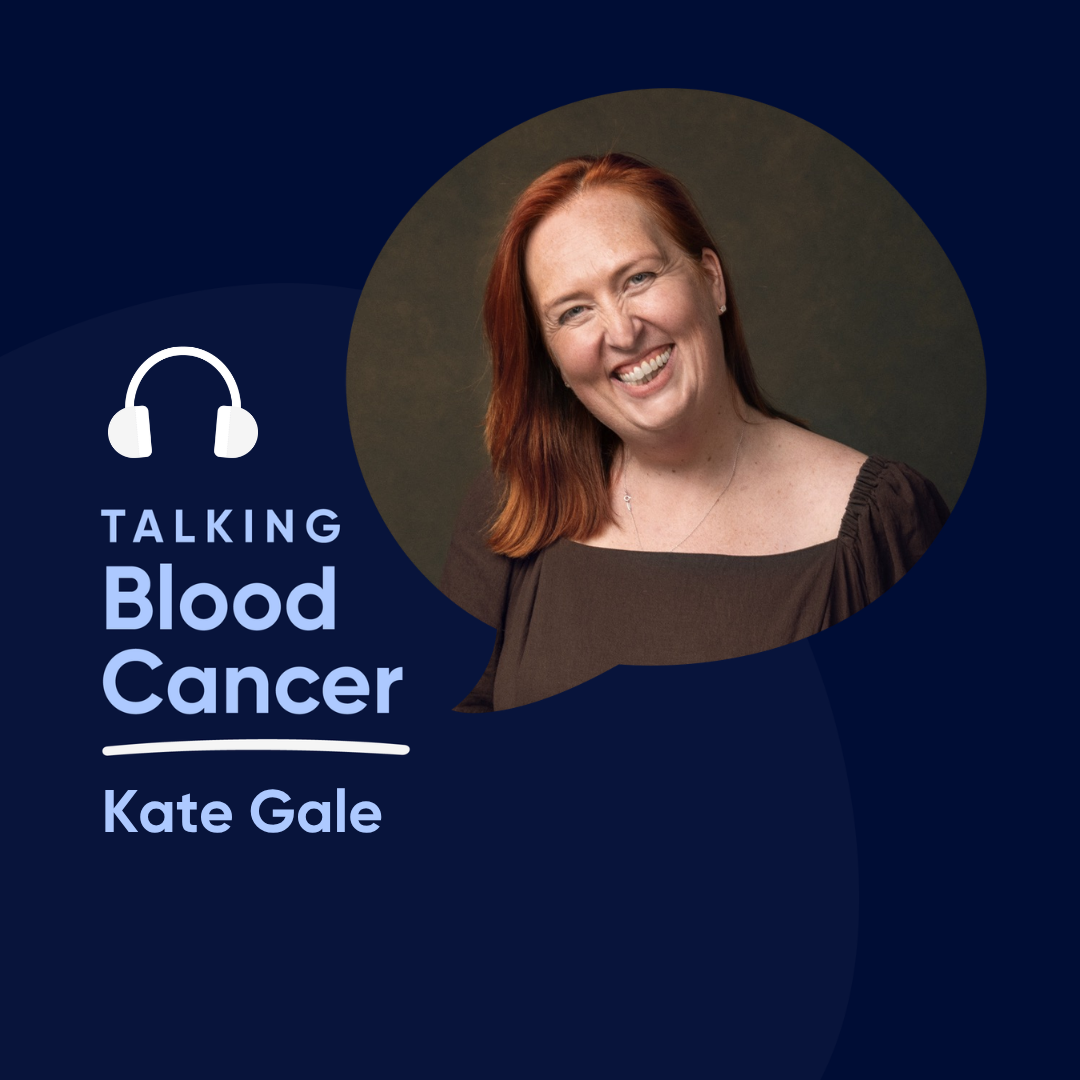
In this episode of the Talking Blood Cancer podcast, host Kate Arkadieff is joined by Kate Gale to discuss her lived experiences with cancer, including both a breast cancer diagnosis, and more recently, B-cell acute lymphoblastic leukaemia.
Kate shares how she first discovered her breast cancer at age 27, prompted by a conversation with a client at her hairdressing salon. She describes the challenges faced when her initial concerns were dismissed due to her young age, and the importance of self-advocacy in receiving a timely diagnosis.
They explore the complexities of managing cancer as a young mother and the significant changes in identity that come with hair loss and other side effects. Kate speaks openly about her journey through both breast cancer and later leukaemia, the different treatment experiences and the psychological toll of facing a second, unrelated cancer diagnosis after years in remission.
Kate explains the differences in mindset and coping strategies required for a solid tumour compared to a blood cancer, including the challenges of leaving her local community for treatment in a major city. Talking about the impact on family dynamics, the importance of acknowledging difficult emotions, and the gradual process of rebuilding trust in one’s body. Listeners will hear about the long-term effects of treatment. Kate’s approach to life after cancer, emphasising the value of taking each day as it comes, making conscious choices about mindset, and the importance of supportive care for both patients and their loved ones.
[00:02:36] Intro
[00:02:36] Kate Arkadieff: So, hi everyone. My name is Kate Arkadieff, and I’m your host of Talking Blood Cancer today. And I have a really special guest that I’m excited to help her share her story here on Talking Blood Cancer. So as we always do, we do ask our guests to introduce themselves. So if you could start off by sharing your name, where you’re located, what you were diagnosed with, and then who was in your support network?
[00:03:00] Kate Gale: Hi guys. My name is Kate Gale. I‘m a 45-year-old mum, wife, and I live in Ballarat in Victoria. And I was diagnosed with breast cancer in 2008 and, more recently 2023, with B cell acute lymphoblastic leukaemia. And I have a huge tribe behind me. I have…, like I said, I’m a wife and a mum, so…, my husband Bob, my two daughters, Brie and Gemma, and a big network of helpers in the background.
[00:03:30] Kate Arkadieff: Oh wow. Well, so take me back. My maths isn’t good. I envision that when you were diagnosed with breast cancer, life was at its fullest, being a mum with younger children. What led you to the doctor? What took you to that moment to go, “Hmm. Something’s not quite right.”
[00:03:49] Kate Gale: I was actually a hairdresser. I was 27 at the time, and I was in my hairdressing salon, and I was cutting a client’s hair. Her name was Jan, and she was a very vibrant character. She had the best personality, and this one day she was just very down in the dumps. And I asked her the weird question, you know, when you wanna ask someone if they’re okay, but you’re a bit too scared of the response…
[00:04:12] Kate Arkadieff: Hesitant.
[00:04:13] Kate Gale: Yeah, but I went through that awkwardness, and I said, “Jan, are you okay? I can tell you’re not okay.” And, she told me that she’d recently been diagnosed with breast cancer. She’d had surgery, and every time I went round to her left side, she was a bit scared that I was gonna bump her and hurt her. And then probably the question that has changed my life…, and I go back to this question every single day; I’m reminded of it. She looked me in the eye, and she said, “Kate, have you done a breast check?” I’m like, “Yeah, yeah, of course I have.” And I had never, never done a breast check.
[00:04:48] Kate Arkadieff: At 27. It’s not something in the…, that we’re told as women to begin checking.
[00:04:54] Kate Gale: That’s right. It doesn’t happen to 27-year-olds. So. I never had, I think I’d had breast checks when I was pregnant with my daughters, but apart from that, I had never done a self-breast examination. But the next morning in the shower, I thought of Jan, and I thought of that question, and I did a breast check, and I found a lump.
[00:05:13] Kate Arkadieff: Really? And what did you think? Did you think it was breast cancer? And just go, oh, that’s a lymph node, or a milk duct?
[00:05:21] Kate Gale: Uh…, straight away, I thought, “That’s not right.” My daughter Gemma was one, and I’d not long finished breastfeeding her. So I thought, “Hmm, maybe this is just a blocked duct or something.” But my uncle on my dad’s side, he died of a malignant melanoma a few years before that, and we’d always just had it drummed into us. Anything wrong, anything weird, you get it checked. So off I went to the doctor.
[00:05:48] Kate Arkadieff: Was the doctor, given your age, given the diagnosis, were they curious to go, “Maybe this is something,” or did they dismiss you?
[00:05:57] Kate Gale: I was dismissed.
[00:05:58] Kate Arkadieff: Okay.
[00:05:59] Kate Gale: Yeah. “You’ve just finished breastfeeding, you know, it’ll just be a milk duct, or you might have mastitis.” And that didn’t sit well with me. ‘Cause one, I’d never had mastitis when I was feeding. And two, I felt fine. Like, apart from this lump, it was like I just knew I had that gut feeling that something wasn’t right. Anyway, I left the doctor, and it was about three weeks later I returned because Gem had been climbing over me and I was getting elbows in the boobs, and it was actually really sore. So I went back, and I said, “Yeah, something’s definitely not right here. I think we need to look a bit further.”
[00:06:36] Kate Arkadieff: And then you did that. What, what…, then were you listened to?
[00:06:40] Kate Gale: Well, sort of?
[00:06:41] Kate Arkadieff: Okay.
[00:06:42] Kate Gale: I, uh, I went for a…, a mammogram. I was told beforehand, at my age, it was probably very unlikely that they could see anything, because of dense breast tissue at that age. But because I had fed two children, maybe I’d broken down that density a little bit that they could see something. And as a matter of fact, on the morning that I went and had that mammogram, the lady that did it, she looked me up and down before I walked in the room, and she said, “How old are you?” And I said, “I’m 27.” And she said, “Well, you’re wasting my time and yours.” And then the anger…, the anger hit. I’m a redhead, so I have a short fuse, but I said to her, “How about you do the job that you’ve been asked to do, and then if you don’t see anything, then happy days. But I know that there’s something there.”
[00:07:32] Kate Arkadieff: What was her face after she did that scan? And I’m so proud that you said that, ’cause to be your own advocate, when people are pushing you down in your health, when you know in your body, something isn’t right, that’s so brave of you.
[00:07:46] Kate Gale: Yeah. She took the pictures, and there was a big TV in the wall. So I could see, not that I can read mammograms or ultrasounds, but I could definitely see a big black…, a dot, I suppose you could say. And she actually said to me, she goes, I’ll be back in a moment, rushed out the room, and then came back in, and she said, you’re going for an ultrasound. And I was faced with another ultrasound. I’d already had two. And I said to the man, because it was the same gentleman doing it. And I said to him, “It’s not mastitis, is it?” And he just said, “Look, I’m gonna put this on the urgent pile to be read urgently, and I suggest that you get in touch with your doctor.” So my GP actually rang me later on that afternoon whilst I was on the couch watching the Wiggle Safari with my girls, and…
[00:08:33] Kate Arkadieff: Which is what any 27-year-old mother should be doing.
[00:08:37] Kate Gale: Correct. And yeah, she said, “Kate, it looks malignant. I’m so sorry, but I’ve booked you in with the breast surgeon, and you need to go and have biopsies done tomorrow morning at nine o’clock.”
[00:08:48] Kate Arkadieff: That fast.
[00:08:49] Kate Gale: Yeah, well, it was six weeks from when I found the lump to when I actually got the diagnosis that…, yeah. Things were pretty quick once the ball got moving.
[00:09:00] Kate Arkadieff: Did you ever go back and tell Jan that she saved your life?
[00:09:03] Kate Gale: Yeah. No, I did. You know, from one question, everything changed.
[00:09:07] Kate Arkadieff: And that’s it, right? From one moment everything changed. Like, I envision…, did you, and I will, you know, I apologise, breast cancer isn’t a space that I’ve spent a lot of time in, and my knowledge to it isn’t as strong as say, blood cancer, but did you start treatment, or was it surgery, or did anyone explain side effects or potential other risks?
[00:09:28] Kate Gale: I suppose they did in the beginning. You don’t hear much once you’ve got the diagnosis. I had an unsuccessful lumpectomy where I didn’t come out with clear margins. And then I asked for a mastectomy of my right breast. But even then the surgeon was very hesitant to do that.
[00:09:48] Kate Arkadieff: Because of your age or…?
[00:09:49] Kate Gale: Yeah, I kept getting that thrown back at me was, “You’re too young.” And I’m like, “Well, I’m too young to have breast cancer, but here we are.”
[00:09:56] Kate Arkadieff: But I do.
[00:09:58] Kate Gale: And I’d rather get rid of it, you know, take the entire breast…, actually take both breasts. Like I’m just…, I’m done. I’ve fed my children, they’ve done their job. Right now, they’re trying to kill me. So I prefer that they were gone. But yeah, after a lot of toing and froing, I ended up with just the right mastectomy. We had a round of IVF just to freeze some embryos, just in case we wanted to have more children. That was a fight as well. But it took my beautiful OBGYN to talk me into that and just say, “I don’t think you’re done yet, Kate, so let’s just have that safety net there.” And then, a port insertion, and then we started chemo. And I copped the works again, “Because of your age, because you’re pretty fit and healthy then, we’re gonna throw everything that we can at you. So they did.”
[00:10:48] Kate Arkadieff: And did you get to do that treatment in Ballarat, or did you need to move or?
[00:10:54] Kate Gale: No, I did…, everything was done in Ballarat, which was an absolute Godsend. So, yeah…
[00:10:59] Kate Arkadieff: The balancing of motherhood and the responsibility of being a mother and a wife and managing a house, and then having that intense chemotherapy, I envision just would’ve been incredibly tough.
[00:11:12] Kate Gale: Yeah. You have to…, well, you as a mum, you would know, nobody can look after your children like you can.
[00:11:17] Kate Arkadieff: So true.
[00:11:18] Kate Gale: So to hand that over to a certain degree, that was really hard, and especially having babies like a 3-year-old and 1-year-old. I was very grateful that they were so little, because I didn’t understand what was going on. We had to keep things very simple for them with, you know, “Mummy’s sick and mummy’s booby’s sick so that they had to take it so she could be better. And she has to have some special medicine that’s gonna make her hair fall out.” Things like that. But…,
[00:11:46] Kate Arkadieff: Simplifying it for their…, age-appropriate…, yeah.
[00:11:50] Kate Gale: But thank God for my beautiful parents. They lived three hours away from us. But I’d have chemo every three weeks, and one round, mum would come up, and she’d stay with me and look after the children. And the next round she’d take them back to her place and…, for a week I could just recover, which was fantastic. But yeah, it was a lot, you know, big dream of being a mum and finally got to be a mum and then all of a sudden it’s…
[00:12:15] Kate Arkadieff: It’s not what the dream you thought was gonna be.
[00:12:18] Kate Gale: No.
[00:12:19] Kate Arkadieff: Can I ask you as a hairdresser, to then losing your hair, what was that like?
[00:12:25] Kate Gale: Cruel.
[00:12:27] Kate Arkadieff: Yep.
[00:12:28] Kate Gale: It was my identity. It really was, and…
[00:12:31] Kate Arkadieff: In so many levels.
[00:12:33] Kate Gale: Absolutely, it was my work. I was Kate the redhead that…, I had the most beautiful, natural red hair. And I was proud of it, and to be in the beauty industry, like, I must admit, I wasn’t the…, your quintessential hairdresser, but I didn’t get up…, I got up every morning, I put my makeup on, I did my hair. I was always put together, and I was proud of the way I looked and the way I portrayed myself. And then all of a sudden, you know, here I am, Kate, no hair. But we had fun with it. We did have fun with it. Yeah, I worked a bit during my chemo, I think back now…, stupid. But I needed it at the time. I just needed to be…, that was a bit of normal that I got to have.
[00:13:20] Kate Arkadieff: Yeah. In a world that is so unnormal, and so out of your control.
[00:13:25] Kate Gale: Yeah. So, you know, we got to have a bit of fun with it. I had a, a lady say to me one day, ”Sweetheart, why is your hair so short?” And I said, “Oh, see that hairdresser over there?” And pointed to my boss behind me, and she said, “Yeah.” And I said, “Oh, she stuffed it up so bad we had to shave it.”
[00:13:42] Kate Arkadieff: Ohh.
[00:13:43] Kate Gale: And my boss just looked at me and she said, “I can’t believe you just said that.” And I went, “Yeah, I was just having a moment.”
[00:13:50] Kate Arkadieff: Although it being funny, was it also a way to go, “Oh, I don’t wanna have to share my story with everyone,” because then you have to manage almost their reaction as to…
[00:14:01] Kate Gale: Yeah. That was probably the beginning of me being really passionate about sharing it. Because like we said in the beginning, what 27-year-old gets cancer, like gets breast cancer? So I knew that I was a little bit of an oddity, I suppose. And that one question changed my life. So if somebody was asking me why I had short hair or what was going on with me, I was very open book with, “I’ve got breast cancer, I’m going through treatment, and I hope you’re doing your breast checks.”
[00:14:34] Kate Arkadieff: Such an important message. And you’re right, it’s by sharing…, we can never doubt the impact that has on others.
[00:14:43] Kate Gale: Correct. Yeah, it’s huge.
[00:14:44] Kate Arkadieff: It is huge. And I am gonna just jump you slightly into the direction of, as you have alluded, there was another diagnosis that came along so devastatingly. Can you give us an understanding, kind of what was going on for you? I’m guessing your treatment for your breast cancer had finished. And then were you getting checks then, or how was your new diagnosis discovered?
[00:15:11] Kate Gale: Yeah. So, I actually woke up in the middle of the night with a very sore shoulder, opposite side to my breast cancer. But the pain was like radiating like right through my shoulder and down my side, into my arm, across my chest a bit. And some of the treatment that I had for breast cancer, I knew, had messed with my heart. I knew in the future that I could have heart issues from one of the drugs that I had ta… been taken from treatment. So deep down I sort of knew that, if you have a sore shoulder and it radiates down your arm, then you’ll most likely got some heart issues. So anyway, I pushed it back into the back of my mind, but by morning, I was in a fair bit of pain, and I have a ripper pain threshold. So my husband knew if I was asking to go to hospital, that something wasn’t right. And I actually work in the medical world now. I was a practice manager for an allied health clinic, so I rang one of the doctors there, and I explained what was going on, and she said to me, “Kate, you know exactly what’s happening. Go to the hospital.” It’s harsh. So off we trot…, and we were backing down the driveway, and I remember looking at my front door and thinking, “I’m not coming back.” I don’t know what it was. It was just a really deep-set feeling that I’m not coming back. And so we arrive at the hospital. I knew the, the nursing triage, and they took me straight through, did an ECG, and my heart was fine. They took some bloods, and within 45 minutes I had a cubicle full of doctors and nurses, and they told me that I had leukaemia.
[00:16:52] Kate Arkadieff: And how did that news hit?
[00:16:56] Kate Gale: Yeah. Um, funnily enough, when I was diagnosed with breast cancer, I was angry. I was really angry. And I don’t know if it was because I’d been dismissed a few times, or the fact that my perfect little life that was happening had just been torn apart. But when the doctor sat beside me this time, and she said, “Have you got a support person?” And I said, “Look, my husband’s with me. He’s just gone to get coffee, though. It’s really early in the morning. He’s grumpy, he needs a coffee.” And I started going off on this huge rant about where my husband was, and then I sort of twigged back, and I just…, yeah. And I just said to her, “Okay, give it to me.” And she said, “What?” I said, “It’s back, isn’t it?” And she just looked at me, and she said, “What are you talking about?” And I said, “I’ve had breast cancer. It’s back.” And she said, “No, darling, you’ve got leukaemia.” And it was just…, I suppose I was shocked, but at the same time I was so calm, and I knew that this day would come that I would get cancer again. And I’d thought about it so many times, “What happens if I hear this again? Oh, God.” You know, my world will just be, you know, life will be over. But I wasn’t like that. I was a really strange calm.
[00:18:13] Kate Arkadieff: And what made you think that you…, it was go…, something was going to come back. Was it because you had told statistically there could be a chance of…, there is the link between certain treatments that it can cause a blood cancer later on, or was it something else within you that just, “It’s important.”?
[00:18:32] Kate Gale: I thought I knew everything about breast cancer. I needed to know the stats. I needed to know all that was wrapped up in breast cancer, and I thought I knew it all. I had no idea that some treatments from breast cancer could cause a blood cancer.
[00:18:47] Kate Arkadieff: Really?
[00:18:48] Kate Gale: Yeah.
[00:18:48] Kate Arkadieff: When did you find that out? Oh, I mean, you’ve obviously found out, but like, afterwards… But did they, did someone say this could be a direct relation or, um….
[00:19:00] Kate Gale: Yeah. Yeah. Yeah, I…, look to add a little bit of, you know, more punch to the story, I suppose. Five years after I was diagnosed, my husband was diagnosed with kidney cancer.
[00:19:13] Kate Arkadieff: No.
[00:19:14] Kate Gale: So, we had already been…,
[00:19:15] Kate Arkadieff: Kate
[00:19:16] Kate Gale: Yeah, I know. How much can one family cope? So we’d already climbed a couple of mountains, and I could not believe that I was in that position for a third time. I just could not believe that cancer had become our life again. And whereas the first time around with my breast cancer, I had to know everything. This time around, I shut down. I really put my head in the sand. I call it the “emu effect.” Put my head in the sand, and I couldn’t even say, “leukaemia.” No, it was cancer. I couldn’t even say, “leukaemia.” It was…, I couldn’t acknowledge that I was here again, and that I had to fight again. Yeah.
[00:19:59] Kate Arkadieff: And at this point, how old are your girls?
[00:20:03] Kate Gale: At this stage I had a 16 and a 17-year-old, a nearly 18. She was doing Year 12. And my youngest Gemma was, yeah, 16. And had just swapped schools. She’d just left mainstream school and gone to a sports college. So we had a few big things going on, and the timing was really crap.
[00:20:27] Kate Arkadieff: Yeah.
[00:20:29] Kate Gale: Yeah, it was just head down, bum up, do what I get told and just had to go with the flow.
[00:20:36] Kate Arkadieff: Yeah, I wanna ask, because in my experience, when I’ve sat in front of some people that have had a solid tumour as a first diagnosis and then a blood cancer diagnosis secondary, or even they’ve had people in their lives that have had a solid tumour diagnosis, it’s a very big mind shift to understand that treatment is different, and the approaches are very different as to how one or a doctor will tackle a blood cancer versus solid tumour. Did you have that experience?
[00:21:10] Kate Gale: Yeah. Being so different with…, I suppose this is the really simple way to put it: You’ve got a solid tumour, you cut it out, you get rid of it. Chemos a mop-up, off you go. Compared to a blood cancer, and you’ve gotta think, “Hang on, your entire body is full of blood.” Like you’ve got cancer everywhere. So that was a big thing to try and get my head around, that there’s not one area that we’re targeting. This is me, this is my entirety of…, yeah, it’s all of me.
[00:21:43] Kate Arkadieff: And the treatment protocols are very different as well. They have the longer stays in hospital. A lot of the time some rural hospitals don’t manage that treatment. Was that your case? Did you have to come to a major city?
[00:21:57] Kate Gale: Yep. That conversation when they told me that I had leukaemia, the next thing out of her mouth was, “You’re gonna have to go to Melbourne or Geelong for treatment. We can’t treat you here.” And I think that was my biggest “Oh, God” moment because I could continue to live some sort of life having my treatment here in Ballarat.
[00:22:19] Kate Arkadieff: You said you worked.
[00:22:20] Kate Gale: Yep. Whereas it was that moment, and I mentioned it earlier as I drove, you know, we backed out that driveway, and I looked at my front door, and I just had that feeling that I wasn’t coming back. That was a penny-drop moment for me, that I’m not going home. I was in an ambulance within the hour, on the way to Melbourne. I had no idea where I was going in Melbourne. I just knew that I was going to Melbourne. So, yup. On that ambulance stretcher, and I was counting the white lines on the road as we went over them just to stay focused, not to completely lose it.
[00:22:57] Kate Arkadieff: Wow. That is so big, and so many people I know will hear that and go, “I know that story of being in your hometown and being in your home and then all of a sudden getting this life-changing diagnosis to go, oh, now you actually, you’ve got cancer, but now you actually need to leave this entire safety net and travel to a place that is completely foreign.” How did you manage that? Did your family come with you? Or they were in some pretty pivotal moments of life for them…, your girls?
[00:23:30] Kate Gale: I refused to leave until I’d sort seen my girls. Bob straightaway, my husband, he rang Tabitha. Now Tabitha is my…, we call each other our “breasties”. We met each other when we were going through breast cancer treatment. And I don’t know how she got to the hospital so damn quick, but she was beside me…, it seemed like five minutes. So I had the mum back up, if that makes sense. I had the mum back up, and Bob came home, packed a bag, and he was on the road. So I had Bob with me all the time. He never left my side.
[00:24:09] Kate Arkadieff: Beautiful Bob.
[00:24:10] Kate Gale: I actually call him bodyguard Bob now ’cause he doesn’t let me go very far.
[00:24:14] Kate Arkadieff: Doesn’t? Oh.
[00:24:16] Kate Gale: Not without putting, you know, things in place. God love him.
[00:24:19] Kate Arkadieff: And he’s been it through himself, like it is one thing to have your world rocked, but then it’s another thing to have your beloved world’s rocked as well. And in his case, he’s seen it twice with you.
[00:24:32] Kate Gale: Yeah. And it’s really hard being that carer, being on the other side and not knowing exactly what to do to help. I’ve always said that.
[00:24:40] Kate Arkadieff: Yup, and you’ve experienced it, right?
[00:24:42] Kate Gale: Yeah. Well, I’ve always said that the patient is going through it and they’re doing something to work towards getting better every single day. Whereas a carer just has to sit back and watch that, and that’s really hard.
[00:24:55] Kate Arkadieff: Did you guys change your approach? Because now coming to this diagnosis, you’ve both worn that shoe of a carer and a patient. Was this cancer diagnosis handled differently or approached differently?
[00:25:10] Kate Gale: I think yes, because I handled it a lot differently to the way I handled breast cancer. Like I said, I went the “emu effect” really took place pretty early on, and if it wasn’t for Bob and my tribe that I have back here in Ballarat, yeah, I don’t, I honestly don’t know if I would’ve kept going, ’cause it was…, they literally held me up. The first time around, it was…, I liked to describe it as I built a brick wall, and I couldn’t let any cracks happen in that brick wall. I couldn’t let people see that I was hurting. It was devastating. I was crying myself to sleep every night. It was bloody hard, but I felt like if I let some cracks appear, and people saw me like that, then they’d go to water. And I needed them to be strong for me. I needed them to hold me up. So I was the happy-go-lucky Kate. Yes, I was bald, and I’d put on 25 kilos. I’d changed. I didn’t look like who I was. I did lose my identity. But I had this…, I wore a mask. I wore a mask of, “I’m happy. It’s okay. We’re doing great.” But I was breaking on the inside, and I couldn’t show people that. And it took me until Bob’s diagnosis to realise that I hadn’t dealt with what I had been through. And I needed to do that, and I slowly started to put myself back together. So by the time this diagnosis came around, it was just, there was no wall built, because I didn’t have the energy to…, one build a wall. But I also couldn’t describe to people, especially to Bob that how I was really feeling. Like, I was broken. This one felt like it was…, life was just chipping away that little bit for the last 15, 16 years. But this one was just a sledgehammer. It was, yeah. And I just felt like I couldn’t describe how I was feeling because people just wouldn’t understand.
[00:27:14] Kate Arkadieff: Yeah.
[00:27:14] Kate Gale: It was just a lot.
[00:27:15] Kate Arkadieff: Can you articulate it now in reflection and with hindsight, or are you still at that point where you go, “I still can’t put emotional words to that time.”
[00:27:26] Kate Gale: I can describe what I was going through and how I was feeling. It’s the aftermath of everything that I still find to this day. I just can’t tell people, I just feel like if I did open right up or I tried to explain that it’s all about me, and I don’t want it to be about me. That’s, you know, I’m not going for the victim side of things. It’s more that I got to see Bri graduate. I got diagnosed when she was doing Year 12, and I missed out on the day that she got her license. All those sorts of things that happened during it, but it means so much to me now, those little things. And I turn into that blubbering mess. You know, somebody wins a gold medal in the Olympics, I don’t even know the person, and I’m an absolute ball of emotions. My girls actually say, “Mum, you make crying into an Olympic sport.” And I go, “What?” Yeah. I don’t mean to cry at everything. It’s just, I just see those beautiful things in life now and think, “God, that’s worth it.” Like, that’s what life’s about.
[00:28:35] Kate Arkadieff: Yeah, and I’m reflecting into our intro and into an interview I did in our first season. And the beautiful Catherine Marshall talks about how she felt really ripped off that this had come into her life and she got diagnosed on the night before her wedding. But she talks about being feeling ripped off, that this has come into life. And as you’re saying, you take that backseat and not being at those big experiences and you having to sit there in a chemo chair or in bed while life keeps going and you are having to miss out again. And Bob’s having to miss out again ’cause he’s with you. And, oh, I couldn’t imagine being so torn and angry and sad, and scared and fearful all at the same time.
[00:29:20] Kate Gale: It is all that, all wrapped into one, and yeah, I do feel ripped off. I explain it to people like this now that, “Yes, I probably got leukaemia from having my treatment from breast cancer.” And people say to me, “Doesn’t that make you angry?” And I go, “Not in the slightest, because if I didn’t have breast cancer treatment, I wouldn’t be here.” But they said, “But now you’ve got leukaemia.” And I went, “Yep. But who knows, in another 15 years they might have the cure.” So even if this treatment does give me a cancer in the future, or my leukaemia returns, the research and how things are moving in the cancer world is massive. And if I can wake up and hear that on the news that they found the cure, then wow, life is done. Happy days. But I can’t…, I cannot dwell in the fact that that’s what gave me leukaemia.
[00:30:16] Kate Arkadieff: The cause and the reaction as to where you are today. But as you say, if you didn’t do it, and I wonder, and I would question, does that question come from someone who’s never had cancer?
[00:30:28] Kate Gale: Correct. And cancer is such, such a taboo subject and such an awkward subject to speak about. And that’s what I’m all about, when you open up that conversation. Yeah, it’s awkward. Nobody wants to talk about cancer. Like, no one. But if you acknowledge it, if you acknowledge that it’s in your life, and other people, especially your closest people to you, acknowledge that cancer’s there, then you can get through it. You can punch through those days, but you have to acknowledge that it’s there to start with. And you need to learn to live with it somehow. Whether or not that’s treatment days afterwards, you’re still gonna get all the emotions. The sad, the angry, the guilt, there’s lots that go with cancer, and it is an awkward conversation.
[00:31:16] Kate Arkadieff: Yeah. I think what you’ve said there’s really powerful about the power to acknowledge it, and how that can shift. Because if you, as you say, you’ve kind of almost done both. You put your head in the sand, and you’ve been really loud and proud about where you were with the breast cancer and fighting it and holding that wall up. There almost has to be a balance between the two because although you said you did, you know you had that wall, but you couldn’t have any cracks. But then how did that serve you? So it is finding that balance, and I’d say to people, there are some days that you can have that wall so tightly pasted together that nothing’s getting through you. But then the days…, it’s almost like a net where water can flow through. Or there’s other days when it’s just a complete flood, and that’s okay. But it’s, as you’ve said, it’s writing each emotion and acknowledging it through the experience.
[00:32:10] Kate Gale: Yeah, like I said in the beginning, I couldn’t say, “leukaemia”. That was so much worse than cancer. But now, I have ridden all those waves all the way through treatment, and thankfully I’ve come out the other side pretty good, but I can say “leukaemia” now. But it did take a very long time for me to be able to acknowledge that I didn’t just have cancer, I had leukaemia.
[00:32:35] Kate Arkadieff: And can I ask, did that take time? And was that time and correlation with…, as you could almost see treatment beginning to work or as you got deeper into the treatment regime and having some wins back?
[00:32:52] Kate Gale: Yeah. I didn’t have many wins in the beginning. I’m Kate Gale, and I do not do things easy. I started treatment, and I fell into the routine of it all. We had to move to Melbourne. We had to have an apartment just right near the hospital, ’cause I had to be back and forth to the hospital every second day, for treatment, for top-ups if I needed, like blood transfusions or whatever. So I found my rhythm, and then I had a stroke.
[00:33:22] Kate Arkadieff: No, you didn’t.
[00:33:23] Kate Gale: I did.
[00:33:24] Kate Arkadieff: Kate. There’s sometimes I should do interview prep, and there’s other times that…
[00:33:30] Kate Gale: Ahh, yeah, had a stroke. It was one of the chemos that did it, which caused clots. And I got clots in my lungs, and one little bugger got…, made it to my brain, and I had a brain bleed. Thankfully, it wasn’t too bad. I did lose my left side for a little bit there. I still have my left side. I just say it’s a little bit behind the eight ball at times.
[00:33:54] Kate Arkadieff: Yeah. Wow.
[00:33:55] Kate Gale: Um, but it’s, you know, if I get over it overexhausted or tired and whatnot, that sort of…, it just gives me a reminder that, “Hang on a minute, pull up a bit then.”
[00:34:03] Kate Arkadieff: Mm.
[00:34:04] Kate Gale: I was in the rhythm of things. I’d got my head in the game and just went, right, we just have to keep doing this. And then I had the stroke, and I think that was my moment of, “Right, head’s in the sand. I’m done. What else can you throw at me, seriously?” But then Bob said to me, God love bodyguard Bob, “One day at a time, Kate. That’s all we need to do is one day at a time.” And I used to always say, “One foot in front of the other, just keep going.” But that one day, I really…, sat with me, and I really thought about it and thought, “He’s right. I just need to wake up every day, and I just need to take one day at a time.” And even my…, I call them my leukaemia nurse, Ness, she sort of twigged onto, I didn’t need to know everything. So she’d give me, like, leukaemia treatment goes in phases, and I’d get one phase at a time. That’s all she’d tell me in advance. And I knew what drugs were in that phase. And Bob would have it all down the calendar that, “Okay, we need to have a lumbar puncture here this day, and we need to do a bone marrow here, and you need to have this chemo or la la la la.” And I only ever had one phase ahead of me. That was it. Whereas breast cancer, I had to know it all. I had it all on the diary. I knew when I was finishing treatment, when I could celebrate, it was…, yeah. Whereas this time, it was literally one day at a time. And that’s what I had to stick with.
[00:35:38] Kate Arkadieff: And I think it’s perfect advice for people to try and adapt because you’re right, it can be so overwhelming. And then if you have to throw in a transplant in there as well, that you look down at it and you go, “That is a big journey that I’m needing to go on. But there’s nothing that we can…,” As you say, as Bob…, Bodyguard Bob has said, “It is one day at a time because all we can deal with is what is physically in front of us, and that is today, and this moment.” That is a really beautiful way to approach it.
[00:36:10] Kate Gale: You can’t control what you can’t control.
[00:36:12] Kate Arkadieff: You cannot.
[00:36:13] Kate Gale: So if I did not…, if I knew what was ahead of me, too far in advance, I would try and control how I was gonna play that, whereas nothing went to plan.
[00:36:24] Kate Arkadieff: Did not sound like it.
[00:36:25] Kate Gale: Yeah, it’s even the days that you go to treatment though, it’s like you think, “Okay, it’s only…, I’ll be in an hour, it’ll be done.” You can guarantee that it’s gonna take all day because something will happen. Something will happen.
[00:36:41] Kate Arkadieff: Yeah.
[00:36:42] Kate Gale: So, I also learnt…, patience. ‘Cause nothing…, one’s on time in a hospital, nothing goes to plan. So you just have to go with the flow and take that one bit at a time. Yeah.
[00:36:53] Kate Arkadieff: And did you have to have a transplant at all?
[00:36:55] Kate Gale: No, I didn’t.
[00:36:56] Kate Arkadieff: You didn’t?
[00:36:57] Kate Gale: No, though after my first phase and I had my second bone marrow biopsy, I was MRD-negative from that first phase. I still remember the anxiety to try and get…, sitting there, waiting for those results. And Vanessa actually saw me in the waiting room, and she came out, and she bent down in front of me, and she said, “You look like you’re about to throw up.” I went, “I feel like I’m about to throw up. I’m so nervous.” And she said, “Kate, it’s all good. You’re good.”
[00:37:28] Kate Arkadieff: Thank God for Vanessa.
[00:37:29] Kate Gale: Vanessa…, oh, Ness is a godsend. She is a godsend. I never had to have the transplant, but I keep that in my backpack. If this does come back, I’ve still got that option. So I’ve got that little bit of… You never lose hope. You’ve always got hope.
[00:37:44] Kate Arkadieff: Hope is the last thing that can be ever taken away from us until our dying breath. That’s the…, we’ve all…, a lot of us hold hope until that last moment. So…
[00:37:53] Kate Gale: Yeah.
[00:37:54] Kate Arkadieff: And going through treatment and, you know, having had…, it sounds like there was a tremendous journey involved all of this. How did you go about building trust back into your body? Do you…, have you?
[00:38:07] Kate Gale: We’re still working on that. I suppose that’s the only time that I have felt anger this time around…, is my body really let me down. The only symptoms I had, apart from the sore shoulder, which happened to be an enlarged spleen that was just radiating pain elsewhere. I’d break out in a sweat for no reason. Like I’d pick up a washing basket and I’d break out in a sweat, and I’d be breathless, and I’d think to myself, “How the hell, have you got so unfit?” But then, I was thrown into menopause when I had my first treatment, so I’m like, “Whoa, have I been premenopausal and now we’re copping the works here, what’s going on?”
[00:38:49] Kate Arkadieff: And was those sweats for a long period of time, or was it short and sharp that you kind of noticed that symptom?
[00:38:55] Kate Gale: No, it was short and sharp, but it wasn’t until after I was diagnosed that I sat back and thought about,” Kate, like, how did you miss this?” My gums were really, like, pale. My eyes were, yeah, I was so tired. I’d come home from work, and I’d just sit on the couch and fall asleep, which wasn’t me. So yeah, I was angry at her that she had failed me again. But I knew, like earlier on that, I gained a heap of weight, 25 kilos with breast cancer. And I swore to God this time around I wasn’t gonna put on weight. I was really gonna look after my body as much as I possibly could. So I put on 30 kilos instead.
[00:39:35] Kate Arkadieff: But for what it is, you want to have weight going into an experience like this because…
[00:39:41] Kate Gale: Yeah. Look, the amount of steroids I was on, which is a part of your treatment, it was insane. My appetite was just incredible, but…, so I’m not surprised. But I’ve only just started, like in the last month, on my weight loss journey now. And I know that it’s gonna take time. And my body isn’t what she used to be, and she’s been to hell and back, and I have to be gentle with her.
[00:40:07] Kate Arkadieff: I’m also gonna ask you to be kind.
[00:40:10] Kate Gale: Yeah.
[00:40:10] Kate Arkadieff: Can you be kind to your body? Because you’ve done a lot.
[00:40:12] Kate Gale: I’ve been surprised, actually, what she can do.
[00:40:16] Kate Arkadieff: Yeah, it’s incredible.
[00:40:18] Kate Gale: I get on my treadmill every single morning, and yes, I can’t walk as quickly as I used to be able to, but I can walk.
[00:40:26] Kate Arkadieff: Yep.
[00:40:27] Kate Gale: And I’m pulling up okay. And getting back into the gym, just slowly working on it. But it just makes you sit back and think how incredible your body actually is. And yes, she’s put me through hell, but at the same time she’s still going. So I…, I gotta be grateful for that.
[00:40:45] Kate Arkadieff: Yeah, because you’re right, and I think some people don’t give themselves the grace as to when they’ve been through treatment and in such intense treatment as one has to, in this case I’m gonna speak to blood cancer, that…, what your body had to go through. So when treatment essentially stops, and I’m doing quotation marks, “stops”, you know, in that acute phase that actually…, it’s gonna take time. It’s not gonna be like it was pre-diagnosis. You can’t potentially do what you did before in your strength and your fatigue management, and even just the fatigue from the mental load of what you’ve gone through, right? Because sometimes it’s not until that treatment has stopped that you actually take that breath and go, “What was that?”
[00:41:36] Kate Gale: Yeah. And I suppose that’s another thing that’s really hard to explain to people that…, going back to work is massive. Because you have to use your brain, and she hasn’t been used for a while, and…,
[00:41:48] Kate Arkadieff: And you’ve had chemo. There’s actually a thing called “chemo brain”.
[00:41:51] Kate Gale: Absolutely. But yeah, that’s a really hard thing to explain to people that I just can’t, or you’ve gotta put things into place. Such as, you know, if you’re going to, say for instance, I walked the block for the first time, and Bob said, “I’m coming with you.” Of course Bob was gonna come with me. But putting into place the fact that you’ve gotta, you are watching your feet constantly because you’re still a little bit wobbly, or you come to a slight incline, and that’s hard. It’s hard enough walking on flat ground, like going up an incline, that…, to explain that to somebody else, they just look at you like you’ve got two heads, like, “Are you serious? Like it’s a walk around the block.” But that’s huge. That’s massive for someone that’s been through treatment.
[00:42:37] Kate Arkadieff: Absolutely. And people don’t get it. And I remember having a conversation with someone. And they were really down on their fitness. And I said, “What’s your goal? What would you love to achieve to change your life and your outlook?” And their response to me was, “Just getting off the toilet by themselves.” And I was like, “Yep, that is it.” And he’s like, “You know, I feel so embarrassed that I can’t, but it is.” And we were able to place him through a program which helped him achieve his goals. And people get to this thinking that it has to be a huge goal, as to, you know, doing 2Ks, instead of just being able to manage that gentle around the block, or being able to get off the toilet or the couch or wherever it may be. But those goals, those little goals help us gain back that independence and self-confidence and trust in our bodies.
[00:43:30] Kate Gale: Yeah, and you do have to be gentle with yourself. You just gotta be kind, and it will happen. It’s just gonna take time.
[00:43:37] Kate Arkadieff: Yeah. And how are the family now, having gone through three diagnoses. As a tribe, how do you all manage your ways through that?
[00:43:48] Kate Gale: I was really worried about the girls when I was diagnosed with leukaemia because I thought they were okay after my breast cancer treatment, but it was…, during those teenage years, they had a lot of anxiety, and it also stemmed back to me being sick. So this time I thought, “Oh God, I’m doing it to them again.” So I made sure this time that there was things in place, that there was backups for everyone, and now, they’re not keen to walk into a hospital. They were pretty much brought up in a hospital. But I am so damn proud of the girls and the women that they have become because they’ve had to take this road. So they’re really kind, generous girls that give back to the community and help others, especially those going through a cancer journey. They talk to other kids. Bri now lives in Melbourne, going to uni down there, and she’s studying to be a teacher. And Gem is a learning support officer, education support as well. But they are stronger and they actually say this to me, “Mum, it’s crap that we had to go through cancer, but we are better people for doing it, for being there and walking that with you.”
[00:44:58] Kate Arkadieff: Yeah. And can I ask, for parents that are listening, when you were first diagnosed with breast and leukaemia and also the kidney cancer for bodyguard Bob, did you think that ever your children would say that positive spin on the experience was there, that fear to go, this is never gonna end well or tarnish their lives? Did you ever have that thought?
[00:45:25] Kate Gale: This time around, yes, I thought the guilt that I carried to put them through it again. But, I dunno. It’s just made all of us so much, so much stronger people and just look at life completely differently. You know, even Gemma had a hard time at school. She was dyslexic, and just didn’t fit in. But she’s that person now that looks at life completely differently and appreciates the little things. And I know they even say to me, you know, if someone’s been nasty or something’s happened in their life. And I go, “Girls,” and they go, “I know, mum. We look at life differently.”
[00:46:05] Kate Arkadieff: Yeah. Impact and outlook is very different.
[00:46:08] Kate Gale: Absolutely. And I don’t want to be, well, no, I won’t say that. I had a girlfriend call me “Cancer Kate” one day, and it really took the wind outta my sails. I thought, “Really? You just think of me as Cancer Kate?” And I was a little angry, and then I went, “No, I am. I am Cancer Kate, and I’m more than cancer.”
[00:46:30] Kate Arkadieff: Absolutely, you are.
[00:46:32] Kate Gale: “But, I am Cancer Kate, and I have walked that road, not once, not twice, but three times now.” And if, like I said, if I can share my story as Cancer Kate and change one life, then I’m happy to be Cancer Kate. And it’s the same as my girls. They just know that they’re different to other kids because they’ve had to go through what they have. Yeah. We’ve never, ever actually kept anything from them. We haven’t gone into full detail, especially when they were younger, but this time they wanted to know what was going on, and they understood it.
[00:47:08] Kate Arkadieff: Being all age-appropriate,
[00:47:10] Kate Gale: Yeah. But going back to the “acknowledging it”, that it’s there, and it’s something that we have to deal with. So
[00:47:17] Kate Arkadieff: Because it’s not going away.
[00:47:18] Kate Gale: No,
[00:47:19] Kate Arkadieff: It’s not, and yeah, and you know, unfortunately, for you, and I would ask, out of ignorance, do you have double the checkups because you have to get your checkups for your breast cancer and then your checkups for your blood cancer, and then you’ve got bodyguard Bob’s, his checkups as well. So would I be right in saying there’s always a microscope being looked at under…, you know, your bodies are being looked at?
[00:47:42] Kate Gale: There is, and there isn’t.
[00:47:43] Kate Arkadieff: Yeah?
[00:47:44] Kate Gale: I got the…, at 10 years with my oncologist that I had with breast cancer, and he’s now passed away. So I don’t see him anymore, but…,
[00:47:52] Kate Arkadieff: You don’t.
[00:47:53] Kate Gale: At 10 years, he just said, “Kate, go live your life. Just try and put this in the back. You’ve been here, you’ve done it, you’re good. Go live your life. You can just have blood tests with your GP once a year. That’s all you need to do. Just check your markers.” So I did that. Bob’s the same. Bob, thankfully he only lost a kidney. He didn’t need to have chemotherapy, radiation or anything like that. So, we had that. “You’ve got cancer. Great, here we go again.” And all the anxiety that goes with it. But his was pretty straightforward. And now it’s blood tests once a year just to double-check everything. Myself, yes, I’m under a bit of a microscope, but it’s a blood test once a month. And it’s a bone marrow biopsy every three months. And yes, they’re not pleasant, but if that’s what I need to do, keep living a somewhat normal life, then I’m okay with that.
[00:48:49] Kate Arkadieff: Yeah, and I had someone once refer it to…, if I have to break it down in the percent of what I have to deal with in life. So if that’s on my maths is really bad outta three months, say it’s 0.5 or whatever percent of that time I have to give to have that bone marrow biopsy. But then to give me peace of mind and to know that my body’s doing what it needs to, then that’s what I’ll do instead of trying to flip it the other way, go, “Oh, I have to do it,” but it’s going split second small percentage of the three months to give me the “Okay.”
[00:49:24] Kate Gale: Yep. And it does get easier. Like it’s…, you’re always gonna worry about your results. You’re always gonna worry about hearing it again, that it’s back, or we have to go again. But you do get to a point where you start to trust a little bit.
[00:49:41] Kate Arkadieff: Can I ask you to share what you told me just before we start, press record? And that was it was time for your checkup, and what did you not have?
[00:49:50] Kate Gale: I didn’t have my blood tests.
[00:49:53] Kate Arkadieff: You didn’t have your blood test. And can I ask, would Kate, first year out of treatment for blood cancer, would that have happened?
[00:50:02] Kate Gale: Absolutely not. I’m very diligent with getting my blood tests and keeping an eye on things, but I suppose life got in the way. And that was just…, I’d forgotten. So my haematologist called me, and, “Yep. No blood test.” ‘Cause I’d forgotten.
[00:50:20] Kate Arkadieff: Yeah.
[00:50:21] Kate Gale: But she wasn’t angry. She was happy that I was…, yeah. I…,
[00:50:25] Kate Arkadieff: Was living life.
[00:50:26] Kate Gale: …, had forgotten. So I…, yeah, got back into living.
[00:50:30] Kate Arkadieff: Yeah. Because the wheels won’t fall off. I mean, we do absolutely need to keep on top of it and do our blood tests, but if you, you miss it by a couple of days, you know, when you’re in that survivorship phase, that it’s a beautiful sign that you’re living.
[00:50:46] Kate Gale: Yeah, that’s right. I had, or Tabitha, that I mentioned earlier, my breastie, she said to me very early on, “You don’t get a choice in the hand that you’re dealt, but you get a choice in the way you play it.” I always go back to that. You choose. Actually, Gemma, my youngest daughter has a tattoo on her wrist with the two words you choose. Because that’s what we live by every single day now. You choose whether or not the day’s gonna go well or not. Wake up with a smile or…, yeah.
[00:51:17] Kate Arkadieff: Well, we always ask people to share some golden nuggets, and I really love that you choose as a golden nugget to give people, but I will ask the question. If there was some, what would you give to somebody who potentially either is just listening and just diagnosed or is caring for someone or even has, treatment’s finished and now they’re in a space that is more challenging than they thought it would be? What would you say to those people?
[00:51:43] Kate Gale: The first thing I say to everyone is, “You take one day at a time. That’s all you need to do, just one day at a time. Don’t get too far ahead of yourself.” And, “Choose the way it goes. You choose to tackle it head-on and positively or let the anxiety take over, and it’s not the most enjoyable journey.” So one day at a time and you choose how you play it.
[00:52:08] Kate Arkadieff: Well, thank you for those golden nuggets. You really beautifully shared your story so bravely, and…, ’cause it’s not easy. It’s not easy being so raw and honest as to the toughest days that I’m sure you’ve experienced in your life. And as you said, the impact…, and by sharing your story and acknowledging it how powerful that can be for someone else. And you can never underestimate your words and your sharing the story and the path that you’ve walked. So thank you so much for doing that with me today. I really appreciate it, and I know our listeners will too.
[00:52:40] Kate Gale: More than welcome. Thank you, Kate.
[00:52:42] Kate Arkadieff: Our pleasure.
[00:52:43] Outro.