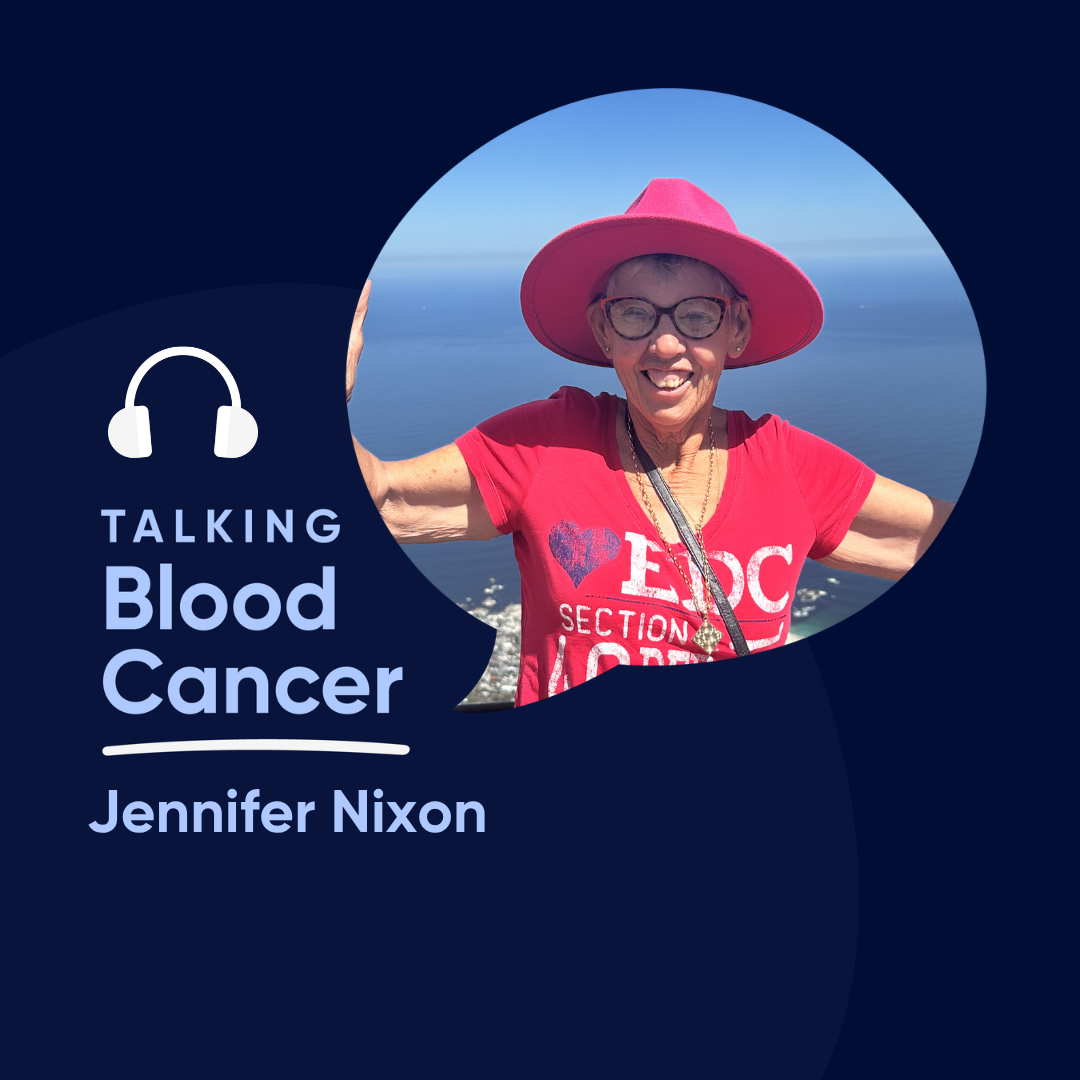
In this episode of the Talking Blood Cancer podcast, host Kate Arkadieff sits down with Jenny Nixon, who shares her experience of being diagnosed with both myelodysplasia and acute myeloid leukaemia. Jenny openly discusses the emotional and physical challenges of her journey, from the shock of her initial diagnosis on Christmas Eve to undergoing two life-saving bone marrow transplants.
Jenny talks through the early signs and the long process leading up to her first diagnosis, and how routine blood tests and a period of uncertainty led to a major change in her life. She describes the hardships of intensive treatment, including complications, extended stays in hospital far from her rural home, and the need to adapt to new routines post-treatment.
They also discuss the support networks that helped Jenny through treatment and recovery, including friends, family, and medical staff. Jenny’s story also covers the practical aspects of returning to daily life, managing fatigue, and building connections with her transplant donors. Emphasising the importance of gratitude, adaptability, and seeking support, whether practical or emotional, when living with blood cancer.
Jenny also shares insights for other patients, touching on mental and physical resilience, and the significance of community. Her advocacy for blood donation, and her efforts to assist others facing similar challenges, the role of lived experience in supporting and educating newly diagnosed patients.
[00:02:36] Intro
[00:02:36] Kate Arkadieff: Hi everyone, I’m Kate, and today I have a really special guest on the episode of Talking Blood Cancer today. And as always, we will get our guest to introduce themselves. So what I will ask is could you please tell us your name, your age, when you were diagnosed, what you’re diagnosed with, and where you are living?
[00:02:57] Jenny Nixon: Hi, my name is Jenny Nixon. I’m 67 years old, and I live in Wagga Wagga, New South Wales. On Christmas Eve, 2016, I was diagnosed with myelodysplasia, which led to me having to have my first transplant. Then in August 2022, I was diagnosed with acute myeloid leukaemia, which led to me having to have a second transplant.
[00:03:26] Kate Arkadieff: Wow. So a bit of a journey you’ve had.
[00:03:28] Jenny Nixon: A wild ride and a long journey.
[00:03:32] Kate Arkadieff: Ah, yeah. And Jenny, what was kind of happening for you around, like, obviously it was Christmas Eve, but what was happening for you in that December to make you go, ” I need to go to the doctor,” or….
[00:03:42] Jenny Nixon: Actually, my first journey started in March 2016. I had routine blood tests. I was given the form in October 2015.
[00:03:53] Kate Arkadieff: Mm-hmm.
[00:03:53] Jenny Nixon: But through various things plus the loss of my dad, I didn’t get those blood tests done until March 2016. They came back showing irregularities within my bloods, but nothing to show any sort of condition. So my blood tests were repeated approximately every two weeks. Sometimes my red cells would play up, sometimes my white cells would play up. And then finally in December that year…,
[00:04:23] Kate Arkadieff: Mm-hmm.
[00:04:23] Jenny Nixon: I was asked to go to Sydney for a bone marrow biopsy, and that’s when the myelodysplasia was diagnosed. That was early December, and I got confirmation Christmas Eve that year.
[00:04:34] Kate Arkadieff: And did you…, when they were watching your blood test over that time every two weeks, did you have an understanding of the why and what they were looking for or what they thought?
[00:04:44] Jenny Nixon: I don’t think they had any clear indication themselves until my bloods got bad enough for me to be asked to go to Sydney for the biopsy. So it was a long process of trying to figure out what could be going on, because it was going from red to white cells that were playing up, and it was just a long process to get a diagnosis.
[00:05:05] Kate Arkadieff: Yeah. And were you feeling unwell during that time?
[00:05:09] Jenny Nixon: No, maybe just a little bit tired, but apart from that, I felt fine.
[00:05:14] Kate Arkadieff: And to receive that news that, you have in fact, got something that’s quite serious, how was it to receive that news? Were you in hospital, or was it once you got to Sydney?
[00:05:23] Jenny Nixon: I was actually sitting at the pub in Wagga with a friend having lunch when I got the call. And I just knew immediately that I just had to get on with it, do what I had to do, suck it up, roll with the punches, and not feel sorry for myself. But it was nice to have the support of my friend there to…,
[00:05:40] Kate Arkadieff: Absolutely.
[00:05:42] Jenny Nixon: …, help me absorb it, yeah.
[00:05:43] Kate Arkadieff: Yeah.
[00:05:44] Jenny Nixon: Mmm.
[00:05:44] Kate Arkadieff: ‘Cause you hear that news and a lot of people say it’s almost like the world stops and everything’s kind of spinning around you, and you almost kind of lose your centre for that moment.
[00:05:52] Jenny Nixon: Yeah. When I went to Sydney two weeks prior, I had an indication that there was some sort of blood issue, but at that point I wasn’t sure what it was until I got the actual diagnosis.
[00:06:05] Kate Arkadieff: How long from that diagnosis till you had your transplant?
[00:06:09] Jenny Nixon: I had my transplant in February 2018.
[00:06:13] Kate Arkadieff: Okay, yeah. And how was it? It was an unrelated donor, was it, that you…
[00:06:18] Jenny Nixon: I had a guy from Germany by the name of Larz. He kindly donated his bone marrow to me. I was just gonna say I was lucky enough to meet him in March last year in the community rooms, yeah.
[00:06:29] Kate Arkadieff: Wow. And that just must have been an incredible experience.
[00:06:33] Jenny Nixon: I can’t explain how amazing it was.
[00:06:36] Kate Arkadieff: How did you guys get in connection?
[00:06:38] Jenny Nixon: I did it through Stem Cell Australia. After two years of your transplant, you can apply to have contact with your donor, then the donor has the right to respond, and he did. And then I was cruising from Cape Town to Canary Islands with some friends, and along the way I got a message to say him and his wife are flying over to the Canary Islands to meet me.
[00:07:03] Kate Arkadieff: What do you say to the person that donated something to an absolute stranger to save your life?
[00:07:08] Jenny Nixon: Well, interestingly, we were to meet at our accommodation, and we were walking from the ship to the bus stop to go to our accommodation and a car drove past, and the people in the car were waving. And I went to my travel buddies, “Who in the Canary Islands would know me?”, and then I just went, “Oh, my God, it’s my donor.” And they just stopped the car in the traffic and got out. I just ran up to him, hugged him, cried, and said, “You are my hero. You will never know exactly what you’ve done for me.”
[00:07:38] Kate Arkadieff: Wow. What a moment.
[00:07:39] Jenny Nixon: It was incredible. And there had been a story going around the ship about a person that had two bone marrow transplants and was meeting their donor. So there were people from the ship that were aware of the story that were standing around. So there were other passengers that got to witness the experience as well.
[00:07:59] Kate Arkadieff: You go through, I have no doubt, that when you’re having your transplant, you almost wish for those moments to think, “I wanna be travelling again, or be able to meet this person, who is it that’s donated it,” and that…, that came to fruition for you.
[00:08:14] Jenny Nixon: It did, yes. It was amazing, because my transplant was such a rough ride and a wild ride, and I nearly didn’t survive. So to get through and then have that opportunity was just incredible.
[00:08:27] Kate Arkadieff: And what was that…, you say that it was a really wild ride. What was the experience like? ‘Cause did you have chemotherapy before you went…, like a number of rounds of chemotherapy before you went in, or…?
[00:08:39] Jenny Nixon: Yep. So I stayed in Wagga and had azacitidine injections for six months. But they didn’t work. I’d stopped making red blood cells, so my haemoglobin would drop down to 41, so I would go into hospital every three weeks, have 4 to 5 bags of blood. Then I’d have one good week and one really bad week, and then I’d go back in. So I ended up with 120 blood transfusions throughout…, leading up to and throughout. Then once they realised that the azacitidine wasn’t working, it was then decided that I needed to have the transplant.
[00:09:16] Kate Arkadieff: And could that…, but where did you have to travel for that? Did you have to go down to Sydney?
[00:09:20] Jenny Nixon: Yep. I went to Sydney. I was in hospital for six months, I think it was? Five or six months. Then I lived in Sydney for five months after I had the transplant.
[00:09:33] Kate Arkadieff: And were you by yourself for all that time?
[00:09:35] Jenny Nixon: Yeah.
[00:09:35] Kate Arkadieff: That’s an incredible…
[00:09:36] Jenny Nixon: Yeah.
[00:09:36] Kate Arkadieff: You were by yourself.
[00:09:37] Jenny Nixon: Yeah.
[00:09:38] Kate Arkadieff: And what did you do? Are you someone that thrives off connection and things like that, or are you someone that can journey along by yourself?
[00:09:46] Jenny Nixon: Yep, I do love connection. And I have an incredible friend who stood by me throughout it. She would spend time at hospital with me. She came to the hospital for me to have my transplant. Then, when I was intubated in ICU, she would come. I don’t know how often she was there because obviously I was unconscious. But she has told the stories of her sitting by my bed, telling me jokes, and holding my hand, and willing me to live, and which I strongly believe she did all of that. She kept my family updated. My kids were called to say goodbye to me. I know, so it was a pretty wild ride. So I was extremely lucky to actually get through. But thanks to my amazing doctor, who had the determination and the true grit to do everything he could to save me. And I guess maybe a little bit of determination on my side as well, and I was able to get through it.
[00:10:43] Kate Arkadieff: It sounds like an incredible feat to have to overcome.
[00:10:47] Jenny Nixon: Mmm.
[00:10:47] Kate Arkadieff: And when…, was that determination something that you already had and walked with in life, or did you have to find…, discover it?
[00:10:55] Jenny Nixon: Yes, yes. Like I’ve had a lot of upheaval in my life…,
[00:11:00] Kate Arkadieff: Mm-hmm.
[00:11:00] Jenny Nixon: …, and I think that has built me to be the person I am today. It’s taught me to be strong.
[00:11:07] Kate Arkadieff: Yeah.
[00:11:07] Jenny Nixon: It’s taught me to be independent. And then, when I had to spend that time in Sydney after hospital, all my friends worked. There was really no one. My kids had little kids, so I just looked after myself.
[00:11:22] Kate Arkadieff: How did you do that? How did you do and find the energy to cook, bath yourself, get your groceries, get yourself to the hospital?
[00:11:30] Jenny Nixon: Yeah, there were some great people in the St Vincent’s Hospital accommodation that I shared with. Off I used to go to the shop with them with my walker. I mainly lived on crumbed fish and steamed vegetables that I could buy packaged. And there were some wonderful people there that would share their food with me from time to time. We had one wonderful lady that used to cook us a roast dinner every Sunday, so we would share the cost each week of…, it was someone’s turn each week to do that. I used to Uber up to the hospital because from the accommodation at St Vincent’s, you either had to walk up a steep hill one way, a steep hill another way, or go upstairs. And because I had to learn to walk again, I couldn’t manage those hills and stairs for a long time.
[00:12:23] Kate Arkadieff: Yeah.
[00:12:23] Jenny Nixon: But when I sort of started walking again, a guy from the accommodation used to come to the hospital with me. He’d walk behind me with his hands on my back, pushing me up the hill to help me get up the hill. So I had lots of good, good support.
[00:12:38] Kate Arkadieff: Sounds like you really formed a community.
[00:12:41] Jenny Nixon: Yes. And we’re all in those houses because we’re going through tough times, so everyone just supported each other.
[00:12:50] Kate Arkadieff: Mmm.
[00:12:50] Jenny Nixon: Unfortunately, I couldn’t give what they had given to me, with cooking and things like that because I was so unwell, but…, I just found a way to manage.
[00:13:01] Kate Arkadieff: And found a way to manage, yeah. I know people will hear that, and I have no doubt they’ll find it such an inspiration. And my question is, and I always like to ask is…, were there days that were really tough mentally?
[00:13:14] Jenny Nixon: Can’t remember any.
[00:13:15] Kate Arkadieff: You can’t remember any?
[00:13:17] Jenny Nixon: Nope. Nope.
[00:13:18] Kate Arkadieff: Yeah.
[00:13:19] Jenny Nixon: And I think too, because of what I’ve experienced in my life…, has taught me to be mentally tough as well as tough in other ways.
[00:13:27] Kate Arkadieff: Yeah. Because it is. It is a practice, isn’t it, that you have to stay at. And unfortunately, sometimes it is the things that, you know, are the toughest challenges that do help lead you to a stronger mindset. But it is a daily practice. You know, mental health is a really…, something that we all need to keep on top of daily so…
[00:13:43] Jenny Nixon: Yes, it was physically more challenging. Much more challenging physically than…, I don’t recall. Oh, I had one spot where I was in a rehab, that was after I left Ward 9 at St. Vincent’s, and I struggled a little bit in there, just because it wasn’t the same environment.
[00:14:05] Kate Arkadieff: Yeah.
[00:14:05] Jenny Nixon: It was cold, the showers were cold. But apart from that, I just was lucky enough to be mentally…,
[00:14:13] Kate Arkadieff: Yeah.
[00:14:13] Jenny Nixon: …, strong the whole time.
[00:14:15] Kate Arkadieff: And when you returned home, and I think that’s the challenge that our rural and remote patients do have is that…,
[00:14:22] Jenny Nixon: Mmm.
[00:14:22] Kate Arkadieff: …, they are away from all that they know when they go through treatment. And for you, returning back home to Wagga Wagga…, Wagga Wagga is where you lived at the time, wasn’t it?
[00:14:31] Jenny Nixon: Yep.
[00:14:32] Kate Arkadieff: How was that transition back? I know people desperately wanna get back home when they’re in the city, in the big smoke, but then they return, and sometimes it can be a bit jarring because you’re used to having those constant reassurance and checks, and you get familiar with that. But then you’re back in an environment where you can feel the isolation and the distance from your treatment team.
[00:14:56] Jenny Nixon: Yeah. My hardest part about leaving Sydney was leaving the people that cared for me. That was such a difficult time for me to walk away.
[00:15:07] Kate Arkadieff: Mmm.
[00:15:07] Jenny Nixon: But anyway, I came home. I had lots of support. Lots of people would call on me. Lots of people cook for me. Lots of people bought me essentials. There were times when I was too unwell to see people, but I would get care packages dropped on my front step. I was going to Sydney every two weeks for checkups, so I felt again that I had that…, that connection with those that saved my life. I just got on with it. Saw my GP here in Wagga regularly.
[00:15:38] Kate Arkadieff: Yeah. Did your GP understand what you had been through, or did you have to educate them a little about…,
[00:15:45] Jenny Nixon: Oh, no, she was kept informed of what was going on, and she will give me a call every now and then just to check in how I was.
[00:15:52] Kate Arkadieff: That’s very, very lucky to have…,
[00:15:54] Jenny Nixon: Yeah. I’m extremely lucky for the people that I have in my life, whether it be medical people or friends, family. I’m extremely lucky to have them all.
[00:16:04] Kate Arkadieff: You have indicated that you’ve had a second transplant. So once life kind of began to find its new normal post that…, your first transplant, were you working, or were you able to live almost life as it was pre- when a cancer walked into your life, or?
[00:16:20] Jenny Nixon: I’ve worked for myself for a long time. I do baking and sewing and ironing, just whatever people want done.
[00:16:28] Kate Arkadieff: Yeah.
[00:16:29] Jenny Nixon: I used to bake for a lot of cafes, so I had to cut out the cafes because I couldn’t promise that I would be able to bake and deliver on a certain day. That all became too much for me, but I was able to work around my fatigue because my fatigue was the hardest thing for me to be able to deal with.
[00:16:47] Kate Arkadieff: Yeah. And how…, was that something that you just naturally surrendered to, or?
[00:16:53] Jenny Nixon: Yep.
[00:16:53] Kate Arkadieff: You did.
[00:16:53] Jenny Nixon: Don’t fight it. I manage it. So I…, I’m a big believer if we don’t look after ourselves, we can’t expect our doctors to look after us.
[00:17:02] Kate Arkadieff: Yeah.
[00:17:03] Jenny Nixon: So I never had to learn to manage the fatigue, I just managed it.
[00:17:08] Kate Arkadieff: I really like what you said, “I don’t fight it, I manage it.”
[00:17:12] Jenny Nixon: Yeah.
[00:17:12] Kate Arkadieff: You know, it flips it, doesn’t it? You know, it…, it’ll put you…, by being able to manage and accept what you can manage, places you in a sense of control, and us humans love control.
[00:17:24] Jenny Nixon: Yeah.
[00:17:24] Kate Arkadieff: Love control, don’t we?
[00:17:25] Jenny Nixon: Yeah. Yesterday morning, I ran out of puff at 11:30, so I just went to bed. And then finally, I got out of bed two or three hours later, and then it took me until 4:00 o’clock to sort of get going again, but I didn’t push it. I just waited until I felt…
[00:17:40] Kate Arkadieff: Ready.
[00:17:41] Jenny Nixon: Capable of doing some sewing.
[00:17:43] Kate Arkadieff: And so you were nuttering away and doing what you could do.
[00:17:47] Jenny Nixon: Mmm.
[00:17:47] Kate Arkadieff: And then was there a moment…, was it just through your usual routine checks that you discovered that you had something else grumbling along, or?
[00:17:55] Jenny Nixon: No. I had seen my doctor in April, and my bloods were so good, and had been so good, he said, “Come back and see me in October. Instead of four-monthly, we’ll do six-monthly appointments.”
[00:18:10] Kate Arkadieff: Yeah.
[00:18:10] Jenny Nixon: And I said, “You beauty, I’ll see you after I go to Africa.” And he said, “You can’t have yellow fever vaccination. You need to come and see me before you go, so come and see me in August.” And you always have blood tests the week before you see your haematologist.
[00:18:26] Kate Arkadieff: Mmm.
[00:18:27] Jenny Nixon: So I went to see him to get my letter to say I couldn’t have yellow fever, and he said, “You’re not going to Africa. You’ve got acute myeloid leukaemia.”
[00:18:34] Kate Arkadieff: Oh my God.
[00:18:35] Jenny Nixon: That was three weeks out.
[00:18:39] Kate Arkadieff: Ooh.
[00:18:40] Jenny Nixon: Yeah
[00:18:40] Kate Arkadieff: I know you…, you’ve got a resilient mindset, but how did that shift and that smack of information…
[00:18:45] Jenny Nixon: I hope this isn’t the wrong thing to say. I just said, “Shit happens. I can’t change it.”
[00:18:50] Kate Arkadieff: No.
[00:18:51] Jenny Nixon: I was just grateful that I didn’t get to Africa and get sick over there.
[00:18:55] Kate Arkadieff: Absolutely. Imagine that.
[00:18:56] Jenny Nixon: And had I waited that extra two months with acute myeloid leukaemia, that would’ve had another two months hold on me.
[00:19:04] Kate Arkadieff: You might not have been here, Jenny.
[00:19:06] Jenny Nixon: I know. So, I’m just extremely grateful.
[00:19:09] Kate Arkadieff: And blessed, yeah.
[00:19:11] Jenny Nixon: Even though I got diagnosed the way I did, and so close to Africa, I’m grateful that I got the opportunity to, I guess, not go to Africa and get my diagnosis.
[00:19:22] Kate Arkadieff: And did you instantly have to start treatment or…?
[00:19:26] Jenny Nixon: Yeah.
[00:19:27] Kate Arkadieff: Back to Sydney or…?
[00:19:28] Jenny Nixon: Yeah, I got my diagnosis, confirmation on the 26th of August, and I was in hospital on the 30th of August.
[00:19:38] Kate Arkadieff: In Wagga Wagga or in Sydney?
[00:19:39] Jenny Nixon: No, in Sydney. So I had five days to cancel all my baking jobs, find house sitters, make sure my dog was cared for because she got diagnosed with cancer the same week I did.
[00:19:50] Kate Arkadieff: No, she didn’t.
[00:19:52] Jenny Nixon: Both times.
[00:19:53] Kate Arkadieff: No. Are you kidding?
[00:19:54] Jenny Nixon: No, I’m serious.
[00:19:56] Kate Arkadieff: Oh my God, so your dog got diagnosed at the exact same time, both times?
[00:20:01] Jenny Nixon: Both times, yeah. So I had to sort of put things into place if something happened to her. So I had five days to get my life sorted and get to Sydney.
[00:20:11] Kate Arkadieff: And how did you feel going in? Did you not feel like you kinda knew what to expect, or were you like, “This is a whole different ball game”?
[00:20:19] Jenny Nixon: I was scared because of what happened the first time. I was so close to death. I knew what could happen. But I couldn’t wait to get back to Ward 9 and see everyone. That ward is like my mother’s womb. I’m cared for, I’m loved, I’m respected, and taken good care of, and I felt safe. So I was…, I was happy to go back. Yeah.
[00:20:40] Kate Arkadieff: Yeah, and it just sounds like too…, not only were you safe and that, and, and you felt loved and cared for, but you trusted.
[00:20:47] Jenny Nixon: Oh, I trusted. Yeah. The first night I was in, a nurse came at 2:00 in the morning to do my obs, and she looked over the bed at my face and said, “Jennifer Nixon, is that really you?” And I said, “Yes, this is really me.” She had been part of my first transplant team. So there was familiar faces.
[00:21:08] Kate Arkadieff: Yeah.
[00:21:08] Jenny Nixon: I had to change doctors because my doctor had stepped back from doing transplants.
[00:21:13] Kate Arkadieff: Mm-hmm.
[00:21:14] Jenny Nixon: Still a haematologist at St Vincent’s, but had stepped back from the actual transplant.
[00:21:19] Kate Arkadieff: Yeah. And did that mean that at that point, did you already know that transplant was on the cards for you? Or did you think, “Oh, I’ve already had one. Can I have another one?”
[00:21:28] Jenny Nixon: Oh, no, I knew that was going to be the case. So, I had 10 months in the hospital pre-transplant…,
[00:21:37] Kate Arkadieff: Mm-hmm.
[00:21:38] Jenny Nixon: …, with a couple of times of being able to get home for a few days. First three rounds of chemo, I got six infections each time. So it was a bit of a rough ride. I used to get the rigors, and I’d lay in my bed and shake, and all sorts of crazy things, yeah.
[00:21:54] Kate Arkadieff: You don’t do anything in halves.
[00:21:56] Jenny Nixon: Nope. I certainly don’t. If you’re gonna do something, you gotta do a good job.
[00:22:00] Kate Arkadieff: Yeah. Yeah, you can take it to that extent. And it…, was it almost like…, were you able to learn? Like you said, you kinda knew you had six, and you’d get the rigors, and were you then just able to mentally prepare yourself in those rhythms to go, “Okay, well I’ve had my chemotherapy. Next week everything’s gonna be in my boot, so I’m not gonna feel great.” Was there a pattern of that?
[00:22:21] Jenny Nixon: Yeah, but I knew what to expect. Well, I say I knew what to expect, but I didn’t have any expectations, as in, I was gonna bounce back, and I was gonna be fine, and I was gonna get out of hospital for awhile. I just knew that things could get a bit rough.
[00:22:34] Kate Arkadieff: And then strapping yourself up for a second transplant. No doubt, it was an unrelated donor again.
[00:22:42] Jenny Nixon: Yes. And that donor had to match my first donor, not me.
[00:22:46] Kate Arkadieff: Oh, really?
[00:22:47] Jenny Nixon: Yes, because I had Larz’s DNA, so Bernhard had to match.
[00:22:54] Kate Arkadieff: Wow. And so how was the second?
[00:22:57] Jenny Nixon: It was a piece of cake.
[00:22:58] Kate Arkadieff: It was a piece of cake.
[00:23:00] Jenny Nixon: It was easy.
[00:23:01] Kate Arkadieff: And what do you think was different? Just it was?
[00:23:05] Jenny Nixon: It was easy. I didn’t get the infections, ’cause the first time when I was so sick, I got a blood infection, a bowel infection, severe pneumonia, and kidney failure. That was all in one hit. And this time I got, I think a…, a slight blood infection, but apart from that, it was pretty smooth sailing.
[00:23:23] Kate Arkadieff: Yeah. What’s so interesting, and what I’d really love to highlight to our listeners is that it’s…, it goes to show that Jenny Nixon is one person, and you’ve had two transplants, but two totally different experiences.
[00:23:35] Jenny Nixon: Yes.
[00:23:36] Kate Arkadieff: And did you do anything different? Did you present…
[00:23:39] Jenny Nixon: No
[00:23:39] Kate Arkadieff: No
[00:23:40] Jenny Nixon: I was just lucky the second time around. So now we have Jenny Nixon version 3.0.
[00:23:47] Kate Arkadieff: 3.0.
[00:23:52] Jenny Nixon: Yeah.
[00:23:53] Kate Arkadieff: And how does, you know, you say it was a piece of cake compared to the first one. So you know, I…, I’ve heard you said you were gonna go travel to Africa, but… So how have you, I never wanna say moved on or, you know, move…, let’s say move forward, if that’s the word you’re comfortable with. But moving forward from a diagnosis and transplants, how do you rebuild? ‘Cause it is almost like rebuilding yourself after you’ve been through something like this.
[00:24:12] Jenny Nixon: Well, it is, yeah. I just appreciate every day I wake up.
[00:24:17] Kate Arkadieff: Mmm.
[00:24:17] Jenny Nixon: I make the most of each day.
[00:24:19] Kate Arkadieff: Mm-hmm.
[00:24:19] Jenny Nixon: I think of my donors every day. I’m grateful to them every day, and I just look after myself so I have the opportunity to be able to travel and do the things that…, that I wish to do.
[00:24:32] Kate Arkadieff: Yeah.
[00:24:33] Jenny Nixon: If someone mentions coffee or lunch, I’m there.
[00:24:35] Kate Arkadieff: Yeah.
[00:24:36] Jenny Nixon: If someone mentions flying somewhere, I’m there.
[00:24:39] Kate Arkadieff: Yeah, I love that. It sounds like also…, would I be right in saying your daily practice is almost gratitude?
[00:24:46] Jenny Nixon: Oh, it is. Yeah.
[00:24:47] Kate Arkadieff: Mmm.
[00:24:47] Jenny Nixon: Yeah. And another interesting thing about this transplant is my blood group has changed from O positive to O negative.
[00:24:55] Kate Arkadieff: Yeah.
[00:24:56] Jenny Nixon: Yeah.
[00:24:57] Kate Arkadieff: It’s an incredible thing, isn’t it?
[00:24:58] Jenny Nixon: Yeah. I just realised how precious life is.
[00:25:02] Kate Arkadieff: Yeah.
[00:25:03] Jenny Nixon: I realised how important donating blood is. I was a blood donor. I gave 104 donations. I’ve now had 160 transfusions.
[00:25:12] Kate Arkadieff: Wow.
[00:25:13] Jenny Nixon: So I now get the importance of donating that blood.
[00:25:18] Kate Arkadieff: Yes, and it’s that simple act, isn’t it? That simple act of kindness for somebody that you don’t even know.
[00:25:25] Jenny Nixon: That’s exactly right. Yep. And I knew what I was doing when I was donating blood was important, but I now realise how important it is. When I stopped making red blood cells, if I didn’t have other people’s blood, I wouldn’t have made a transplant.
[00:25:42] Kate Arkadieff: Yeah. And it’s incredible, and it’s…, it’s that selfless act that people do and, you know, you had people from around the world.
[00:25:50] Jenny Nixon: Mmm.
[00:25:51] Kate Arkadieff: Have you been able to meet your second donor yet or connect?
[00:25:54] Jenny Nixon: I’ve had contact with him on WhatsApp.
[00:25:56] Kate Arkadieff: Oh, really?
[00:25:57] Jenny Nixon: So we do chat from time to time. You know, it was my eighth anniversary of my first transplant last weekend. So I always send them photos of me celebrating, and thank them. I probably drive them mad, how much I thank them, but then I know they don’t really get the gist of…, it’s just like, “Oh, it’s nothing.” It’s like, it’s not nothing.
[00:26:18] Kate Arkadieff: Because if they didn’t, you wouldn’t be here.
[00:26:21] Jenny Nixon: No. So I actually joined the bone marrow register when I was 18, and I got called up two months after my first diagnosis.
[00:26:29] Kate Arkadieff: Oh, wow.
[00:26:31] Jenny Nixon: Yep, and that also scared me because there was a person in front of me who needed what I needed.
[00:26:38] Kate Arkadieff: Yeah. How did you deal with that?
[00:26:40] Jenny Nixon: That was actually probably one of the most difficult things to deal with. That I couldn’t help that person, and that person was ahead of me, so that meant…, was I gonna be given the opportunity? It was…, it was a bit mind-blowing.
[00:26:55] Kate Arkadieff: And you…, ’cause you truly understood what was on the line for that person.
[00:26:59] Jenny Nixon: Yeah.
[00:27:00] Kate Arkadieff: Wow, it’s funny how life and fate works, isn’t it?
[00:27:03] Jenny Nixon: Yeah.
[00:27:04] Kate Arkadieff: And so you’ve mentioned that you traveled, and I know that a number of the questions that do get asked to the foundation is, “How do I travel after having a blood cancer?” Was travel always something you did before, or?
[00:27:18] Jenny Nixon: Yeah, I did a fair bit of traveling beforehand. And, as my current haematologist said, “We don’t give you transplants for nothing. We can’t wrap you in cotton wool.” Said, “Just go and enjoy your life and travel.”
[00:27:33] Kate Arkadieff: And you do.
[00:27:35] Jenny Nixon: Yes, when I went to Africa…, I was in Africa 12 months ago.
[00:27:38] Kate Arkadieff: So you did get to Africa.
[00:27:40] Jenny Nixon: I did get to Africa. The people that…, they continued on when I got diagnosed, and then they took me back.
[00:27:48] Kate Arkadieff: Oh, what a beautiful group.
[00:27:49] Jenny Nixon: I know. Not to do exactly the same thing, but to do the cruise. And they were fabulous. I made sure I took all my paperwork so that if something happened, everyone knew what my life was about, what care I needed.
[00:28:04] Kate Arkadieff: That’s some really good tips. Is that what you do to prepare? Is there kind of a process that you do too, to prepare before you go?
[00:28:11] Jenny Nixon: Yeah, I’ll just make sure that…, like my friend that looked after me through, through transplants, and my kids have copies of my itineraries. And I kept in touch, saying, “I’m okay.” And as I said, I took all my paperwork with me. I did a list of phone numbers of my haematologist, my GP, so that my travel buddies could, in fact, touch base back home if…, if anything was needed. Of course, insurance. My friend and I both did our insurance. One of my friends, I travelled with two young guys, and one’s mum, and myself, and my friend Kerry and I both went through the same travel company, but booked individually. And when we compared our travel insurance, mine was $1,100 dearer than hers. Anyway, we both rang back to make sure everything was okay, but mine was because that big C word.
[00:29:07] Kate Arkadieff: Yeah.
[00:29:08] Jenny Nixon: Even though I had no insurance, and I couldn’t buy insurance to cover me for that, it was because I’d had the cancer that I was stung an extra $1,100. So I found it interesting. And we were on a cruise ship, I didn’t get sick, but we were on a small cruise ship. I did get double pneumonia when I came home, so I spent a week in isolation in Wagga Base. Because I’d been to Africa, they had to…
[00:29:34] Kate Arkadieff: Do that.
[00:29:34] Jenny Nixon: Isolate me. Yeah, but it doesn’t worry me. I’d do it all over again.
[00:29:40] Kate Arkadieff: And it’s…, what it sounds like, Jenny, is that you just live it to the fullest now.
[00:29:45] Jenny Nixon: I do, yep.
[00:29:46] Kate Arkadieff: Yeah. That it’s an active choice to present yourself every day and to really grab every opportunity.
[00:29:53] Jenny Nixon: Well, these two donors have given me this life. I need to appreciate them and, make the most of what I’ve been given.
[00:30:01] Kate Arkadieff: Yeah. And you went through a heck of a lot, especially that first time around, and that’s what you fought…, the life that…, you can tell me if I’m wrong, but the life that you’re living today is the life that you fought so hard for…,
[00:30:13] Jenny Nixon: Yeah.
[00:30:13] Kate Arkadieff: Since Larz has walked into your life.
[00:30:15] Jenny Nixon: And who knows what the future holds? I’m not gonna wait for tomorrow in case.
[00:30:20] Kate Arkadieff: Mmm. Yeah. And that’s it, right? Where the one thing is time is borrowed, it’s never promised.
[00:30:26] Jenny Nixon: Mmm. No. I’ve learnt that the hard way.
[00:30:29] Kate Arkadieff: You know, in every episode we ask our guests to share something with the listeners. Some golden nuggets or some words of wisdom. Can I ask you, do you have anything that you would say to someone who’s either gearing up for transplant, just come out of transplant, or just diagnosed?
[00:30:47] Jenny Nixon: Try to have a positive mindset, because positivity drives us down the right highway in the journey of life.
[00:30:54] Kate Arkadieff: It does.
[00:30:56] Jenny Nixon: To those that are supporting…, or friends, please don’t ever say, “You’ve got this,” because how do we know? We don’t know. Instead, always say, “I’m always here for you.”
[00:31:08] Kate Arkadieff: Mm, yes.
[00:31:09] Jenny Nixon: Yeah. And never be afraid to ask for help. Never be afraid to accept help, because those that offer…, because they want to.
[00:31:18] Kate Arkadieff: Yeah, the genuine desire to help. Because it’s so true. We can’t do this alone. This isn’t a journey that can be done alone. You know, think of the team that it took for you to receive the treatment and to be where you are today. It’s people from all over the world that helped you get where you are.
[00:31:35] Jenny Nixon: I will say we have two sorts of people in our lives when it comes to serious illness. We have those that give us courage and strength, and we have those that give us determination.
[00:31:47] Kate Arkadieff: Yeah. I think you’re someone that gives us determination.
[00:31:50] Jenny Nixon: Oh. Yeah, without the friends that helped me and supported me, and my family, I wouldn’t have got through. I know I wouldn’t have.
[00:31:59] Kate Arkadieff: Yeah.
[00:32:00] Jenny Nixon: How do you repay your donor? How do you repay your doctors, your friends? You can’t. You just need to be grateful.
[00:32:08] Kate Arkadieff: Yeah. And live, you know, be grateful, but live every day that you fought.
[00:32:12] Jenny Nixon: I might spend some days all day on the lounge, but you know what? Those hard times, they remind me of how many good times I have, so I’m always grateful for the tough days.
[00:32:23] Kate Arkadieff: Yeah. And as you said, you know, those are the days that you’ve surrendered to, you’ve listened, you haven’t fought against, and it’s okay. You don’t always have to be, I think, running 1,000 miles an hour or, you know, travelling the world, but it’s just living to what you can and to adapt as you can. You know, you said before that you used to love baking and sewing and all of that, but baking isn’t something that you can do now, so you’ve adapted.
[00:32:47] Jenny Nixon: Well, I do a little bit of baking. I’ve just really cut back on what I do. Yeah.
[00:32:52] Kate Arkadieff: So again, yeah, scaling back and adapting to what you can in this moment.
[00:32:56] Jenny Nixon: Yeah. Late last year, I was sick for two or three months. I got shingles, which got infected, and then I got a respiratory infection.
[00:33:04] Kate Arkadieff: Yeah.
[00:33:04] Jenny Nixon: And I felt sorry for myself going through those. I know I did. But after I felt better, I went, “It’s okay to get that because it reminds you of the good times.”
[00:33:13] Kate Arkadieff: Yeah And that unfortunately is gonna happen. You are more susceptible to illnesses and all those odd little bugs that float around.
[00:33:22] Jenny Nixon: Yeah. And it was mainly because I went off my antivirals, which is the right thing to do two years out from a transplant. But obviously my immune system isn’t good enough. Since I’ve been back on them, I’m fine again.
[00:33:33] Kate Arkadieff: Yeah. Jenny, I can’t thank you enough. You’ve given us some really beautiful advice, and it’s refreshing to hear that you can absolutely go through, you know, really hard and triumphant times, but to be able to come out…, I don’t wanna say the other side, but, you know, on the other track of it and still being…, enjoying life and embracing it.
[00:33:55] Jenny Nixon: Yeah. And these things make us the person we become, and it teaches us about kindness. It teaches us how important life is.
[00:34:04] Kate Arkadieff: Yeah.
[00:34:04] Jenny Nixon: There’s many lessons to be learnt, going through a situation like I have.
[00:34:08] Kate Arkadieff: Wow. And I think still learning. Everybody’s still learning, isn’t it?
[00:34:12] Jenny Nixon: Oh, of course. So I do what I can now to help other people. You know, I went up to Sydney my first time blinded. Didn’t know what I was in for, didn’t know about accommodation, didn’t know any of those sorts of things. So now, if I can help someone learn about those things, it takes a weight off their shoulders. So I’ve sort of become a bit of an advocate.
[00:34:36] Kate Arkadieff: Yeah.
[00:34:37] Jenny Nixon: You know, tell them about my favourite restaurants in Darlinghurst, which is where the hospital is, and where’s the best economical places to eat.
[00:34:45] Kate Arkadieff: Yeah.
[00:34:46] Jenny Nixon: And where the supermarkets are. And it just makes it easier for the next person
[00:34:51] Kate Arkadieff: It does. It really does. And as you say, it’s that when you are so removed from your hometown and having to travel in, it’s the things that you just don’t even think of that make…, just that step even a bit harder. As you say, it’s finding where’s your local Woolies or your Coles or stuff like that, that people who already…, their heads are spinning, recenter themselves in a time of chaos.
[00:35:17] Jenny Nixon: Yeah, I had one particular lady call me, before she went up, and she was just beside herself. She didn’t know about the accommodation. She knew nothing of what was laying ahead of her. Of course, I couldn’t medically advise her, but I could tell her about the accommodation and give her the names of people that can support her in Sydney, and how good the hospital was, and when she got off the phone she said, “I can do this now.”
[00:35:43] Kate Arkadieff: Yeah.
[00:35:43] Jenny Nixon: Yeah. To pass on advice, I think, is a really important thing to do.
[00:35:47] Kate Arkadieff: It so is. You know, I remember having a conversation with somebody once, and they were coming down to Brisbane, and they lived way out west in Queensland. And they were so overwhelmed at the thought that all their little town had was a roundabout, and then they were coming to the big smoke and having to travel into a place where there’s traffic lights and things like that, where, for us city folks, we don’t even think of that. We don’t even think of the impact of what it is like having to travel in for treatment and to have people like you that are helping just relieve that little bit of stress to go, “Hey, I’ve been there. I’ve done it. I know what it feels like, and these are my tips.”
[00:36:27] Jenny Nixon: Yeah. That’s exactly right. Can I just say, too, another thing I do on every anniversary is I thank the blood donors at Lifeblood Wagga. I bake blood drop biscuits.
[00:36:39] Kate Arkadieff: Do you?
[00:36:40] Jenny Nixon: And ice them with red fondant and just stamp on them, “Legend,” “Hero,” “Thank you.” And then I write a little poem to put with the biscuits so people know what the biscuits are about. So because once again, without them, I…, I wouldn’t be here today.
[00:37:01] Kate Arkadieff: That’s a beautiful gift. You keep giving after you’ve received, and there’s a lesson in that, isn’t it?
[00:37:07] Jenny Nixon: Yeah, and it just hopefully encourages people to continue on their journey because sadly I can’t. As much as it frustrates me.
[00:37:14] Kate Arkadieff: Yeah. Well, that’s incredible outlook, and I thank you for sharing your time and your story with us here today. I know so many listeners are just going to enjoy the conversation. So thank you so much.
[00:37:27] Jenny Nixon: And thank you to you and the Leukaemia Foundation. I appreciate everything that they’ve done for me.
[00:37:33] Kate Arkadieff: Aww, it’s our pleasure.
[00:37:35] Outro[00:00:00] Introduction