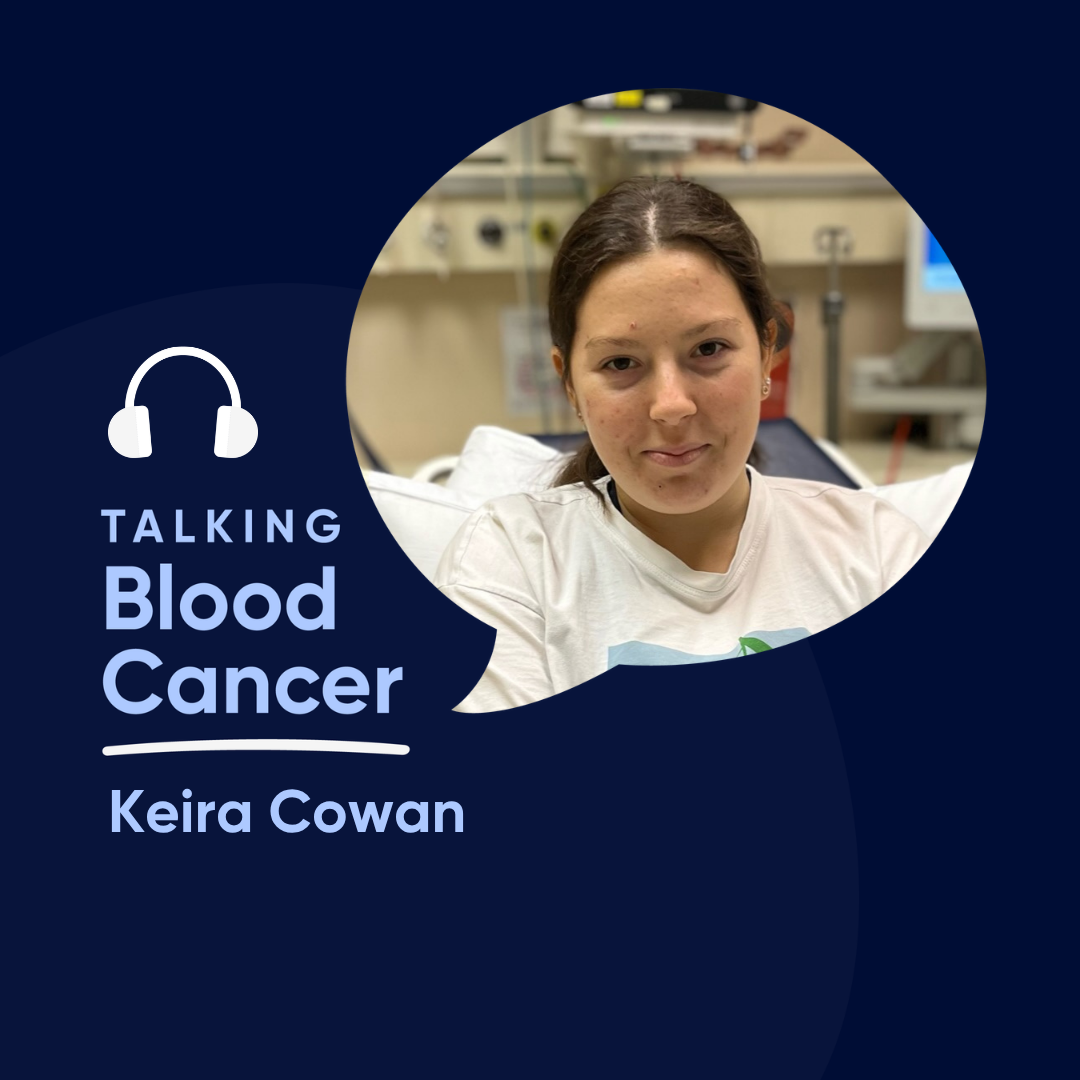
In this episode of the Talking Blood Cancer podcast, host Kate Arkadieff sits down with Keira Cowan to discuss her lived experience with severe aplastic anaemia. Diagnosed at age 15, just before her 16th birthday, Keira Cowan shares her journey from the first signs of illness through her diagnosis and the subsequent impact on her education, friendships, and mental wellbeing.
Describing how her symptoms were first noticed by her family and friends, leading to a sequence of medical appointments and hospital admission. She recalls the shock and uncertainty of hearing her diagnosis and the anxiety that followed during her initial hospitalisation and treatment.
They explore the challenges of managing a blood disorder as a young person. Discussing the realities of missing school, maintaining friendships during long periods at home, and the role of a reliable support system. Keira speaks candidly about feeling isolated at times and the strategies, such as getting a pet and maintaining regular communication with close friends, that helped her cope emotionally.
Highlighting the importance of supportive healthcare services, such as hospital schools and flexible academic arrangements. Keira Cowan discusses the transition from paediatric to adult care, her ongoing health monitoring, and her determination to pursue a career in healthcare inspired by her own journey. She offers honest advice to others facing a diagnosis, emphasising the value of leaning on support networks and acknowledging that it is okay not to be okay.
[00:00:00] Intro
[00:02:36] Kate: Hi there, I’m Kate Arkadieff, and I’m the host of Leukaemia Foundation’s podcast, Talking Blood Cancer. Today, I have a really special guest, and I’m so excited to sit down and spend time with and to have our listeners hear her remarkable story. So as always, I will ask our kind guest to introduce their name, their age, what they were diagnosed with, and then who is in their support network, and where they are living in Australia. So I’ll hand over to you
[00:03:04] Keira: My name’s Keira Cowan. I am currently 18. I was diagnosed with severe aplastic anaemia when I was 15, a week away from turning 16. I’m living in Adelaide, South Australia, and currently my main support network is my mum, my sister, and my best friend.
[00:03:27] Kate: Aw. And so 15, almost 16. I just think you’re at high school. Were you at high school…,
[00:03:36] Keira: Yeah.
[00:03:36] Kate: …, at that time? And what was kind of prompting you to go, ‘I think it’s time I need to go to the doctor’?
[00:03:43] Keira: Well, it wasn’t actually me who booked the doctors appointment, it was my mum. And I was doing a placement for my VET (vocational education and training) course at the time. It was in a ELC (early learning centre) centre at my school. And it was two weeks, and I was at the second to last day, and I was just really tired, really pale. I’d been getting lots of comments about it. I actually went home and, like, put fake tan on…,
[00:04:12] Kate: Yeah.
[00:04:13] Keira: …, to be like, oh, like, need to, like, not look pale and stuff. Like, there was no thought of that was something to do with my health at all. And then I was at my sister’s netball game on the Saturday, and my mum just turned around and looked at me, and I think it was ’cause everyone else was there and she, like, had people to compare me to. She’s like, “You just look so pale, like…,”
[00:04:32] Kate: Oh, Keira.
[00:04:33] Keira: “…, kind of ghostly.” And so she booked a doctors appointment, and my last day of placement was on the Monday, and I, like, insisted on going and finishing. And the whole day I had this headache, and I was just beyond tired. And I was very nauseous. But in my mind, because I was working in an ELC, I just thought I’d caught something from one of the kids.
[00:04:55] Kate: Can I ask, is ELC early childhood education?
[00:04:59] Keira: Yes.
[00:04:59] Kate: Yep.
[00:05:00] Keira: So they were four-five year olds, yeah.
[00:05:02] Kate: Yeah, so it all makes sense. All dots are easily drawn, yeah.
[00:05:06] Keira: Yeah, and so the doctors appointment was booked for the day after that, but that day when I got home, I was lying on the couch and I had this really bad headache and I couldn’t move.
[00:05:17] Kate: Mm-hmm.
[00:05:17] Keira: And later we found out that was because my haemoglobin was really low, and so there wasn’t enough oxygen going around.
[00:05:25] Kate: So you said you had that doctor’s appointment booked for the Tuesday.
[00:05:30] Keira: Yeah.
[00:05:30] Kate: And so I, I envision being 15 that your mum took you to that appointment. Did she?
[00:05:36] Keira: Yeah. So we basically went to the appointment in the morning, and he looked at me and he was like, “You look very anaemic.” And so he was like, “Worst case scenario, if your iron is low, we can do an iron transfusion at the clinic, and that should boost it back up.” And so I went and got bloods done, and he also booked me for an ultrasound to see if it was something to do with, ’cause I have really heavy periods, and so to see if that was something that was contributing to my anaemia. So I was booked in for an ultrasound appointment that day, and so mum had work, and she came home from work early, and I thought it was just to be like prompt and on time for this ultrasound appointment. And we were driving in the car, and I was like, “This isn’t the way to the ultrasound appointment.”
[00:06:25] Kate: Mmm.
[00:06:25] Keira: And basically I was like, “Where are we going?” And she said, “Well, the doctor’s clinic has called me and asked me to bring you back in.” And immediately it was like alarm bells because I have a really busy GP. Obviously all GP’s are busy…,
[00:06:42] Kate: Yeah.
[00:06:42] Keira: And especially for blood results you don’t really like go back in person on the day unless something’s wrong. And so we went back in. We were kind of waiting around for five minutes before he came out. There were heaps of people like in the waiting room, and he just kind of like came out and he was like, “Come on in.” And we both stood up, and he was like, “No, just Mum.”
[00:07:07] Kate: Oh.
[00:07:07] Keira: And so I was like, “Oh.” And so Mum went in, and I was kind of left sitting out there.
[00:07:13] Kate: How did you feel when you knew it was about you?
[00:07:17] Keira: Yeah, it was very kind of shocking because it was just obviously nothing like that had ever happened before. And you hear…, it just kind of felt like a movie scene where it was like, “This is not really real.” And it was just like…, I was literally, like, out of placement two weeks ago. Like, th-
[00:07:37] Kate: Mmm.
[00:07:37] Keira: It can’t be that serious. Like, I’m still up and moving…,
[00:07:38] Kate: Yeah.
[00:07:38] Keira: Like…., and so a nurse came and grabbed me and brought me to, like, a private room out back. And she, um, said, ’cause she obviously could tell I was quite, like, stressed…,
[00:07:52] Kate: Yeah.
[00:07:52] Keira: And she said, “You can, like, go on the computer, but just, like, don’t tell anyone,” ’cause you’re like, “I’m not meant to let you.” And that was obviously very kind of her, but the only thought I had was like…, and this might sound quite abrupt but, “Am I dying?” Because it was just, you know, she’s being so nice, and I’d met this nurse before. She’s, like, quite a strict kind of go-by-the-rules type person, so I was just like, “Why is she breaking rules for me? Like, this must be serious.”
[00:08:20] Kate: Mmm.
[00:08:20] Keira: And so I was sitting in the room, I reckon I was there for another 10, 15 minutes, and my mum and the doctor came in and took a seat. And Mum had been crying, I could tell, and the doctor just sat down, and he looked at me, and he was like, “You’re very sick. You need to go to the emergency room. We can’t call an ambulance, it will take too long. And you need to try and be strong for Mum.” And so what I didn’t know at that time, my brain was like, “Be strong for Mum? What do you mean?” Like…,
[00:08:52] Kate: It’s about me.
[00:08:53] Keira: I’m the one who’s sick.
[00:08:54] Kate: Yeah, that’s a very interesting choice of the way that he’s handled it, the words that he’s now used. That’s a really…, yeah
[00:09:01] Keira: Yeah, but what I didn’t know in there, and it makes sense to me now why he used this wording, was mum basically went in there and before he, like, had the chance to tell her anything, she asked her, “Is she dying?” And he said to her, “She’s very sick. I don’t know.”
[00:09:19] Kate: Oh, that’s so heavy.
[00:09:20] Keira: So there was no one mum could call at the time to drive us to the hospital, so mum then had to drive me to the emergency room. And I’m in the car going like, “What’s going on?” And she’s like, “It’s, it’s fine. Like, let’s just get there and…” Yeah. And so it was, it was very quick paced after that. But yeah, it was that GP office’s. And he was my regular GP as well, and so I still see him and stuff. I love him. He’s an amazing doctor, very thorough. I have a really good relationship with him, especially after all my treatment and stuff. He’s been kept in the loop. But yeah, that GP office part of my diagnosis was quite traumatic.
[00:10:02] Kate: And I can see why. I mean, you know, although you were 15, your body, and I, I really do believe it doesn’t matter how old you are, your body’s in tuned enough and can read energy to know something is really off and isn’t right, and you can feel it all through your cells, and you were obviously experiencing that, and then to be told you need to be strong for your mum and not quite understanding exactly why, I can see how that would’ve been really confusing…,
[00:10:35] Keira: Mmm.
[00:10:35] Kate: …, which could turn into being really scary.
[00:10:37] Keira: Yeah, definitely.
[00:10:39] Kate: When you got to hospital, and I imagine that drive, although I, I’m unsure as to how long it actually was, would’ve felt like an eternity, what was your experience then? When were you told that…, what was going on with your body?
[00:10:52] Keira: So I wasn’t told until probably an hour after we got into the emergency room. And I have other chronic illnesses that lead me to kind of, not break bones, but have injuries and stuff. So I have experience with the emergency department, and obviously it’s not a quick in and, like, get seen situation. You’re waiting a long time because they’re in such high demand. And so to be kind of whisked through immediately was a very strange experience. I sat down on the bed, two nurses came and talked to me, and then immediately I had a cannula placed, and they had hooked me up to a platelet and blood transfusion.
[00:11:36] Kate: Instantly, wow.
[00:11:38] Keira: Yeah, which was so foreign to me at the time. I was like, “What is this? This is so strange.” And to me, I was like, “Oh, maybe it’s just a quick fix,” like thinking…,
[00:11:48] Kate: Mm-hmm.
[00:11:48] Keira: “Oh, like medicine or something, like, I can just be out.” And so I asked Mum, I was like, “Do you reckon we can go home after this?” And she was like, “No, I, I don’t think so.” And so a doctor came and spoke to us to get more information from us, and then went away. And then an hour later, a different doctor came, and she said, ” We need to let you know what the worst case scenario could be from your blood results that were taken”. ‘Cause they did a repeat in the hospital as well. But my initial blood results, in the GP office, were… I think my haemoglobin was at 60…,
[00:12:29] Kate: Mm-hmm.
[00:12:29] Keira: And it’s meant to be from, I think, 115 to, like, above that. So quite low. And then that kind of was reflected in all the other blood values. So they said, looking at my blood results, it looks like you either have leukaemia or severe aplastic anaemia. And then they said, “We need to do a bone marrow biopsy and, to confirm the diagnosis.”
[00:12:55] Kate: And had you heard any of those words before as a 15-year-old?
[00:13:00] Keira: Leukaemia, yes, because I had actually…, I was reading a book where the main character had leukaemia, and so my thought was, “Have I just jinxed myself?” Like, that was my little innocent brain.
[00:13:14] Kate: Yeah.
[00:13:14] Keira: So yeah, it was very confronting, shocking, and obviously hardly anybody knows what severe aplastic anaemia is, so I definitely didn’t know what that was. And so I was kind of thinking, “Oh, I hope it’s that. I hope it’s not leukaemia,” you know? And so, now I can go, “Well, you don’t want either of them.” But back then I was going, “I just hope it’s not leukaemia.” So, yeah.
[00:13:37] Kate: Yeah, ‘cause that’s what you knew, and you more so understood what it was all about.
[00:13:41] Keira: Yeah.
[00:13:42] Kate: And so I wanna ask, did you go to the children’s hospital at that point? You were in the children’s hospital care there?
[00:13:50] Keira: Yeah, Women’s and Children’s.
[00:13:51] Kate: Yeah. So I guess I’d love to ask that, you know, moving, once you got that diagnosis, and I guess having had that bone marrow aspirate, it would’ve given a, a clearer picture as to what medically was going on. Did they then jump straight into, once they got the results back, you need treatment and everything like that? Is that kinda how it quickly unfolded for you?
[00:14:12] Keira: Yeah. So from the time I… So from the Tuesday, I was admitted into hospital ’cause the two transfusions weren’t enough. They needed more.
[00:14:24] Kate: Mmm.
[00:14:35] Keira: Anyways while they were kind of figuring out diagnosis, I wasn’t stable enough to go home. And then two days after that, so a day after my bone marrow biopsy, one of the consultants from the haematology and oncology department came down and confirmed my diagnosis.
[00:14:45] Kate: Mm-hmm.
[00:14:45] Keira: And then I got moved up to Michael Rice, which is the haematology and oncology department in the Women’s and Children’s Hospital. And was put in the room they use for radiation treatment. And so it had a metal toilet, and the room was very kind of clinical. It wasn’t like a normal kind of ward room. And so that was really confronting. And then we had my consultant who managed my care throughout treatment, and then a nurse consultant come and discuss my diagnosis and then also, like, straight away discuss treatment options. And then I think a day after that I went home. So within four days I had been diagnosed, discussed treatment, and then kind of figured out sort of a plan of action.
[00:15:41] Kate: Yup. Now, as of 15 year old… Well, at this point it would’ve been closer to your birthday, right? Is that…,?
[00:15:48] Keira: Yeah.
[00:15:48] Kate: Right? Yeah.
[00:15:49] Keira: Yeah.
[00:15:50] Kate: So I wanna ask, how was your head and your mental health coping at this point? Because I know adults struggle to hear that news and far… such fast concession and, and the plan, it just, you’re on the rollercoaster before you even ask to get, be on it. How were you coping in all of that timeframe?
[00:16:09] Keira: I think really, and I think my mum would agree with how she was feeling as well, it was just such a state of like shock and denial. Like, it hadn’t actually hit yet. I was just kind of like going through the motions.
[00:16:23] Kate: Mmm.
[00:16:23] Keira: But not going, “Okay, like, this is actually quite severe.” And also it’s a disease, and obviously similar to many blood diseases and conditions, it doesn’t have a specific timeline. And so you don’t know whether it’s going to be, like, three months, a year, two years, 10 years. You just have no idea. And so I had no idea of the long term kind of timeline of it. And so I really thought it was just gonna be a month or like, you know, just you’re out sick for like a few weeks of school and go back.
[00:16:58] Kate: Yeah.
[00:16:58] Keira: And it wasn’t until I had started treatment even that I realised it was gonna be a much longer journey.
[00:17:04] Kate: Yeah. And in that time, did they have to talk to you about fertility preservation or anything like that?
[00:17:13] Keira: It wasn’t discussed so much because I didn’t get chemotherapy.
[00:17:20] Kate: Mm-hmm.
[00:17:20] Keira: It was more of an immunosuppressant.
[00:17:22] Kate: Mm-hmm.
[00:17:22] Keira: But I had two treatment options, and one of them was a bone marrow transplant…,
[00:17:28] Kate: Mm-hmm.
[00:17:28] Keira: Which is the preferable option if they can get a sibling donor match.
[00:17:33] Kate: Mm-hmm.
[00:17:34] Keira: So your sibling would be above 80% match, I think, to your HLA (human leukocyte antigen) typing, and then that lowers the risk of rejection of the bone marrow transplant.
[00:17:45] Kate: Yeah.
[00:17:45] Keira: But unfortunately, my sister wasn’t a match. And so the next kind of treatment option is a three drug approach to immunosuppression, which is the route I took.
[00:18:00] Kate: Yeah. And so being, I’d say 16 now that you would’ve turned, did you have to… like, was your treatment an inpatient or was it an outpatient mostly? What were you able to do and juggle to keep the normality of being 16?
[00:18:18] Keira: Yeah, so the first part of the treatment was inpatient. It was meant to be four days, and so a four hour infusion of a treatment, horse ATG (anti-thymocyte globulin)…,
[00:18:31] Kate: Mm-hmm.
[00:18:32] Keira: …, every day for four days. And then depending on whether you had a, like, big or small reaction to that, they keep you in to make sure that no adverse or, like, really adverse reactions happen.
[00:18:47] Kate: Yeah.
[00:18:47] Keira: But I was…. Obviously, when you have low immune system and you’re dealing with your body not working properly, other things go wrong too. And so I had a lot of ED (emergency department) admissions that turned into hospital stays as well. And so before my treatment, I was actually in the hospital for a week prior to when my treatment was scheduled. And so that turned into a two and a half week stay. And then the rest of my treatment was just oral medication. However, because my blood levels and all other components of my blood were quite low…,
[00:19:27] Kate: Mm-hmm.
[00:19:27] Keira: I was coming in two to three times a week to the clinic to get transfusions and blood tests. And I also had a PICC (peripherally inserted central catheter) line, so to get that cleaned as well.
[00:19:36] Kate: And how did you tell your friends about that? What was going on?
[00:19:40] Keira: To be honest, I can’t exactly remember. But, I think I told them because it happened, it was really quick, but while you’re kind of going through it, it feels quite slow.
[00:19:55] Kate: Mm-hmm.
[00:19:55] Keira: And so it happened kind of like gradually over the four days. So I probably snapped them on Snapchat and just was like , “Hey, I’m like in hospital,” like plot twist, you know?
[00:20:06] Kate: Mmm.
[00:20:06] Keira: Like, just joking about it. And then kind of like giving updates of like they think it might be or it is. And so like, thinking back on it, I don’t really know how I did it because if I had to do it again, I think it would be something I struggle with, and it’s something I worry about if my blood levels go down or if I have a significant relapse, how would I tell people? Because, you know, they’ve seen me go through this whole journey. It’s really hard to then tell them that, you know, it’s kind of gone back to where it was.
[00:20:42] Kate: Yeah.
[00:20:43] Keira: But yeah, I think friend wise, it just… It wasn’t like a, “I have this.” It was more kind of like a… And also, all my friends had been on camp and had gotten back the day that I got admitted.
[00:20:57] Kate: Right.
[00:20:57] Keira: And so they were like trying to catch me up on like stuff that had happened on camp, and I was like, “This is really good, guys, but also I’m in hospital. Sorry to tell you.” So yeah.
[00:21:09] Kate: Yeah. I wanna jump back to what you said about, you know, that fear of it returning and the fear of, how do you then manage that if it happens? And, you know, have you walked with that fear since you’ve been diagnosed of, “What if?” Is that been something that you’ve had to struggle with and of deal with?
[00:21:31] Keira: Yeah, definitely. And I think it’s hard because for the first probably year and a half, it’s a very gradual process because it’s immunosuppression.
[00:21:42] Kate: Yeah.
[00:21:43] Keira: And it’s not so much like trying to get rid of anything in the body, it’s more trying to teach the body to make more cells itself.
[00:21:53] Kate: Mm-hmm.
[00:21:53] Keira: And so that takes quite a while, and so my blood kind of levels were going up and then coming down and then going up and down again. So they were fluctuating, and then some of them just didn’t want to go up. And so for probably a year and a half it was kind of a stalemate situation. And then… So it wasn’t really a what if, it was just kind of stuck in it, and the waiting was really hard. But after that it kind of, yeah, as my numbers got better, it was also hard because it’s like I want to be happy about it, but I’ve seen them go down. So then it’s like a mix of like being hopeful and being happy, but then not wanting to jinx yourself either. Because if you celebrate it, then if your levels drop after you celebrate it, it makes you feel even worse. So yeah, it’s hard.
[00:22:41] Kate: That constant push pull of those two emotions of that’s it, the goal of you seeing those blood results rise, but as you say, being so fearful to celebrate that because your body’s let you down once before. So how do you rebuild that trust? Did you, you know, that year and a half you said, and you described as a stalemate. I imagine you almost would’ve just been living for the next blood result to see what was happening, what was your body doing. How did you manage that yourself, you know, as a young adult? Were you also at school as well, able to still go to school, or?
[00:23:19] Keira: For the first six months I was off. So I got diagnosed three weeks into semester two, so around August. And then for the rest of that year I was off.
[00:23:34] Kate: Mm-hmm.
[00:23:34] Keira: And I didn’t go back to school until middle of term one in 2024.
[00:23:37] Kate: Yeah.
[00:23:38] Keira: So it was very hard because you’re not at school, you don’t really have the distraction. My sister was at school, my dad was at work, my mum was at work. And so, Mum’s work allows her flexibility to come and go more so than Dad’s work. He’s like 9:00 to 5:00, whereas Mum does more shift work, so she could come home and check on me.
[00:24:02] Kate: Yeah.
[00:24:02] Keira: But yeah, it was very hard, and we actually got a dog. It’s a really funny story. We got a dog.
[00:24:10] Kate: Tell us that story. That’s what we’re here for.
[00:24:14] Keira: After treatment, and it was what kind of kept me going through treatment because all of the nurses in Michael Rice were going, “Oh, you should like look at a dog to get.” Because recovery after it was a very long road, and my immune system, other than fatigue levels not allowing me to go back to school, my immune system was quite low.
[00:24:37] Kate: Yeah.
[00:24:38] Keira: And like was too dangerous for me to go out. So they all kind of knew I would be at home, and they thought that a dog would be a good idea to keep me company. And so I was on like Gumtree and like all these dog kind of sites, like seeing all these like puppies and what we should get and stuff. And this dog popped up on Gumtree, and he was four months old, and he was a Cavoodle. And I just looked at him, and I was like, “This is the one.”
[00:25:06] Kate: “That’s my dog.”
[00:25:07] Keira: And we were in a rental at the time, and so that was always Mum’s excuse of, “No, we can’t have a dog because we’re in a rental. Like, you’re not allowed. But we can have a dog once we, like, move houses and buy our own house.” And we were in the process of building at the time.
[00:25:22] Kate: Yeah.
[00:25:23] Keira: And so Mom was like, “We can get one like after we like move into our new house.” And I don’t think she ever wanted a dog secretly. But…
[00:25:34] Kate: Sometimes as a mum myself, I… and my children are begging for a dog, I am, I… side with your mum, yeah. You had a lot going on in that house, Keira.
[00:25:43] Keira: Yes. No, I think she, no, I know she regrets it sometimes still to this day. But I was like, “No,” like, “This is the dog.” And so mum was just like, it would be a really good idea to have someone or something there to keep me company. And so three days after I finished treatment, we went out to this family’s home to look at the dog, and we like walked in the door and he like somersaulted towards us, and we were just like, “This is the dog.” And so we were like, “We want him.” And so within two days he was living with us, and he’s now three, so yeah.
[00:26:26] Kate: And what’s his name?
[00:26:27] Keira: Ziggy.
[00:26:28] Kate: Oh, Ziggy.
[00:26:30] Keira: Yeah.
[00:26:30] Kate: You know, I love that. Because dogs, they are healers. People do say that they absolutely are healers, and there is something in that. You know, you were at a time where you were disconnected at a point in your life from your, you know, your friend network when it is so pivotal to be running with that peer group. And whoever placed that idea in your hand and suggestion, or if that was you, I think it was potentially could have been really changing for your mental health. I mean, you can speak to that yourself. Sounds like you had some long hours at home by yourself, so to have company, what…, that must have just been such a big change for you.
[00:27:09] Keira: Yeah, I say it the whole time. Like, some days he was literally the reason, like, I got out of bed. And, being at the hospital so much, it kind of became my safe place, and I felt more comfortable being in the hospital because I knew if anything was to go wrong…,
[00:27:27] Kate: Mm-hmm.
[00:27:27] Keira: You know, everything was there. Whereas being at home was kind of like limbo. Like, I couldn’t ask anyone if I was feeling any symptoms that were strange or, you know, there was just like a lack of feeling of safety…,
[00:27:40] Kate: Mm-hmm.
[00:27:40] Keira: Just because there’s not medical professionals in the home. And so even coming home from the hospital, like it made me excited to go home to see Ziggy and, you know, just like walking in the door and his waggy tail every day. Like, it’s just amazing. And he’s actually a really clever dog because during the time when I was neutropenic, and my immune system was really low, I would get a lot of toe infections and he, whenever I had an infection in my toe, he’d try and start licking it, and obviously that’s not good, and I’d have to stop him. But he was basically like an identifier of them.
[00:28:18] Kate: Yeah.
[00:28:18] Keira: And also if I was having like any really low days, he would be really attentive to me, like he wouldn’t want to leave my side.
[00:28:24] Kate: Aww.
[00:28:125] Keira: And he’s a cavoodle, obviously. They’re very like velcro dogs, but even still, yeah. And it’s really nice even now because I spent so much time at home with him by myself that we’ve formed a very good bond.
[00:28:38] Kate: How amazing is that, that he was able to read your energy and maybe at even times when you weren’t even sure exactly what you were feeling…,
[00:28:48] Keira: Yeah.
[00:28:48] Kate: But he knew that he needed to stay next to you and be there just to support you through those moments when you might not even have had the words for those moments.
[00:28:57] Keira: Yeah, yeah.
[00:28:59] Kate: Oh, Ziggy, what a…, what a part of the, the story he’s played.
[00:29:03] Keira: Yeah.
[00:29:04] Kate: And how was it, you know, like you had Ziggy, but how was it being that, young adult? You guys are in that period of being so connected to social media and still being able to watch the world go on, because when something like this comes into life, you really take a back seat and you become a viewer, not a participant in the story. So how did you manage that? How did you, you juggle that?
[00:29:30] Keira: I think it was really hard because initially everyone hears, “Oh, she’s really sick. She’s in hospital. Like, she’s really unwell”, and you get a surge of attention, but not just attention, like, people are kind of more attentive, and that’s how it is with anything. But then with a chronic illness, it’s hard because as the person who’s suffering from it kind of gets sick with it being there for so long, people tend to forget that it’s chronic, it doesn’t just go away.
[00:30:03] Kate: Yeah.
[00:30:03] Keira: And so it was really hard, especially because at times my immune system was so low I couldn’t go out, like even with my friends.
[00:30:11] Kate: Mm-hmm.
[00:30:11] Keira: So it was really hard watching it kind of go on, and it did really affect my friendships. You know, it’s really interesting situation because people you expect to kind of stick by your side and support you feel uncomfortable or don’t know what to do, and I actually lost a really close friend because she didn’t keep in contact, and I was obviously too sick to initiate that. And so that friendship just faded away. But then I had so many other people who stepped up when I really didn’t expect them to. Like, my best friend literally called me every single day to check on me.
[00:30:53] Kate: Aw.
[00:30:53] Keira: And we’re on the phone for hours and stuff. And so that kept me going a lot. Like, that was a really important part because she was updating me about school stuff. And mum used to say to me, she would be like, “Is it not hard, you hearing all of the stuff that’s going on?” And while it was, it was also better than being left out of the bubble, you know? Because that was my other fear, that eventually I would get better and I would go back and I would just kind of be left behind because…,
[00:31:26] Kate: Mm-hmm.
[00:31:26] Keira: I’d been left out. But no, my best friend has been absolutely amazing. She’s been my rock, yeah.
[00:31:30] Kate: Oh, that’s amazing. You’re right. Like, you know, I would ask the same question to my daughter, “Is it harder to hear what’s going on and then not being participant?” But you’re right, and I wonder as well, it would’ve just been a, an escape from what was happening in your reality, as well, and…,
[00:31:48] Keira: Yeah
[00:31:49] Kate: …, to just be accepted and someone speaking to you about what’s going on and, ‘cause at that age, you just wanna be included, don’t you? And seen, and…, yeah.
[00:31:59] Keira: And it was a really nice form of connection because obviously people who you don’t talk to as much are checking in on you more and going, “How are you?” You know, “What’s been going on and stuff?” And it’s really, really valued support, and I’m really grateful for it, and definitely I would consider a huge part of my support network and what kept me going. But it kind of gets to a point where you have so many people questioning and, like, asking those questions that you think, are they just asking about, like, medically how am I? Like, how am I, like, mentally? Like, you know, not how is life in general going? And so to have someone who’s not living with me every day, but someone who’s not going, “How are you? Are you feeling okay today?” Obviously, she was really, like, considerate and stuff, but being on a kinda channel where she can already kind of see and get a vibe instead of having to ask continuously was…,
[00:32:59] Kate: Mm-hmm.
[00:33:00] Keira: …, really appreciated.
[00:33:01] Kate: Yeah. She was able to read you.
[00:33:03] Keira: Yeah.
[00:33:04] Kate: And did it affect your schooling? How did you juggle, like you said, six months off school, that’s, you know, that’s a significant period of time, and you and I have chatted a little bit before about kind of where you’re at now. But how… Then stepping back into that world, of schooling, how was that then, that jump?
[00:33:22] Keira: It was really tricky, especially because when I stepped back in, it wasn’t a situation where it was like, “Okay, she’s back like five days a week, seven hours every day.” I didn’t have the stamina for it. I was still feeling really unwell. I was still going through treatment as well. And so, my attendance rate was really low in Year 11, which was 2024, and so that affected my learning and my subjects quite a bit. But I had a really great support network of teachers, and my school was really amazing with supporting me throughout all of it, communication wise, special circumstances… One of my teachers who was, like, our house kind of guardian…,
[00:34:09] Kate: Mm-hmm.
[00:34:10] Keira: Got trained on how to clamp my PICC line if anything…,
[00:34:15] Kate: Mmm.
[00:34:15] Keira: …, kind of, like, went wrong with it. So he actually, like, got some medical training.
[00:34:20] Kate: Oh.
[00:34:20] Keira: So yeah, everyone was really amazing, and the coordination from Michael Rice and then also hospital school, and my school was really amazing. It was just… It kind of took… Obviously, there’s a lot of self advocacy you have to do…,
[00:34:36] Kate: Mm-hmm.
[00:34:36] Keira: And that Mum did for me because it’s just such an unprecedented kind of time that people don’t know what’s going on, so you have to kind of really be your own advocate. But it did take a lot of the hard work out of it for us, so we could kind of just focus on my learning and my health instead of admin side of things.
[00:34:55] Kate: That’s amazing. Were you able to kinda step back and see all the support that you were giving and just feel the community of people just trying to get the best result for you, not only in your health, but your education, your mental health, and were you able to see that? Cause to me, that’s what I see.
[00:35:13] Keira: 100%. Like, if I didn’t have that huge support network, I just wouldn’t have made it through that time. It was just incredible. And I also want to touch on hospital school because it’s such an amazing service.
[00:35:30] Kate: Mmm.
[00:35:30] Keira: So while I was kind of attending my own school, I also had the opportunity to go in as kind of like a hybrid student to hospital school. And they have teachers who kind of sit with you one on one and do whatever your assignments are from your school, and sit with you and work with you through that, and it’s just such an amazing school. And it’s within the hospital, so it was very convenient for me during my appointments. If I had a clinic day, they also have people who come up to the ward and up to the clinic. If you’re having an infusion, you can’t go down to the school. But when you enter the school, it really is a school. They’ve got a reception. They’ve got a, like, high school classroom, a junior school classroom, and a library. It’s really amazing, and it’s a very comfortable space to learn because there’s such a range of students in there. Some students aren’t patients themselves. They have patients who are siblings or parents.
[00:36:33] Kate: Mm-hmm.
[00:36:33] Keira: And then it has people for short stays and longer stays. So yeah, it’s…, you just know you’re not gonna get judged, and I didn’t feel that at my school when I went in. But I guess if I could kind of describe it, it’s just them anticipating…, being able to anticipate your needs more than a normal school would.
[00:36:53] Kate: Mm-hmm.
[00:36:53] Keira: And they have smaller numbers, so they can be more attentive to your learning and whether you need to have a break and, you know, go and sit down or go home early. So yeah.
[00:37:02] Kate: That’s amazing. And you’re so right, like they are…, those spaces within the hospital and the hospital schools. They’re a specialised teacher that recognise that you as a child, young adult, are going through something that’s extraordinary. And it’s not something that usual children of those age groups experience, alongside learning. So there’s a special way and a special approach that needs to happen, and I’m so glad you had that beautiful positive experience to help guide you through because…, I mean, education is so important. And it is at times, and I know some parents will listen to this, that it is really hard to balance education and illness and, and chronic illness alongside each other. So, that’s really powerful for people to hear, is to embrace it, to embrace that support and learning when you can. And you’ve touched on education, and I want to leap you forward to were you able to graduate with your class?
[00:38:01] Keira: Yes, I was.
[00:38:03] Kate: Wow.
[00:38:03] Keira: Year 12 was definitely very hard. My teachers were very accommodating. I definitely made use of the extensions and the kind of accommodations to assignments during my Year 12, but it was definitely a push, and I did graduate. I got my SACE (South Australian Certificate of Education) certificate, and I also got my ATAR (Australian Tertiary Admission Rank). So yeah, it was a very, very big accomplishment for me and it felt really special being able to walk across the stage knowing everything that I had accomplished, yeah.
[00:38:38] Kate: How resilient you are to achieve that and to maintain it at the level, you know, with your other friends to finish at that time. But it’s a resilient that, you know, a resilient lesson that you didn’t ask for. But you absolutely rose to that challenge. And did you have a goal as to what you wanted to be or study or experience after school alongside your experience that you have had?
[00:39:03] Keira: Well, since I was eight, because I have a chronic illness called Ehlers-Danlos syndrome, which affects kind of muscles and connective tissue.
[00:39:16] Kate: Mm-hmm.
[00:39:16] Keira: And it causes me to be fatigued quite often. Dislocations and sprains are like very common, which is why I am a frequent emergency department visitor.
[00:39:28] Kate: Makes a lot of sense, yeah.
[00:39:31] Keira: But yeah, so it took mum five years to get me diagnosed, which is actually quite a short amount of time for this condition. It’s, it’s a hidden illness…,
[00:39:42] Kate: Mmm.
[00:39:43] Keira: And there’s not enough awareness around it so that people would be able to recognise it within themselves. There’s a lot of symptoms that just kind of would show up separately, but it’s when you put them together that you understand it. And it took five years for me to get diagnosed by a paediatric rheumatologist, and the minute I walked in the door, he said, “I know why you’re here, but sit down and tell me.” And so that was really powerful, and that was kind of when I decided later that that’s what I wanted to do. So my goal was to become a pediatric rheumatologist, and then when I became sick, I didn’t really think about it for a while until I was off school and then was like, it’s really hard to get into med when you’re, going to school every day…,
[00:40:34] Kate: Yeah.
[00:40:24] Keira: Let alone when you’ve missed so much. And so I was kind of like, maybe we need to adjust the expectations, because I would say I set quite high standards for myself. I don’t do it as much anymore, which this process has granted me that gift. But before, I set very high standards, and I was quite a high achiever, and so that was quite a large blow for me to have to take to know that…,
[00:41:04] Kate: Yeah.
[00:41:04] Keira: Eventually, if I wanted to, I could do it, and it’s still my goal, but it’s not gonna be in the route I had planned.
[00:41:12] Kate: Mm-hmm.
[00:41:12] Keira: And so I kind of was talking to some of the nurses in Michael Rice because you spend quite a lot of time with them.
[00:41:22] Kate: Yeah.
[00:41:22] Keira: And I said, “I still wanna do med, but I just don’t really know how I’m going to get there.” And I know…I already knew that if I didn’t get into med before I became ill, my second kind of route was to do a biomedical degree and then transfer into med. And so I kind of was like, “Oh, well, I could just do that and then do med as my, like, kind of first choice now.”
[00:41:52] Kate: I love that you say “Just do med”. Like it’s such… You really are, I, I love it. You are absolutely a high achiever, and I love it.
[00:42:00] Keira: But I was kind of sitting there going, “I can’t really see myself doing like…” I’m not sure whether it’s three or four years, the biomedical degree. But I can’t really see myself not having any hands on interaction because that is kind of the main thing I would enjoy.
[00:42:20] Kate: Yeah, the purpose of that role.
[00:42:22] Keira: And so I just think if I had done that, I would’ve become bored, honestly.
[00:42:30] Kate: Mm-hmm.
[00:42:30] Keira: I need interaction, I need hands on learning. And so I was talking to the nurses, and they said that I could do nursing and then do post grad medicine, and I was like, “Oh, that sounds… I’d love to do that.” Like, I see nurses every day basically, and I’m just in awe of everything they do. They’re the most amazing people, especially the nurses in Michael Rice. They just put a smile to your face, whether you’re in a bad mood or good mood.
[00:42:56] Kate: Mmm.
[00:42:57] Keira: They just know exactly how to help you and what to do. And so I kinda looked at that, and that is now kind of my route of where I’m heading, so I’m doing a Bachelor of Nursing currently.
[00:43:10] Kate: Wow. You know, I have no doubt listening to your story and hearing you speak that you are absolutely gonna get to your end goal of being a doctor. And as to whatever field you end up in, I know you’re gonna do a beautiful job. And to balance that out with a nursing degree and nursing experience will only make you a better doctor, because you are right, the nurses are the heart of the medical team.
[00:43:36] Keira: Yeah.
[00:43:37] Kate: And you will carry that knowledge and respect through to your, your medical practice as a doctor. So I can’t wait to see you achieve your goal.
[00:43:46] Keira: Thank you.
[00:43:47] Kate: And I would love to ask, I’m mindful of time, but I want to ask, how are you now?
[00:43:52] Keira: In terms of my health, my levels are slightly low but stable. They’ve been just kind of fluctuating a little bit, and that’s my current norm. So I would say what we were talking about earlier in terms of the “what if” is probably very ever present right now. But I have enough going on otherwise to kind of distract myself most of the times from that.
[00:44:20] Kate: Yeah.
[00:44:20] Keira: So, I do work, half admin, half clinic, and so that keeps me quite busy. And yeah, I would say right now I’m just focusing on balancing uni, but obviously prioritising my health, which is something that I was debating whether to take a gap year and just kind of work on keeping my health in order and taking a break. But, with this condition, there’s always a risk it’s never gonna go away, that of it coming back. And so to kind of put my life on hold to work to get my health better, I think is a bit kind of unorthodox just because this has taught me that everything…, I suppose everything you get to do is when you’re having a bad day or whatever, usually you have the mentality of, “Oh, I have to do this,” you know?
[00:45:21] Kate: Mmm.
[00:45:21] Keira: “I have to go to work. I have to study. You know, I have to go to the shops to get food.” But going through something like this, it really, like, gives you the perspective of, “I get to,” you know?
[00:45:31] Kate: Yeah.
[00:45:32] Keira: “I get to go to work. I get to study. I get to eat,” you know? There were days when I couldn’t eat because I was nauseous. It just really changes your perspective, and I would never say that I’m grateful for becoming ill and becoming sick, but I would definitely say I’m very grateful for the perspectives I’ve gained from it
[00:45:53] Kate: Yeah. It’s a beautiful outlook, it really is. And, you know, you, you spoke a lot about how to look after your health and…, but does that include your mental health as well? Is there anything you do in particular to help nurture that space of you?
[00:46:08] Keira: I would say Mum and I are very extroverted people and we talk about our feelings a lot.
[00:46:16 Kate: Mm-hmm.
[00:46:16] Keira: And so like, even sit down on the couch for, like, two hours, three hours sometimes and just kind of blurt and, like, speak about our feelings. And I did see a psychologist while I was going through treatment, but I didn’t find it to be the most helpful thing for me personally. I found that, you know, talking to someone I knew who knew how my brain worked and could kind of, like, get some more stuff out of me and tell me the right things, whether that’s, you know, going, “You need to take a break, you need to slow down,” or a gentle push going, you know, “You’ve got this,” like, “You can do it. You just need to trust yourself.” I would say friends and family are probably my biggest mental health support.
[00:47:01] Kate: Yeah. And you’re so right. You do really need to find out what works for you, and it’s so beautiful that you are articulate and you can speak about your feelings in a comfortable space because, as you’ve said, just communicating is ever so powerful in itself. So, you know, from what I got from you in listening is it’s the power of keeping talking…,
[00:47:25] Keira: Yeah.
[00:47:25] Kate: …, and how that supports your mental health.
[00:47:27] Keira: Mm-hmm.
[00:47:28] Kate: And, I know seeing that you were diagnosed when you were 16, and now knowing you’ve gone into adulthood, I would think that that would mean you’d have to age out of the children’s system into the adult. Has that happened?
[00:47:45] Keira: Yes, it has, and it was a very weird feeling.
[00:47:49] Kate: Mmm.
[00:47:50] Keira: I had my last appointment in the children’s system early this year, and I have had an appointment with my new adult haematologist. So she’s really lovely. It’s not really any different, but the space and the feeling between the two places is very different. It’s so strange, and I think it’s similar to going from high school into uni. But it’s so weird going from being the oldest kid in a space like that to then being, like, basically a baby in an adult kind of haematology-oncology situation, especially when there’s a lot of older demographic there.
[00:48:32] Kate: Yep.
[00:48:33] Keira: So yeah, it’s very strange and a very new chapter, but, you know, it’s one I’ll have to navigate, so yeah.
[00:48:41] Kate: Hmm. You are right. You were the older fish in that children’s pond, and now you’re, again, you’re that small fish in sometimes a very older p… A very much older pond. And I can hear it, being quite jarring to have to dip into. And you’re right, the walls look different, it feels different. You know, when you’re in a children’s hospital, they’re wearing really beautiful, bright colored scrubs. Yes, that’s coming into more so the adult system now, but sometimes it’s not.
[00:49:13] Keira: Yeah.
[00:49:14] Kate: And it’s those little things that I imagine help the nervous system just also relax a little as well.
[00:49:18] Keira: 100%, yeah.
[00:49:20] Kate: Well, as I said, I am aware of our time, and we always ask our guests at the end of each episode, are there any golden nuggets you would give to our listeners? And, you know, those listeners can be someone at the start of a diagnosis or stepping into survivorship or, you know, as you’ve said, a chronic illness that’s ongoing or even a, a parent or a carer listening. Is there any advice that you would like to leave?
[00:49:46] Keira: I think I would say, especially coming from a people pleaser myself, going into my first appointment with my haematologist when I was 16, I walked in, and she was like, “Oh, you’re very smiley.” I was like, “Yeah.” And she was like, “You don’t have to smile. Like, you don’t have to be okay. I’ve had so many people who walk in and, you know, just smile through it, and then they end up, like, going through it, and that’s okay.” And I was like, “No, like, I’m gonna be grateful for everything. Like, I’m gonna smile through it.” And then I did until treatment, and then I didn’t, and I wasn’t happy, and I wasn’t positive, and, you know, I wasn’t okay. And I think my message is, it’s okay not to be okay. And it seems so simple, but you really should lean on your support network and let everyone else hold you up when you feel like you’re gonna fall down.
[00:50:41] Kate: Mm-hmm.
[00:50:42] Keira: Because you genuinely don’t have to be positive and happy and grateful to be strong. You can be mad at the world. You can be crying. Everyone who’s gone through this knows that you have bad days, and you get mad at your loved ones, and you feel bad after it. But they don’t take it to heart, because they know you’re going through it, and you just… You’re strong for existing. You’re strong for getting up in the morning. You don’t have to have a smile on your face when you’re going through treatment. Just being here and, you know, going through it is enough.
[00:51:11] Kate: That is so beautiful and powerful. And thank you. You’re right. Some days it could be that you’re awake in bed, but still in your jammies at 7:00 AM, at 7:00 PM that night. It doesn’t…, that’s just what you need. As you say, it’s about honouring where you’re honestly at.
[00:51:29] Keira: Mm-hmm.
[00:51:30] Kate: Well, thank you so much for sharing your story with me here today. It is incredible to hear you speak and to hear your outlook and how you continue to manage this illness alongside life and, with some beautiful, ambitious goals. And I’m sure the listeners, along with me, will wish you all the best in achieving your goals, and I would love to check in with you in the years to come to hear that you have in fact achieved those goals of becoming a medical doctor. So thank you so much for sharing the time and space with me today.
[00:52:02] Keira: Thank you so much for the opportunity to do so.
[00:52:05] Kate: Our pleasure. Thank you.
[00:52:07] Outro.