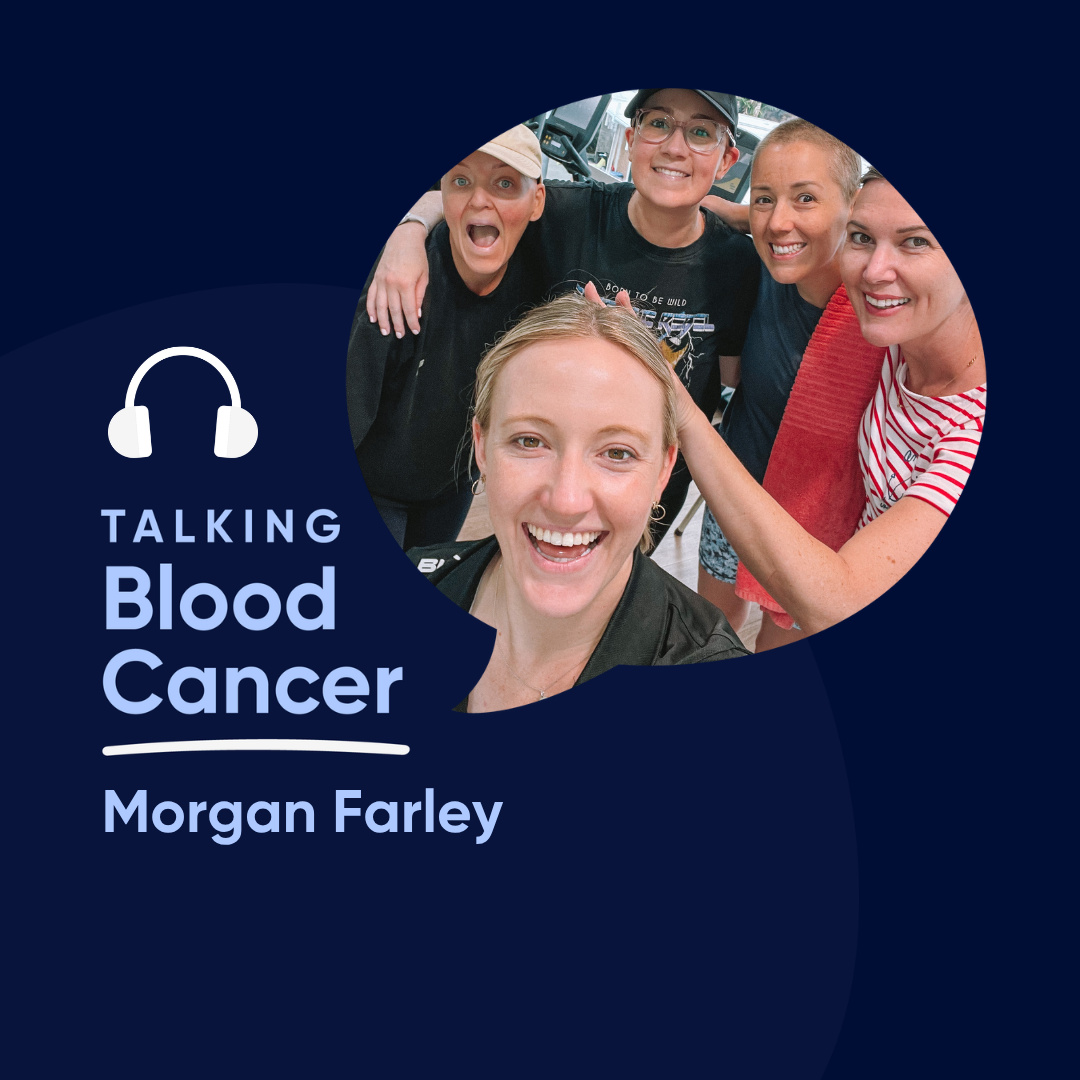
In this episode of the Talking Blood Cancer podcast, host Maryanne Skarparis speaks with Morgan Farley, an exercise physiologist whose personal journey and professional expertise have shaped her unique approach to patient care for people living with blood cancer.
Morgan shares how her background as a high-level athlete and her experiences supporting her grandmother through lymphoma led her to specialise in exercise physiology for cancer patients. She describes the challenges her grandmother faced after being diagnosed, including recommendations to reduce physical activity during treatment, and how together they developed a simple, home-based exercise program that helped her grandmother maintain strength and improve well-being.
Exploring the growing body of research showing that targeted exercise not only manages side effects such as fatigue but may also strengthen the immune system and improve treatment outcomes for people with blood cancer. Morgan Farley explains how even short bouts of exercise can make a positive difference, and how tailor-made programs can fit each individual’s circumstances and abilities.
The importance of addressing both the physical and emotional effects of a cancer diagnosis, with insights on how finding purpose and community support can help people adapt and thrive during and after treatment. Concluding with practical advice, including the value of consulting with an exercise physiologist, starting with small steps, and not neglecting muscle strength in one’s exercise routine.
[00:00:00] Introduction
[00:02:35] Maryanne: Hello, my name is Maryanne Skarparis, and I’m quite excited to have here with me today, Morgan Farley. Morning, Morgan. Thank you for joining Talking Blood Cancer.
[00:02:48] Morgan: Hello, lovely to be here.
[00:02:50] Maryanne: Morgan, what we usually do is we find out a little bit about who you are, and if you can share your story and your connection with blood cancer and a little bit about you.
[00:03:00] Morgan: Wonderful. I am an exercise physiologist by qualification, and I have a personal history of being quite a high-level athlete, which is what drove me to studying exercise physiology in the first place. But throughout my University degree, I was doing internships at the Queensland Academy of Sport. I was working for the Brisbane Lions. I was really going down the pathway into high-performance sport. I got accepted into my Master’s of Physiotherapy to look more in a high-performance rehab type role. But a few years earlier, I’d lost my grandfather to colon cancer, and then in my third year of university, my grandma was diagnosed with lymphoma. And at that point in time, she was 80, living independently, going to Tai Chi, aqua aerobics, garden club, you name it, my grandma was there. And then when she was diagnosed and given the option of treatment, she had CHOP at the time. It was sort of communicated, “Oh no, stop those activities, reduce your risk of infection, stay inside, and just rest.” And being in my third year of university, I sort of thought, “Well, she’s 80. If she rests, it’s gonna be really, really, really hard for her to start again, and she’s going to end up quite deconditioned.”
[00:04:23] Morgan: But I didn’t quite know what I could do. Going back then, there weren’t any guidelines for exercise in cancer. It wasn’t anything that was really taught at university. And so I asked her haematologist, “Can I exercise her? Will I hurt her? Is there any damage I can do?” And he said, “Oh, she won’t really be able to, I don’t think, but you won’t hurt her, so you can give it a shot.” And I am quite a competitive person, and I thought, “Well, here’s a challenge. You think I won’t be able to? I’ll find a way,” and went to my university lecturers, explained the situation and said, “Can you help me do a bit of a program for my grandma?” Fast-forward to the end of her treatment, she never missed a cycle. She went into hospital once with UTI infection, and her haematologist said, “Oh my gosh, can I send more people to you? I’ve never had someone at 80 years old tolerate this so well.” And I sort of laughed and said, “Well, let me finish my degree first,” and it never left me how much she transformed after exercise. And I say exercise, but for her it was in her living room, using chairs, using a few, like, bands. We would walk together up and down her street, and then she had some Tai Chi videos that she would do by herself on the TV. And it was actually a really nice thing for us to do together through that time. And after it, no matter which family member was coming over, couldn’t believe how much brighter she was after doing the movement.
[00:05:54] Maryanne: Can I ask Morgan, ’cause I, you know, I love a conversation, and I love your passion in wanting to help your grandmother. How lucky is she as an individual to have a granddaughter who’s happy to invest time in her health and wellbeing. When you invited your grandmother to participate in exercise, what did that conversation look like? Did she struggle with being diagnosed with a blood cancer, and was it difficult to get her going?
[00:06:22] Morgan: It was really difficult. And she also was placed with the option not to undergo chemotherapy, given her age, and it was, it was made pretty clear it was going to be quite tough. But my grandma is quite a fighter, and she’s a very strong person, and elected to undergo the treatment. But she was in a mindset of, “I just need to rest. I just need to get through this as best I can.” And she was ready to sort of watch her TV shows and kick back and get through the next sort of six months. So it took a lot of conversations around how it might help her, and I found the best way was meeting her halfway with something she was already doing and enjoying, which was the Tai Chi. So we started just doing some Tai Chi in the living room, and then little things I started to sneak in like, “Okay, now we’re going to get up and down from your armchair 10 times.” And she’d groan a little bit, and do it. And then by the end she was asking me to come around and do it. So I think a big part of it, and I’ve learnt this now having done this for 12 years since then, is that it’s normalising it to activities that people are already doing. Because exercise can be a really scary thing for someone that maybe wasn’t doing any exercise before they were diagnosed or have quite a high symptom burden and fatigue levels, and they feel like what they were doing is completely unattainable. And it’s trying to help people find an in-between, to do it, which I think is what really helped my grandma start moving, and it’s something I use every day to help people move when they’re living with quite high symptom burdens or recently diagnosed and trying to find movement that helps and works for them.
[00:08:09] Maryanne: How lovely, and what a rewarding experience for you. So your grandmother was willing to participate in the different activities that you invited her to do. Tell me what her treatment regime and progression and post-treatment has looked like because of your involvement.
[00:08:27] Morgan: Yeah. So she, as I said, was 80 when she was diagnosed, and we celebrated her 90th birthday in January this year. And she, up until about two years ago, was leg pressing her body weight in the gym with me. But unfortunately she’s had a few, not related to cancer, medical experiences. Had a fall, ended up in hospital, caught COVID while she was in hospital, and that’s now led her to be in a nursing home. But she…, every morning does her exercises and then goes to the exercise classes at the nursing home. And we had her 10-year review with a haematologist, and he was still very happy from a cancer perspective, and she hasn’t needed any other treatment except for that initial bout of CHOP chemotherapy
[00:09:17] Maryanne: Wow. So what a trooper, 90 years of age. Bless her. So with that experience, because often…, are you happy to share, because you love your grandmother and you’re invested in her health and wellbeing because of the connection that you had being your grandma, what did it do to direct your area of expertise and your study and your future, moving forward?
[00:09:39] Morgan: Yeah. So I was nearing the end of my degree, so at about one year since my grandma’s diagnosis, and I was really trying to figure out what I wanted to do. I had all the textbooks to study, GAMSAT and go and do medicine. I’d been accepted into the Master’s of Physiotherapy, and we couldn’t let go in my mind how incredible it was to be able to help and see the power of exercise from my grandma, and I wonder if I could do that for other people. This coincided with a period in time where I read a book. It’s quite a famous book. It’s called “It Starts With Why” by Simon Sinek, and he was all about thinking about what he calls is this golden circle, where it needs to start with why. Why are you doing what you’re doing? What motivates you? What sits behind it? Before you then look at how you’re going to do that, and then what it is that you will do to achieve your why and your how. I also then was talking to people to get some career advice, and they all would ask me questions like, “What would bring you sort of the most happiness getting out of the bed in the morning knowing you were about to do?” And no matter which way I thought about it, as much as I loved working for the Brisbane Lions, helping more people like my grandma live better during cancer and live longer after their cancer diagnosis didn’t compare in my mind to helping the AFL players jump a little bit higher or get an extra game out. If I stayed, I would have gone on to win a few more grand finals, which would have been nice. We weren’t that good back then. But that’s where I really made the decision that I wasn’t going to do medicine, and I wasn’t going to do physiotherapy, and I was going to look for a job at a clinic that was helping people with cancer using exercise.
[00:11:28] Morgan: And I spent a few months searching for this mysterious clinic that didn’t seem to exist, which was…, really believe it at that point in time. And I even went to our sort of accrediting body, ESSA, and said, “I really wanna do this. I’m really passionate in this space. Can you help me find a clinic that I can work for?” And they said, “Actually, you’re right. There isn’t a clinic that specialises in helping people with cancer exercise. Why don’t you start one?” And I sort of thought, “Oh my gosh, I’m twenty-two. I’ve just finished my degree. I’ve never worked for someone before, and now you want me to start a business?” And then I just decided, you know what? This is what I wanna do. This is my ‘why’, is to help people with cancer live better and live for longer, and there is no ‘how’ or ‘what’ that currently exists. So I’m going to start my own clinic, which is called Valere Health, after my grandma, whose name is Valerie. So Valere in French means to be strong and resilient, which I think is really, really fitting for what we do. And so I started that back in 2018 now, and it’s still to this day the only cancer-specific exercise physiology clinic that exists in Brisbane. So yeah, that’s kind of how I guess it pivoted my career direction. And that lesson that I learned from reading that book, I honestly think about it almost every week. And it’s actually something that I work with a lot of clients on, because I don’t know anyone that hasn’t been changed in some way by their cancer diagnosis. And…,
[00:13:06] Maryanne: Absolutely.
[00:13:06] Morgan: …, it’s not even the physical side effects, but it’s more what to do with it now. It tends to produce this large period of self-reflection on, “Why am I doing what I’m doing? What do I wanna do with this time that I have?” Because there’s a newfound appreciation for time as well. And I often find it’s in that kind of transition period between finishing up that sort of first lot of chemotherapy or immunotherapy or the transplant, and then it’s, “Wow, what do I do now? Do I want to go back to work? Do I want to live the lifestyle I was living before I was diagnosed? Do I want to spend time with these people, or do I need to sort of look to a new direction?” And I always go back to my clients when they’re having some of these conversations with me and say, “Well, why? Why have you just gone through this really hard thing? What was motivating you?” and help reflect. And then once you know your ‘why’, you can think about how you’re going to do that. So for me, I’ve sort of looked at it: my ‘how’ is one through service delivery, so making exercise accessible for people with cancer, and making also that emerging evidence accessible. So, for example, I started Valere in 2018, which was before the first guideline was released in Australia to recommend exercise as standard of care.
[00:14:32] Maryanne: Can I just ask you, Morgan, because I think it’s really important, and I love the word ‘why’, and I love that you were curious to take your learnings to a different level and pursue this focused area, of how and why people make choices, and what can be your contributions to helping them…, or helping them shape what choices they’re making. Can you share a little bit, with just…, with the listeners, because I know this about you, you did some further study, PhD that was quite directed towards blood cancer patients. Is that correct? Or was it cancer patients or…
[00:15:10] Morgan: My PhD, was in solid tumours, so breast, prostate and colon. But it’s been since doing that PhD…, I really have then moved into the blood cancer space. And if someone told me I could only choose one population to work with, I couldn’t help any other cancer type, it would be blood cancers. And so that’s mainly due to a few reasons. One, the physical and mental toll that treatment for a lot of blood cancers take, and it’s really unique to blood cancers. For example, the transplants and the CAR-T, and a lot of emerging therapies there. Secondly, and this is where my PhD sat within more the solid tumours, that I’ve now moved my learnings into blood cancers, is when we exercise, we get a huge influx of immune cells into the body, and these immune cells have been known to help stop cancer from growing in the first instance. They’ve been known to be harnessed and used for immune-based treatments, so a lot of the immunotherapy…, like the words rituximab or daratumumab might be familiar to you, or transplants, that’s all about your immune system, and CAR-T as well is all about your T cells, one of those immune cells. And so when you do these bouts of exercise, if they’re in a targeted, specific dose, we’re actually able to elicit changes in these immune cells that we have now shown can improve responsiveness to these treatments.
[00:16:46] Morgan: An oncologist that I work closely with, he once described an exercise as the poor man’s immunotherapy, because of these responses. So we’ve been able to show that when we combine blood from people with a blood cancer like CLL or myeloma, these two studies I’m talking about now, when we combine their post-exercise blood with some of the treatments that they’re being treated with, it actually improves their efficacy. So for rituximab in particular, there was one study that showed that exercise increased the effectiveness of rituximab by up to 130%, which is massive. This needs to be transferred into humans, and that’s part of my research now and what I’m doing. So we’re going beyond just helping people feel better, and have a bit more muscle and help manage their fatigue, which is all really, really important things. But sometimes they’re not quite enough to motivate people to move when they’re feeling really average. But it’s this kind of evidence that is actually going to be able to change clinical outcomes to help how long you live for, help your treatments work better, which is what helps a lot of my clients get out of bed and do this kind of exercise.
[00:18:02] Maryanne: I love that you’ve shared that, Morgan, ’cause it is. It’s that seed that’s been planted, and those that are listening to this conversation may not have known that exercise has that impact at a cellular level and how it increases the activities, with regard to the treatments that you’ve mentioned.
[00:18:22] Morgan: Yeah. And it’s that, I guess, going back to when I was looking at my ‘how’. I had ‘how’ being the service delivery in the clinic, but the next one is the research. So, without this kind of research, we don’t know how it’s going to help people, and we don’t know what the best thing for people to do is, and that’s what led me to doing my PhD and that’s a real point of difference in sort of my clinical practice and my clinic, is that we’re able to translate this research and deliver it to people before it’s made guidelines, before sort of your generalist health professionals are hearing about it. And it really also is something that I spend a lot of time educating other health professionals and clinicians on because it’s not just doing it later on. I think a really good example of this is in a transplant or CAR-T setting, and it’s one of the nuances to blood cancers, which is why exercise and movement is so, so, so important, is unfortunately, it can be multiple lines of treatment that people undergo, and sometimes it is…, they’re not curable cancers, so there might be watch and wait periods, multiple lines of therapy. And so you have this big lead-in period sometimes for things like transplants that you may need, or you may not need at that point in time. But if you can start moving earlier, doing these immune-stimulating types of exercise, it’s been shown to also overcome some of the barriers of eligibility for transplants and CAR-T. So if you…, frailer or deconditioned, or if you have an immune system that’s not working properly, you may not even be eligible for these treatments that might be what could save your life. So if we keep people moving earlier on, the evidence says that they’re going to have better immune function at rest, so help fight infections and help you respond better to transplants and CAR-T.
It will then help you be physically stronger, so you’ll have improved resilience against some of the side effects and the time spent in hospital associated with these treatments. But you’ll also improve your eligibility. So frailty and performance status is a criteria to being eligible. So if we can start working on this in advance, you’ll be placed far better for these procedures. And there’s evidence now that also has shown, particularly in a transplant setting, that those who exercise in the lead-up to transplant, firstly, it’s safe and feasible. I’ve got an absolutely incredible client I’ve been working with at the moment, he started transplant actually yesterday. And when I met him, he had lost fifteen kilos as a result of his diagnosis and his treatment to date. He had MDS, and he was preparing for transplant. And we have ended up since not only stopping that muscle and weight loss, he’s gained five kilos leading into transplant. To the point even his platelets, and neutrophils were so low, his haematologist said, “No chemo this week.” And so he picked up the phone and said, “Can I come in every day?” And so we were able to adjust his exercise to be safe within how he was feeling. Because don’t get me wrong, he was fatigued, he was nauseous, he was dizzy. But we were able to find ways to do this safely, and his muscle mass has been associated with transplant outcomes. So less time spent in hospital, longer progression…, cancer progression-free survival, longer overall survival has all been predicted by how much muscle someone has before they go in.
[00:22:05] Maryanne: I love that, because I love storytelling, because those that are listening, they’re listening to the story of a gentleman who has MDS progression wanting to prepare for transplant, and how you engaged in providing a program that was doable in a safe setting. Have you ever struggled with, or have you ever been presented with a client where you have had to look at a broader strategy to actually get them committed, someone who knew they had to do something? Or what would be a key nugget that you’d like to impart in this conversation, just for those that are listening who…, just struggling with taking that first step, you know?
[00:22:44] Morgan: Yeah. And I would actually say that’s more the type of person I see. I think at least once a week someone will sit down in front of either myself or one of my team members and say, “I hate exercise. Good luck. My doctor just told me to be here,” and so a big part of it, firstly, is the evidence. So, when I talk to someone about how not only is it going to make you feel better, it’s going to change your clinical outcomes because ultimately chemotherapy, transplant, that’s not easy either, and that comes with a whole host of side effects that significantly affect people’s quality of life and wellbeing. It’s going to keep them alive, and it’s going to help cure their cancer. So, everyone does it. I have seen such strength and resilience from people going through these treatments that they didn’t even know they had it within themselves. And so when I tell them that, “You know what? This exercise or movement is also going to be able to change their outcomes,” suddenly people become a lot more receptive to it. And then the next part of that is that as little as 10 minutes of aerobic exercise in people with lymphoma has been shown to stimulate the immune system in the ways we need it to, to change these clinical outcomes. And 10 minutes is really, really feasible for someone to do. And often all it takes is 10 minutes, and people start to feel a little bit better and think, “Oh, I could maybe do 10 more minutes.” And so when we’re going through these really, sort of intense treatment periods, we need to be really targeted with what we do. So the one nuance to that is that, to get this immune response, people need to get a little bit breathless. So it’s not just going for a really, really easy walk. It is doing something that makes you that little bit short of breath. Then it’s talking about how that’s actually relative to you and how you’re feeling on that day. So the body doesn’t care if you’re doing what you were doing pre-diagnosis or what you were doing yesterday to get your heart rate up. It just cares if your heart rate is up. So if you’re feeling a little bit average, if your fatigue is high, if you’ve just had a bad night’s sleep and you’re not feeling your usual self, well, it just needs to be a type of movement that is going to get you a bit breathless on that day. So having conversations around that…, I have one lady who said she hates exercise, she hates the gym, she doesn’t wanna do it. And so what she actually does is picks her three favourite songs every day and puts them on, and she dances to her songs in her living room. And she’ll jump up and down, and so that helps her bone density too, because she does have osteoporosis. And she dances and sings, and it fills her full of endorphins and happiness, as well as it gets her a little bit breathless. Then she stops, sits down, and pauses, picks her next song, and gets up and dances again. And that is her aerobic exercise for the day.
[00:25:41] Morgan: So exercise doesn’t have to be this big, scary, daunting thing like boxing classes, running, gym, throwing weights around. We meet you with where you’re at. And because we understand the physiology and the science of what we’re trying to change, we can find a vehicle to do that on you and you. And that comes actually back to the ‘why’, ‘how’, and the ‘what’. We understand why we wanna do something, we understand how we need to do things to be able to change that, and then we figure out the what suits you and what you would like to do to get there. So I have actually never had anyone leave an initial assessment that sat down and said, “I hate exercise,” refuse for a second appointment. And that’s often what helps achieve whatever the goal is that we’re after. But it’s really for you as an individual thinking about, well, why am I going through this treatment? And I mean, the really simple and clear answer is to live, but often it’s then to be there for my children, or to play with my grandchildren, or to be able to provide for my family. And then when we look at how are we going to do that, one of those things is the chemotherapy, the immunotherapy, the transplants, the medical treatment. But then another ‘how’ is through exercise and movement to keep you as strong as we can to tolerate your treatments and get through these, but also to help you respond better. And there’s enough evidence now that’s really saying we can extend your survival as well with these targeted bits of exercise that are then tailored to you
[00:27:19] Maryanne: I love that, Morgan, and I love that you were able to provide that essence of I’m trying to find the word…, comfort, connection for the patient to know that you’ve got the evidence that demonstrates that exercise is important. But then you’re also committed to having those engagements where you place the client’s needs, wants, in how they want to achieve it. So you work with them. It’s not a program that they’re gonna deter from, because it sounds to me like you’re working with them from day one to help in a methodical stepping stone way to improve strength, agility with a focus there, as opposed to attending a class or that sort of thing.
[00:28:02] Morgan: Yeah. So everything we do within my team and my clinic is all individually prescribed. There’s actually not a single thing that hasn’t been individually developed in some way, shape, or form. And then what we do is bring people together with similar experiences in smaller groups to get that social connection, to share stories, to say things like, “Hey, did you experience this?” And then someone say, “Oh my gosh, yes, me too. I’ve never met anyone with that before.” And it helps normalise things for people and give them a supportive group that probably… We run a few transplant groups, and I think that’s almost been one of the most beneficial things because then people with one upcoming get to meet people that have been through it before to help really answer some of those questions. And there’s often a bit of a build-up, and there’s a bit of fear and anxiety around that kind of treatment. But everyone, even if they’re in the same group, is doing their own program that has been designed for them after an initial assessment where we get to know not just the person’s cancer, but who they are before that and who they are outside of that as well. Because exercise isn’t just good for cancer. It’s good for whole wellbeing and getting the most out of life. And so we really work towards that as well as applying the science as sort of our underlying reasons ‘why’. And we’ve never been able to not find something that suits someone to move and exercise. And it’s just about looking at…, it might not be the traditional sense of the word exercise, but we find a way for people to move that suits them, and makes you happy and help you get more out of life.
[00:29:51] Maryanne: Oh, I love it, Morgan. I must take my hat off to you and congratulate you on that initial seed that started the drive in you from the first place. And use the word connection, and you also, from the sounds of things, provide something that’s unique to an individual, which I think is just special. When you are meeting with a client, and you’re trying to encourage that engagement, and they’ve been referred to you by a treating specialist, and they may be a little bit apprehensive, are you able to demonstrate your research or is that a part of the conversation as well? You know, information that you’ve gathered. Is that part of your conversation?
[00:30:28] Morgan: Yeah, definitely. And it’s prioritised in our conversations because that’s our point of difference as well, is having such a deep understanding of the cancers, the treatments, and what the mechanism of actions of the treatments are and the common side effects of those, and then what this research is. Because a big issue sort of I see, and this comes to my third ‘how’, so I mentioned how I came up with, my ‘why’ and then how I was going to do that was through the service delivery, the research, but then it’s through education as well for both people and health professionals, to help more people access the research because often such amazing publications die in journal articles because no clinician has time to read them and as a patient, you don’t even have access to the research databases to read. So I spend a fair amount of time in that initial assessment, educating the person on the exact evidence for their exact treatment and their exact cancer, and then drawing into how that can be applied for them. So a really common one I would go through is, say someone has DLBCL, so a type of lymphoma which has first-line combined chemotherapy and immunotherapy. And all things going well, they won’t need a transplant. But if that was to…, not be effective or if the cancer were to come back, they then go on to get a transplant. I would go through almost all of the evidence that I’ve just sort of spoken about from the Rituximab trial. Doing the exercise can actually help the effectiveness of the drug work, but then it can also help manage some of the side effects to the chemotherapy components of that. A big one is always fatigue. It’s a massive one, and it’s also a common barrier for people thinking that they can’t exercise. It makes logical sense, right? If you’re tired, well, exercise is gonna make you more tired.
[00:32:29] Morgan: But in fact, exercise has the strongest evidence out of everything to actually improve fatigue levels in people with cancer. And exercise is recommended by the big society of oncology as the best treatment for someone experiencing cancer-related fatigue. But not only in that initial, am I talking about that right now, we’re talking about what may be to come, and which could be the transplant-based treatment. So we’re doing really targeted immune-based doses of exercise to be able to not only help that Rituximab work better, but to prepare them for potential transplant, or CAR-T and to help their immune system just get back to normal after treatment. And then there’s the ten minutes of exercise in people with lymphoma. So if they are struggling with that fatigue, then I’m going into, “Well, you know what? Let’s start with ten minutes.” I would much rather someone do ten minutes a day to get then seven bouts of the immune cells into the body. Then wait till they’re having a really good day and do an hour’s walk, from that evidence rationale. So I go through all of that in their initial assessments, and then find ways to personalise the approach based on how they’re feeling and what individual circumstances they have. That’s a massive part, and it’s a massive part of how I train my team and the professional development that I do with my team, and other exercise physiologists around the country now is to try and spread awareness for these benefits and being really targeted with our exercise prescription. Just like they’re targeted with exactly what dose of medication you get, we’re very targeted on what doses of exercise we prescribe people to help manage side effects, but also get these responses.
[00:34:22] Maryanne: Oh, I love it. I love the energy that you’ve brought to this area, and I find it so essential and valuable. Morgan, thank you for sharing such a wealth of knowledge. You know, you don’t have to go into intricate detail, but you mention research, you mention your passion towards gathering information, education both healthcare professionals as well as clients who have a blood cancer. Is that information and research available? If someone were to come to me as a supportive care case manager, would that be information that I could then direct them after this conversation to your area?
[00:34:56] Morgan: Yeah, definitely. What we do is we’ll send out educational resource, so people have access to that. But I’m more than happy to share that with anyone who is interested or wants a bit more information about what I’ve mentioned today. I’m happy to share any information. All of the research I’ve spoken about today is published in journal articles as well, and the Leukaemia Foundation also has some great information on exercise on their website. But yeah, I’m more than happy to share any information anyone may want or need as a result of hearing this today, just over email.
[00:35:31] Maryanne: I love it. I love it, Morgan, and I love that you’ve been willing to share, you know, your time with me this morning, for our Talking Blood Cancer podcast. I think what you have shared is, you know, that seed and that connection from your grandma to developing your own focus and targeted business yourself, supporting people who are living with cancer. I think you’ve shared some lovely insights. Can I ask, if you’ve got one, two, or three golden nuggets before we close this conversation for people that you’d like to share?
[00:36:04] Morgan: I’ve probably got about ten. But if I was to narrow it down, it is… One of my goals in life would be that every single person with a blood cancer that is diagnosed with a blood cancer should get access to at least one initial assessment with an exercise physiologist that has expertise within blood cancers, that can share this research and this information in an individualised way for you and help you be able to tailor, your exercise and movement around your symptoms, your side effects, your diagnosis, your treatment. So if you’re listening to this, it would be to try and seek out an exercise physiologist and at least have one session with them to understand how it might help you in your circumstance and how you can work around some of your symptoms and side effects to be able to do it safely. I do also recommend, as part of that, going to your GP and getting a care plan that will help you get some Medicare subsidies to be able to pay for that because, unfortunately, it’s not available in many hospital systems. Some hospitals you do, but not…,
[00:37:23] Maryanne: Not all.
[00:37:23] Morgan: …, every hospital system. My second nugget would be to do something. Something is always, always, always better than nothing. And ten minutes is enough to change outcomes and to change your factors circulating around in your body. And often the hardest part is just starting. So if you just start with ten minutes, get a little bit breathless, dance to your favourite song, get up and down in a chair, whatever it takes to get you a bit breathless, I promise it’s worthwhile doing. And then my third, I would actually say don’t forget about your muscle. Everyone often will sit…, that I meet will sit and say, “Oh, I go for walks, I’m exercising,” but few people are actually doing anything to build some muscular strength. Muscles have been associated with how great of immune response you can get. But also, two, muscle is so, so important for side effects like cancer-related fatigue. It’s so important for your ability to sort of tolerate and recover post-treatment and surgeries. It helps with bone density. It helps you live well, not just live. So that would probably be my third thing. I would recommend everyone try and see someone, just to get a little bit of individualised guidance around this. Even if you just do one session, they set you in the right pathway, give you some stuff to do at home, because I promise you it will make a difference. I’ve never had anyone leave an exercise session that said they felt worse than when they arrived.
[00:38:58] Maryanne: I love it, Morgan. And you know, I think stay tuned, and if you have more questions, absolutely reach out because this is our opportunity to plant that seed. Thank you for joining me this morning for Talking Blood Cancer, Morgan
[00:39:13] Morgan: My pleasure. Thank you for having me on, and please send any questions through, and I’d be more than happy to answer them.
[00:39:20] Outro