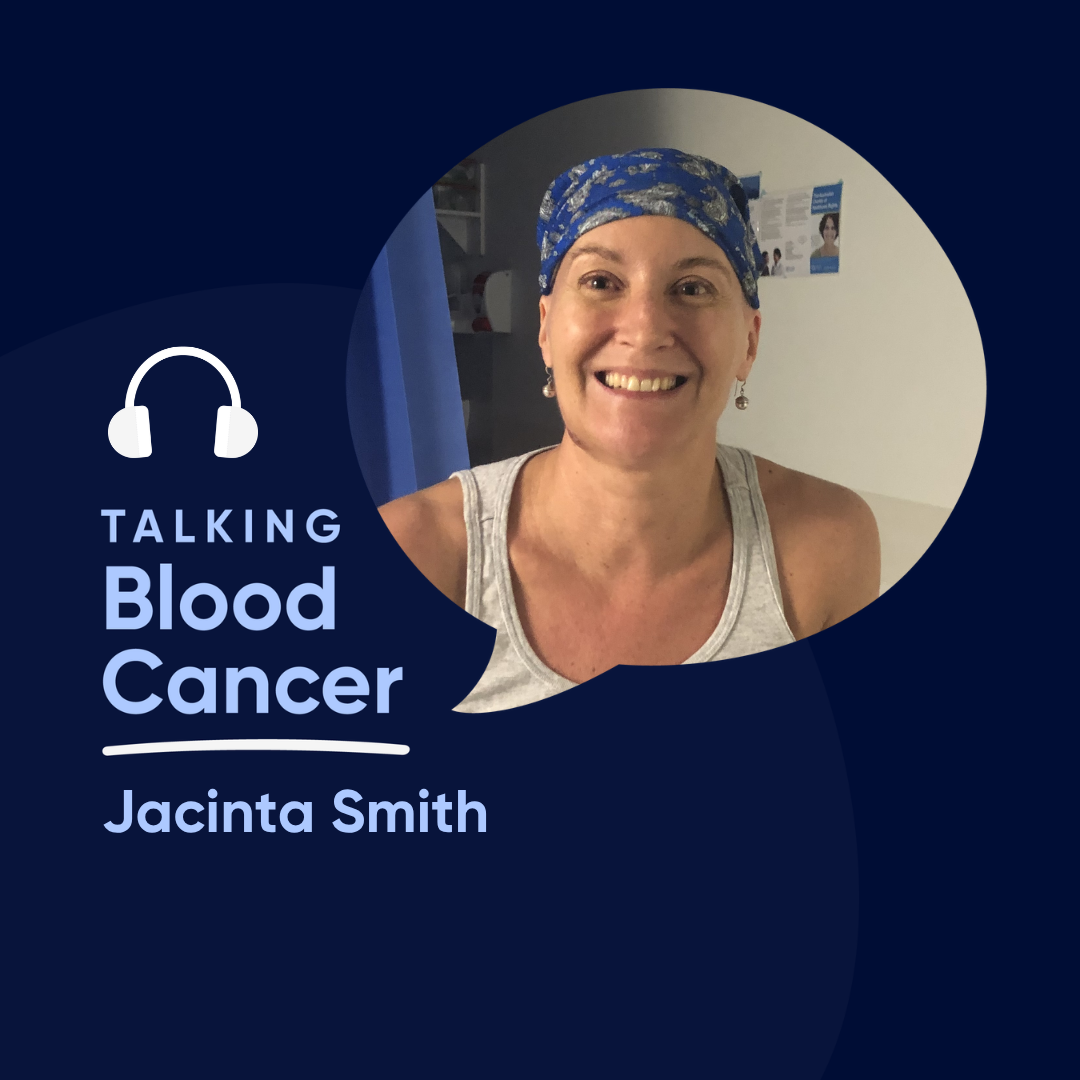
In this episode of the Talking Blood Cancer podcast, host Kate Arkadieff speaks with Jacinta Smith about her journey facing acute myeloid leukaemia. Jacinta shares her experience from the initial diagnosis through the many physical and emotional challenges that followed, providing an honest account of what it means to adjust to life with a blood cancer diagnosis.
Talking about Jacinta’s busy life before diagnosis, including her role as a mother of three and her successful banking career. She describes the early signs of illness, her hospital admission, and the shock of learning about her condition. Jacinta openly discusses the experience of telling her children about her diagnosis and how her family coped during times of uncertainty.
They explore the realities of treatment, including the difficulties of chemotherapy, the need for a bone marrow transplant, and the impact of serious complications like infection and intensive care stays. Jacinta details the physical rehabilitation required after a long hospitalisation and the gradual process of regaining strength and independence. She provides insight into the emotional and psychological effects of her ordeal, including the value of psychological support and the importance of asking questions and staying informed throughout treatment.
Jacinta also highlights her current involvement in health consumer work, supporting other patients and contributing to healthcare improvement. She underlines the significance of staying positive, surrounding oneself with supportive people, and being proactive with both physical health and communication with medical teams.
[00:00:00] Introduction
[00:02:37] Kate: Hi there, and welcome to Talking Blood Cancer. I am your host, Kate Arkadieff. And as we do usually on all of our podcast episodes, we do ask our guests to introduce themselves. So what I will ask of our wonderful guest today, to let us know who she is, where she is living, what age she is, and when she was diagnosed, and what she was diagnosed with. So I’ll hand it over to you.
[00:03:00] Jacinta Smith: Thanks for having me, Kate. My name’s Jacinta Smith. I’m 58 years old now. I was diagnosed in 2019 when I was 51 years old, at the time, and currently living in the northern suburbs of Brisbane. I’m happily married. I’ve got three boys. And at the time of my diagnosis, I had a successful career as a home lender for one of the Big Four banks, and I was diagnosed with acute myeloid leukaemia.
[00:03:28] Kate: And what was happening, I mean, at that time, clearly a very busy woman with three young children and also a buzzing business and career as well. So what else was happening for you that made you um, ‘hmm.’
[00:03:41] Jacinta Smith: It was in March, and I was very tired, and I thought that that may have just been stress, work stress. But then I started getting a very sore throat, extremely sore. Like, I remember just before I got diagnosed, my husband and I had lunch with my mother-in-law, and we had fish and chips and calamari, and I couldn’t even eat the calamari. It hurt my throat, it was that bad, and my neck was a bit swollen. So I went into work on the Monday and I knew that I was unwell, so I locked myself in my office and tried to get everything up to date. Thinking, well, I’m gonna have a few days off, so I want to leave everything how it should be. So I did that, went to my GP the next day, and she said, ‘Okay, there might be some sort of throat infection there. Let’s do some blood tests to rule that out and to see,’ But she didn’t initially seem to think it was anything too terrible. When I went to get the blood test, so the person at Sullivan Nicolaides said, ‘Oh, you don’t look well to me. I’m gonna mark these as urgent.’ So…,
[00:04:45] Kate: Wow.
[00:04:46] Jacinta Smith: Yeah, which was probably very helpful because then I got a call from the GP that evening and she said, ‘Go to emergency, they’re expecting you there. And they’ll let you know what’s happening, but there’s some things going on in your blood counts.’ So we went into emergency, and they were expecting me, and they gave me a clipboard and said to my husband and I go and sit and wait in this particular area. And as you do, I opened up the clipboard to see what it said, and the first thing that jumped out at me was acute leukaemia. And I was like, ‘Oh no, I’m here for an infection, not this.’ My husband and I were both ‘uh…,’ and they wouldn’t actually…, that evening, the doctors and nurses wouldn’t say, ‘Yes, it is.’ or ‘No, it isn’t.’ They admitted me straight away and gave me just some oral chemo tablets that day, but they didn’t actually confirm until the next day that it was leukaemia. And when they did it my husband wasn’t with me. So, that was not good, and the doctor that did that did actually recognise that and apologised to me a couple of days later. So I appreciated that, that he realised that, ‘Oh, that wasn’t the best way.’
[00:05:58] Jacinta Smith: And then I still had to wait a couple of days to get the secondary results from the bone marrow aspirate to confirm what mutations I had. So they moved me to the 5C, which is the haematology ward at the Royal Brisbane and Women’s Hospital. And started the induction chemotherapy straight away. They did come and say to me, ‘Okay, well we’ve found the mutations. You’ve got FLT3 and NPM1, which are not the favourable ones that you want. They give you a poorer prognosis with the FLT, and it necessitates a bone marrow transplant for long-term remission.’
[00:06:37] Kate: You know, I’m just listening to all of that unfold for you in such a quick concession of days. And to know how busy you’ve described your life beforehand. And then to be all of a sudden placed in hospital and admitted, and not leaving at all. How was that for you mentally, besides all what was medically unfolding for you?
[00:07:00] Jacinta Smith: Oh, it was really bizarre to get your head around it. Like I was thinking, ‘Oh, I’ve got a grocery order coming tomorrow, I better cancel that.’ And just thinking of things like, ‘Oh, will my husband and I still be able to go on our overseas holiday next year that we’ve booked?’ Just thinking of little things, but just…, takes you a long time to get your head around something like leukaemia. Because the only times I’d been in hospital before was to have my children, I’ve never was one that got sick or had anything wrong. I actually, when I got diagnosed, I had seven and a half months of paid sick leave because that was how little I had been sick in the past. So it’s a real thing to sort of get your head around that. And then when they’re talking about the bone marrow transplant, and then they say, ‘Well, we will test your…,’, ‘cause I’ve got two brothers, and they tested both of those. One was a 50% match, and the other was a zero match. So they said, they can do 50% if there’s no better option. But, they did commence the search on the worldwide donor registry at that point.
[00:08:05] Kate: And how did you go about telling your boys?
[00:08:09] Jacinta Smith: Well, my husband told them. The social workers at the hospital were really, really good, really helpful. So they helped with him telling them what was going on, and they were good. They were…, the first thing they kept saying was, ‘So, when’s all your hair gonna fall out? When are you gonna be bald?’ It was sort of a thing like, ‘Yes, yeah. Oh, mum’s gonna look funny bald.’ So, and I did ask the doctors sort of straightaway, ‘Is this hereditary?’ And they said no. So I was happy to be able to…, not that my boys were asking that, but for my sake, and to reassure them to say, ‘Look, yeah, I’ve got this, but you’ve got no greater chance of getting it than anyone else, so I am not giving you that sort of bad change in the future there.’ So…
[00:08:55] Kate: You know, when I’m thinking too, like it’s so many of the patients and family members that I speak to when they say ‘Life was just going and happening,’ and you know, by the sounds of it, you were very, you know, you had a great career and things like that. And the shift of that instant pause and stop of the things that you accessed and the things that you connected to. And also at times, you know, work is as draining as it can be, it’s a part of our personality. How was that, I guess, instant stop for you? Or did you struggle with that or was there an acceptance straight away of…?
[00:09:30] Jacinta Smith: Yeah, it was hard. It’s very hard to slow down and stop. And it is hard to lose a lot of your identity because while you’re going through all of this, you’re a patient and you think, yes, I’m a patient and the most important thing is treating this. But I’m also still a wife and a mother, and a daughter and a friend, and I’ve got a career. I’m not just ‘the patient is 51 years old with AML…,’ but like that sort of thing that you really want to be still a person. So, it’s very hard to sort of get your head around becoming a patient.
[00:10:08] Kate: And I think so many people do speak to that as well. And I’m so glad that you’ve voiced that because so many people do feel that life still happens outside them. And it’s almost just sitting there going, ‘Hey, I am still, I’m still here and I’m still a part of this life.’ But at the moment, yeah, you almost feel like you come down to your hospital number.
[00:10:30] Jacinta Smith: Yeah, so then they started the induction chemotherapy straight away. And I was lucky. I tolerated that very well. I was still active. I’d go for a walk around the ward and to the common room, with my IV pole and do that. I was able to be positive and the nurses commented on that. I was reasonably fit and well, because a year before that, for the very first time in my life, I joined a gym and started trying to get a bit of fitness going. Getting, as I’m over 50 now, I did need to sort of do something. And I think that really helped me, and what they said later on in the journey when things went worse, that having that basic level of fitness there was a benefit to me, so…, and I was able to be positive. I, I did though every night…, and my sister-in-law, who’s a GP advised me, she said, ‘You can ask for a sleeping tablet every night if you want to, so that you don’t lay there in the horrors of what could happen.’ And I did take her advice and that was good. So I could sleep, I wasn’t laying there going over and over.
[00:11:35] Kate: It’s when everything’s quiet…
[00:11:38] Jacinta Smith: Yes.
[00:11:38] Kate: …, that sometimes that is the hardest time to control your mind…,
[00:11:41] Jacinta Smith: Yes.
[00:11:41] Kate: …, especially when you’re in a state of the unknown, being fearful. So that’s… Were you able to stay active as well, throughout the treatment?
[00:11:50] Jacinta Smith: Well through this induction, yeah, I did. I was well, and yep, I stayed active. I, um, had a lovely nurse there, Nate. He shaved my head with the family present and sort of made a big thing of it, and I was lucky I went bald, but at that stage I still had eyelashes and eyebrows, so I still looked reasonably okay.
[00:12:08] Kate: How was that for you as a woman?
[00:12:11] Jacinta Smith: It was weird, but it wasn’t too bad because luckily, my head wasn’t weird looking or funny ears or anything like that. So it was strange, but it wasn’t too bad at that stage. So, yeah, I was able to be sort of positive about it and, still kept going and, I was still quite tanned and so forth, so I didn’t…, apart from being bald, I looked sort of pretty much the same. And then I went home in about four weeks after the induction chemo, and I was in remission then, and have stayed in remission ever since too. So went home and even while I got home I could still go for a bit of a walk and that sort of thing. Like I hadn’t sort of lost all my fitness. And then they went to the first consolidation chemotherapy, and that was done as an outpatient. So they give you like a little machine that’s attached to your PICC line in your arm, and you have it in a bag around your neck, and you go in every day and they change it over and check it out. But you’re at home, so it sounds like a really good idea. You’ve got to obviously be really careful with all the neutropenia guidelines, can and can’t do. And I thought I was following them, but I think what my downfall was one day I was outside and absentmindedly picked a weed out of the garden cause you’re not…, obviously not allowed to touch weeds or flowers, plants…,
[00:13:35] Jacinta Smith: And I got to the end of the chemo and I was feeling unwell, but that day I’d needed a transfusion. So I thought, I’m feeling unwell because my platelet was low. I went to bed, woke up quite unwell, shivery, couldn’t breathe properly, and I said to my husband, ‘Well, we need to go to hospital. You know, this is one of those things they’ve told us about.’ Within a few minutes I felt really bad, so I said, ‘No, call the ambulance.’ So we went in there and I got worse sort of immediately and I was vomiting blood. Alarming, but at the same time, I was trying to not let my husband see it so he wouldn’t be alarmed. I was sort of worrying about stressing him out. And, they gave me oxygen, but I still couldn’t breathe. And I had this…, what felt like extreme back pain, but it was actually my lungs. So they took me to ICU and the intensivist said, ‘Look, we can help you to breathe, but we need to use the ventilator to do that, which means we’ll have to give you anesthesia to do that so it will help you breathe.’ And I thought that sounds like alright. And I’ll probably wake up next morning, all good. And I remember them…, they’ve taken my jewelry off and getting me ready and my husband was there and he was saying ‘It’ll be all right. I love you. It’ll be okay.’
[00:14:53] Kate: Oh
[00:14:53] Jacinta Smith: And family were there too, ’cause mom and dad had just flown in from Melbourne to see me. And my oldest son picked them up from the airport and brought them straight to the hospital. ‘Cause they were expecting to visit me at home, would’ve been a big shock for them. And then, it turned out I went into a coma, because I had Pseudomonas infection and pneumonia. And then that led to sepsis and then total organ failure. So I was in a full life support for 21 days. So it was obviously way worse for the family because I didn’t know what was happening. Though you have those terrible, scary hallucinations in that time. And they’re still with me today, even this later. Just really…, a lot of them were really scary and full of worry for my boys and my husband and my family and that sort of thing, and…
[00:15:44] Kate: So you had that whilst you were in the coma? Is that…
[00:15:46] Jacinta Smith: Yes. Apparently, that’s quite common. I’ve spoken to a few other people who’ve been in comas and they talk about it too. So I think because of the ridiculously strong drugs that your brain goes, so they’re like your worst nightmare, only they’re so much stronger that they stay with you.
[00:16:05] Kate: And have you had to do any work around that? Because I would envision that would all…, it falls into PTSD.
[00:16:11] Jacinta Smith: Yes. Well, after I came out of the coma, so that was for 21 days. I was like really scared and confused and freaked out. So I had hospital psychologist that really helped me there. And she helped me actually even after my journey was basically over and I’d would go and see her quite regularly and she helped me with that because I was scared to go to sleep in case I had hallucinations again, or in case I didn’t wake up and went back to a coma. So, that was a terrible time, and they had to call my family in a few times to say, ‘Is there any relatives interstate?’, which there were, ‘They need to come because she probably won’t last the night.’ So, they had a few times where they had to have conversations with my husband, sons and family and say, ‘We are doing everything we can, but we’re sort of at the limit of what we can do’. Um…,
[00:17:06] Kate: Yeah, and how does that sit for them now? Like that’s just such heavy news. And to have that happen, and it is unfortunately not uncommon, but to have that happen multiple times in 21 days is a lot for the human body and the human brain to manage and then throw in love and connection, just amplifies it even more. How were they post that experience, and how they are now?
[00:17:32] Jacinta Smith: Look, with boys, it’s probably harder to tell, and they’re that sort of age where they don’t probably…, shows heaps of emotion, I guess. But I can tell that it does still bother them, and they’ll still…, even just the other day we were talking about this…, and I have to be careful how much I talk about it because I don’t wanna stress them or my husband out. And one of my sons said in that first day, my oldest son, rang out and said, ‘You know, mum’s not in a good way. Come in, she’s pretty unwell.’ And he got in, and he saw me in the coma, and my eyes were half open with this gel stuff on it, and he said, ‘You looked like you were dead.’ He was like, ‘No, mum’s not just…, not in a good way, mum’s really bad.’ So, it was that. And every now and then, my husband will have nightmares about if I talk like too much about it, he will have nightmares. Or when he listens to this, he’ll probably cry as will probably few other people in the family…, it’s definitely has that effect on them. And, and at the time they’re also told, ‘We don’t know what it’s gonna be like, she may lose digits or, uh, limbs.’ They don’t know the long-term effects. So it was obviously a very hard time for them all. And they told my husband at one stage that I was the sickest person in the hospital.
[00:18:55] Kate: Oh, God, that’s not the award you wanna win.
[00:18:58] Jacinta Smith: No, no…
[00:19:00] Kate: You wanna win the richest person award in the hospital, but you don’t wanna win the sickest. That’s…
[00:19:06] Jacinta Smith: Yeah, yeah. That’s…, no, that’s not the best one. But then later on, I became…, a few of the nurses talking to me afterwards, after I came out and obviously lived, they said, ‘Oh, you’re that miracle lady, aren’t you?’ So that, that was a good term. I didn’t mind that, that was good. But yeah, and it…
[00:19:24] Kate: What an experience through your journey that you do hear that’s the possibility and there are those side effects, but what I think that it’s so important to highlight is that you got through it and although it was not easy, and it wasn’t easy for the people watching, but that there is hope and faith that you can make it through. And I think that’s such always an important message. You know, I, I remember a famous doctor say, ‘Well, while there’s hope.’ And I guess through that time, 21 days being completely sedated in a coma, I can envision you would’ve come out quite deconditioned.
[00:20:03] Jacinta Smith: Yes, very much so. I, um, initially, all I could move was my eyes. I could really only whisper, I couldn’t move my hands or anything. I lost all my eyelashes and eyebrows. My skin all started peeling off my hands and feet, and I was really confused and scared. And I went back to 5C, to the blood cancer ward, which was comforting for me because they were so lovely there, and that was…, I felt safe there. I got back with these familiar people who will look after me. But I couldn’t sit up or roll over. I was still on dialysis and had an oxygen, and I had the nasogastric feeding tube for a while, and because I couldn’t move my hand, they got a buzzer like they have in the Burns Unit hooked up because I couldn’t press the normal hospital buzzer, and they’d put my hand on top of it. So I had enough strength to sort of put it down. And they had to make sure, whenever they came in before they left the room, that they’d put the hand on the buzzer because if they didn’t, I couldn’t move it onto the buzzer to press the buzzer. The nurses were also good because they made a sign for my door to say, ’cause I was in a single room at that stage, to leave the door open, because if my hand wasn’t on my buzzer, when I recovered my voice, I could then, when a nurse was passing, if I needed something, I could call out. Whereas if the door was shut, I’d have to wait until someone came in the room. I couldn’t roll over or do anything at that stage. So I was really dependent on those guys helping me there to do things.
[00:21:41] Kate: What a loss of dependence, you know?
[00:21:44] Jacinta Smith: There was so much that I had to…, once I was to the stage where I didn’t need dialysis and oxygen anymore, I needed to be rehabilitated in a way that they couldn’t sort of just do there. So they sent me to a rehabilitation unit. It’s not there anymore, it’s a separate one now at the hospital, but it was a rushed decision. I didn’t know in advance. It was not a very nice place, particularly in comparison to 5C. So it was very scary there, and there was sort of a lack of dignity. Like they’d whisk you out of bed in a sort of a fishing net type thing to work on the wheelchair, and it was just not a good place to be. Once a week, they’d take me by ambulance back to see the haematologist at the hospital. And he said to me, ‘Look, you need a transplant. If we wait too long, you will relapse. But the way you are now, giving you a transplant for anyone is like setting off a nuclear bomb in your body. If we transplant you like you are now, it will kill you. You need to get yourself together, get sitting up, get walking, get mobile, get some fitness.’ So I was like, ‘Whoa, okay.’ I pushed myself so hard to get back to sitting up, and then taking a couple of steps and then walking and then doing all of that. So then I got there, and then after about a month, then I went back to 5C to my old friends there, and had my next consolidation chemo and got through that without dramas and then was able to go home.
[00:23:27] Kate: What did you spend almost near three months in hospital, was that?
[00:23:31] Jacinta Smith: Well probably would’ve been, yeah, a bit…, even a bit more than that. That year, at one stage we added it up and then the time obviously for transplant, I spent more time in hospital that year than at home. So there was a lot there because after that discharge, then I…, a little bit later on prior to my transplant, I got another pseudomonas infection. But fortunately, that time straight away, as soon as I fell a bit off, got a temperature, I went straight to hospital, and they were able to treat it. They kept me there for probably a couple of weeks, but I didn’t have to go to ICU. I just had the normal antibiotics monitor, and then I was okay. So…,
[00:24:10] Kate: Can I ask, was your husband working at all?
[00:24:14] Jacinta Smith: Yes. He owns his own business. So in some ways that’s hard because it’s a big, big job like 12 or more hour days and always on call. However, that also gave him the flexibility that he’d go into work for X amount of time, do what he has to do, and then still be on the phone, but then come and spend the time with me because he couldn’t have been an employee doing that. It just wouldn’t have worked. So it was fortunate that he was in that situation and that he had a good team there, carrying the ball, I guess, while he wasn’t there and while he was obviously physically not there, but mentally and emotionally having all this stuff to deal with and to go through, obviously when it was really bad. So…,
[00:25:04] Kate: That’s incredible. And then…, and that’s not even entering into transplant. Transplant, yes. And you think, ‘Wow.’ And I think, you know, that’s it. There’s…, everybody’s journey is very different. Everybody’s experience with this is really different. And the doctors, they can say, ‘Look, we can do X, Y, Z,’ but the body unfortunately has its mind of its own. Well, it does, doesn’t it? And it just unfold in all different ways, can’t it?
[00:25:31] Jacinta Smith: Oh, absolutely. Yeah. So…, But yeah, I was lucky they found a unrelated donor for me, a 24-year-old female from England, from the UK. That was good, and then I remember the nurses saying to me, ‘Oh, wow, because you know, your blood will change.’ And they said her blood is B positive. And it was like, wow, that’s an amazing omen, ‘be positive.’ We’re gonna be very positive about this. It will work! So, some very good friends of mine actually made a cake, a ‘b positive’ cake after transplant for me, it was beautiful. This cake to say, ‘B positive,’ you know, you’ve got this and that sort of thing. So that seemed like a really good omen. And then they go through the odds, and they said, I’ve got 10 to 15% chance of a transplant-related death. 30 to 40% chance of relapse, 40 to 50% chance of disease-free survival, which doesn’t sound awesome odds, but it would only be 20% chance of survival if I didn’t have the transplant. So the um, transplant greatly, while it has risks, it greatly increases your chances of staying in remission. So there was never any real discussion of should or shouldn’t we have a transplant. That was just always their thinking is that…,
[00:26:50] Kate: That’s what you’re gonna do.
[00:26:51] Jacinta Smith: As my husband kept saying, ‘There’s no plan B, this is what we’ve gotta do. So just keep going forward, and we’ll get there.’
[00:26:58] Kate: Absolutely. And it is. The going forward is all you can do, and you can only control what is in front of you. You could think and put your energy into all the other options and possibilities, but at the end of the day, it’s the facts that are in front of you is all you have.
[00:27:15] Jacinta Smith: That’s right. From the start, I always had great faith in the medical system, and in the doctors, and in the nurses and what they were saying. I never felt doubt or that they might be doing things a bit wrong or, uh, one’s telling me this, but another’s telling me something different. 5C had a really great thing called ‘Cyber’, which was an integrated wards rounds. In a particular timeframe, they would be doctors, nurses, physio, dietitian, whoever was part of your treatment at that point, would do a discussion of where you’re at, what your goals are, and they would include myself and my husband or family, whoever was there in that, and that was, that worked so well, it’s a really great thing.
[00:28:01] Kate: Well, it was inclusive. It sounds like you were a part of your treatment plan that you were in. It humanised it.
[00:28:07] Jacinta Smith: Yeah. No, it was good. So we start the workup, I have to transplant, and all the bits and pieces you go through, the chemo that started at home, but then they admit you a few days before transplant to do the really intense chemo. That was probably the worst bit of the transplant. So before the actual transplant, because it gave me that really bad mucositis and I had to have the nasogastric feeding tube again, which reluctant because I’d already had it, but I was so glad I had it because I could not eat anything for probably about a week. Even sip water hurts, and I had to have Endone, PCA, and then fentanyl and ketamine, where it was a continuous infusion because the pain was quite bad. So I had a very confused drug state there. I remember at one stage I thought my dog was in the room sitting in the chair with me, which he wasn’t, they didn’t bring him in, they didn’t bend the rules, but it was quite a, um, surreal time period when I was like that.
[00:29:11] Kate: Can I ask? I just wanna take you back, ’cause I know that some people are…, they are really reluctant to get that nasogastric tube, and they just…, for some people I know I’ve spoken to, they’re like, ‘That’s the one, I just don’t want that nasogastric tube.’
[00:29:20] Jacinta Smith: Mmm.
[00:29:21] Kate: It’s, you know, and you said you were somewhat reluctant. How was it, you know, I know you said it…, you were…, then ended up being glad, but kind of how did you get yourself to shift to go, ‘I almost just have to surrender to it.’
[00:29:34] Jacinta Smith: Well, I just listened to the nurses. They said, ‘Look, I know you don’t want it, but if you get to a point where you have this severe pain, you will need it. And it’s better that we put it in now while you’re not in pain than have to do it when you are. And if you don’t need it, we’ll take it out. So have faith in us and do it’. And because I did have great faith in the nurses and the doctors, but I guess the nurses are the ones that are involved in your day-to-day care, and probably have more of an impact so you, you really listen to what they say. And so I went, okay, well yeah, I’m reluctant, I’ve voiced my protest, but yes, it’s worth it. And gee, they were definitely right. I absolutely could not eat, and even when I could eat, it was very much a slow, ‘Okay, I’ll have a few bits of yogurt’, and it was still hard to eat.
[00:30:25] Kate: It’s almost like just remove the obstacle, and place in something that can help support. It’s not forever, but it’s to help get you through this time period. Because if you’re not then filling your body with nutrition during a transplant, that’s not gonna help you recover either.
[00:30:39] Jacinta Smith: Absolutely. Yes, that’s right. And I’d lost, well, when I was in the coma, I’d lost 16 kilos. I did put some of that back on by the time I got to transplant, but not all of it. So, the nutrition is so important, and it’s hard to eat. You’ve gotta drink the nutrition drinks as well because they help boost up what you can’t eat. But other than that, mucositis, I was very lucky with the transplant. The day they did the transplant is, as probably other people have told you, it’s a bit of an anticlimax. It’s almost like the nurses make a big fuss, and they make a sign up and it’s every birthday, and it’s really just like getting a bag of blood, which I’d had hundreds and hundreds of already, so it was just like, ‘Oh yeah, okay.’ I was lucky I didn’t really get much GvHD. I was…, few little minor side effects and things and still my tongue’s still a bit damaged and weird. And now from that, I dunno if it was from GvHD or from the mucositis, but compared to what a lot of people have afterwards, I’m very fortunate. And took me 18 days to engraftment, and then I was able to go home and very lucky because they said, ‘In your hundred day period…,’ that crucial period after transplant where you go to hospital twice a week and people are quite often readmitted, and they said, ‘You’ll probably be readmitted at least once in that time. Something will happen.’ But I wasn’t. I got through all that without it.
[00:32:10] Kate: You’ve done your fair share beforehand.
[00:32:12] Jacinta Smith: Right. That’s what I told people. I said I had all my drama before transplant…, after transplant was nice and easy. It all went really well for me. So, I was lucky there, but it took me a lot longer to recover from transplant. Because I was weaker going into it. Probably than if I would’ve gone into it how I was after the induction chemotherapy, it would’ve been a lot easier. But I was very weak for a long time. I was trying to push myself to go for a walk, and I just couldn’t get beyond a little bit up the road for a long time. So we’re lucky we’ve got a pool here at home. So I got in the pool, and I just started walking in the pool, and that was a lot easier than actual walking, obviously, ’cause the water supports you and it’s cool. And I was able to build up my strength that way, but it still took me a long time. I still couldn’t…, when I got to the point where I was safe enough to be at home without having someone with you, like you do have to have 24 hours a day, I have to make sure I didn’t sit on the floor or bend right down because I couldn’t get back up if I did that, and there was nothing to hold onto or no one there and things like…, I remember a few months after I was at the beach with my husband and some friends and I couldn’t go in the water unless I had someone next to me. ‘Cause if a wave had hit me, it’d knock me over and I couldn’t get back. I was like…, so things like that, and…, Or my mother-in-law said, ’cause she used this tactic herself, is she said, ‘When you go out to the shops, even if you don’t need a trolley, get a shopping trolley, ’cause you can lean on it and rest on it as you’re walking around.’ I was like, wow, that’s an amazing tip, I’ll go with that.
[00:33:56] Kate: And it gives your independence back. Because in that time, was there a struggle mentally to, I guess, with wanting to do more, wanting to, they almost say,’Well, you’ve had your transplant, life’s back.’ We know that’s not how it is. It’s actually when the real hard work begins because it is like reliant on you. Did you have any moments of frustration throughout that time period?
[00:34:21] Jacinta Smith: Yeah, lots of them. Yes, yeah. Particularly when I just couldn’t seem to get…, develop that further strength to get to work further up the road and to do a bit more, or when I couldn’t… When I could only carry…, I’d get my groceries delivered, which I was already doing prior to that anyway, but I’d have to get them to bring it inside, and I couldn’t pick up a bag of groceries or a full carton of Coke or anything. Like, I had to do things in halves for a long time. So, it was frustrating for me, having to ask for help with all these things and not being able to do things and, and you go through that stage because you…, on so many tablets, like at my worst I was on 23 tablets a day, was the most I had to take. And you’re at that point where you’re taking…, because of this tablet that gave me high blood pressure. So then I was on high blood pressure tablet, and then this tablet made me neutropenic. So it was such a catch…
[00:35:25] Kate: Every action, there’s a reaction.
[00:35:26] Jacinta Smith: Yes, yeah, and you had this whole thing because…, I had…, taking steroids as well, and that’s when it really affected me. You were saying before about how you look, because I had a round, puffy face, no eyelashes and no eyebrows, and you get the little bit of hair that from the steroids. And then when my hair started growing back, it grew sort of on my forehead first. Like it was really weird, like a monkey or something.
[00:35:55] Kate: Yeah,
[00:35:56] Jacinta Smith: So I was like, ‘Oh, no, look at me.’ You know? Just…
[00:36:00] Kate: You wouldn’t have known yourself.
[00:36:02] Jacinta Smith: Oh, I, I’d forget. And then you’d be washing your hands and looking in the mirror and go, ‘Oh, who’s that? Like, that’s an alien.’ It was really, um, yeah, I did look really weird. That was really strange to get used to, but…
[00:36:14] Kate: And it, you know, listening to you, you know, to…, for hearing about your frustrations in transplant, I just sat here with kindness and going, oh, that, poor you back at that point, and I reflect as to then how you described yourself post ICU, to the woman who had to have the nurse place her hand on the button to then going through all that you did is pulling back as much endurance and as strength as you could after an experience like that to then heading into transplant. And as you said, it’s like an atomic bomb going off in somebody’s body to then recovering from that and then hearing your frustrations, and they’re so valid, and it was such…, and it was so true to you at that point. And I sat there thinking, ‘Oh, I just wanna give you a cuddle.’ So you know that that was an incredible…, what your body achieved and what you achieved was, and is incredible through that time.
[00:37:15] Jacinta Smith: Yeah.
[00:37:16] Kate: You think how far you went, and although when you are in it, it’s hard to look back at it, isn’t it? To think, ‘Oh, I actually have come really far, but I really wanna bring those groceries in, and why can’t I do that?’ Or, or ‘Why can’t I get to the end of the street?’ It’s a really common…,
[00:37:35] Jacinta Smith: Yeah. And then I went back awhile… It was probably uh, 18 months later or so, I went back, we organised it. I went back to both ICU and 5C. I made up a photo frame with photos of my journey, and then a little plaque thanking them for everything, and then a, a food hamper. And went back, organised to go back and see them there and thank them. And It was particularly good with the going to ICU because they organised it so that the social worker, and one of the nurses, and the intensivists that was in charge of my care was there. And he was particularly happy because he said, only 20% of our patients, contrary to what you think actually die in ICU. That…, 80% of them well, they…, but they go back to the ward, and they may die there, or they may not make a good recovery. So he doesn’t generally find out. So having someone come back and say, not only to say thank you for everything you did, but for him to see, ‘Oh, look, she’s fit, she’s wealthy…,’ healthy, not wealthy.
[00:38:41] Kate: Well, you are wealthy in life because you…, you’ve got your health and your family as well.
[00:38:46] Jacinta Smith: Yeah. But living a good life, that’s…, obviously, is very rewarding for him. So that was really good. I really appreciated the chance to go back and do that there. So, yeah. So…,
[00:38:59] Kate: And how special, you know, like they…, those people have forever impacted and changed the trajectory your of your life. Although I know that they get paid to do that, but their passion and dedication to helping people in, in their lowest of moments is incredible.
[00:39:16] Jacinta Smith: Yes. So, yeah. But it’s changed my life.
[00:39:20] Kate: How are we now? You tell me, how are we now?
[00:39:22] Jacinta Smith: Now, well, my life has changed quite a bit. I, I did go back to the bank after a couple of years. It took me to get back there, and I found that it was very stressful, and fortunately we were in a position, and my husband said, ‘No, you’ve gone through enough. You don’t need to go through this. You can retire now.’ And I’d already started doing some health consumer work. So I built on that. So I do different things, such as I’ll go and speak to graduate haematology nurses, tell them my story, tell them what is really good about what nurses can do and things that were not so good. So to give them those tips there and, and that’s really rewarding, and I’ve had them come to me and say. Like months later, years later because I’m doing it for a while. That was so valuable what you did there. So that, I love doing that. I’m on different committees. I’ve involved in clinical trials and research groups, I speak at some healthcare forums, or a few different brochures, and I do a thing called 15 steps where I go to the different cancer wards or outpatient clinics and do a review of certain things that should be happening there. And also speak to some of the patients there to get their feedback to pass on to the clinicians, and I really enjoy that, especially when, when I talk to the people who are in the middle of their journey, I just say, ‘I’m a health consumer. I was a patient who was treated here for leukaemia.’ And that’s all I say. But if they ask more, I’m very happy to tell them more of my story. Particularly, they might have their partner or their family there, and they’ll ask. So I’ll tell them the story, and they’ll look, and they’ll go, ‘Oh, but look at you, you’re in remission. You’re really well.’ And you can see their eyes light up, and they think there’s hope. Like this lady…, pretty much dead or close to dead, and look at her now. That can be me. And that’s not the purpose of those visits. It’s a feedback-type visit. But I walk away so blessed and happy that I’ve been able to give that person and that family some hope that even when you’re in the thick of it, it can seem terrible, but you can have a good, wonderful life afterwards. So I love that side of it. So…,
[00:41:43] Kate: Wow, amazing
[00:41:44] Jacinta Smith: Yeah, and, and I’m still in remission. Until just recently I was having to have venesections every six months because of my high iron, which is very common because of the hundreds of blood transfusions, but it’s righted itself now. So very fortunate in that way. My husband and I try to…, we’ve got a caravan, and we like travelling, so we try to do a big trip to do stuff because you have a much greater appreciation of that. At first, I was, annoyed him on the first holiday because I’d say, ‘Oh wow, I could have died and not seen that, whatever,’…, thinking that. I’m a bit more, I’ve got my head around that a bit more now.
[00:42:21] Kate: But it’s perspective, and it’s real. ‘Cause you’ve experienced how fast it can change and it can be taken away. And I think I’ve said it on this podcast before, and I will say it again ’cause it’s a statement I stand by, is that, time is borrowed. It’s never…, we are not promised time. And, it’s living proof that, yeah, when you are in those moments, when you’ve…, sat in that bed and wished to be out caravaning and seeing the sites of Australia, and then when you do it, yeah, you’re like, ‘Wooh, this may have not happened.’
[00:42:49] Jacinta Smith: It’s such a contrast because I, I’d be laying there thinking, oh, I see my husband walk in, and I’d go, ‘Oh, you’re so lucky having these legs that can walk.’ Just that, and I’d see ads on TV of people running along the beach and go, ‘Oh, that’s not fair. I can’t, I can’t even stand up next to the bed, let alone…’ so yeah. You have that big appreciation for that there. But also, I guess too, at the same time, you also have less tolerance for drama or people not treating myself or my loved ones well, because I think, ‘No, I’ve gone through enough stuff. I’m not gonna cope either…’ So that’s sort of the flip side of it. Which, apparently, is also very common.
[00:43:35] Kate: It really is because you’re right in that contrary of having everything potentially taken away very quickly, it’s…, you learn that how you want to fill your days and time and you know, um, and that if that means that there’s certain things you don’t tolerate anymore, well then that’s okay.
[00:43:52] Jacinta Smith: That’s fair enough.
[00:43:53] Kate: Absolutely.
[00:43:55] Jacinta Smith: Yeah, so, so…
[00:43:57] Kate: Oh, well, I’m aware of our time, and I’ve really enjoyed having a conversation with you today, and every episode we do ask our guests are there any golden nuggets that you could offer to somebody who’s listening today? They potentially could be someone just diagnosed or through treatment or having a transplant themselves, but anything that you would offer other than what you’ve already done.
[00:44:19] Jacinta Smith: So well, at least a lot of it I have covered, but, first off, stay strong and positive throughout your journey and make sure you surround yourself with people who have that mindset. No one that’s dramatic, that’s gonna bring you down. The nurses, as I said before, always said I had a great attitude and that in their experience, people with the positive mindset have better outcomes, so that’s important. Go to emergency as soon as you have any of the symptoms. If…, they will outline to you what you have to watch out for. If that happens, go straight there. After my first incidence, I went there several times for things that turned out to be not really much, but they’re like ‘No, come in,’ because…
[00:45:05] Kate: You never know.
[00:45:06] Jacinta Smith: If much longer, I probably would’ve died. As it was, I was very lucky. So don’t not go. Stay fit and strong throughout your journey so that you have a better chance of recovery, continue to be fit, which is what I try to do. Just…, I hope that now I’m all this time in remission, but it could come back. So at least I’m fit, I’ve got something to fight it with. And probably the last thing would be is ask lots of questions of the medical staff so that you know what’s going on. So you’re involved, so you know, and you’re getting the information from the right source so that you’re not…, to just Google stuff and get something that’s from another country or something that’s outdated, that’s alarmist, and get it from the source and get it right, but, be all over what’s happening to you. You are more in control of your journey and what’s happening.
[00:45:59] Kate: Yeah, I think that they’re so important that you’ve highlighted them, and I really speak to a lot of them myself, and I think that for those listening, do consider taking on the advice because they’re simple things that you can do, as you showed through our conversation that, being fit, you did have your frustrations and it’s not running a marathon, but it’s, just doing what you can and adapting to your situation. So, yeah. Oh, well, thank you so much for sharing your story today.
[00:46:26] Jacinta Smith: It was lovely to chat to you. It gives some information and help for other people out there who may be still going along through their journey. So…,
[00:46:34] Kate: Yeah, it absolutely will. And I know it’ll make such an impact for people and just that beacon of hope that, yes, it can look really dark at times during someone’s experience with blood cancer, but you are today here living proof that it doesn’t always have to continue to be dark. There is the light there, and you’re being positive.
[00:46:55] Jacinta Smith: Yes, thank you.
[00:46:56] Kate: Oh, well, thank you so much.
[00:46:57] Jacinta Smith: Thanks, Kate.
[00:46:56] Outro