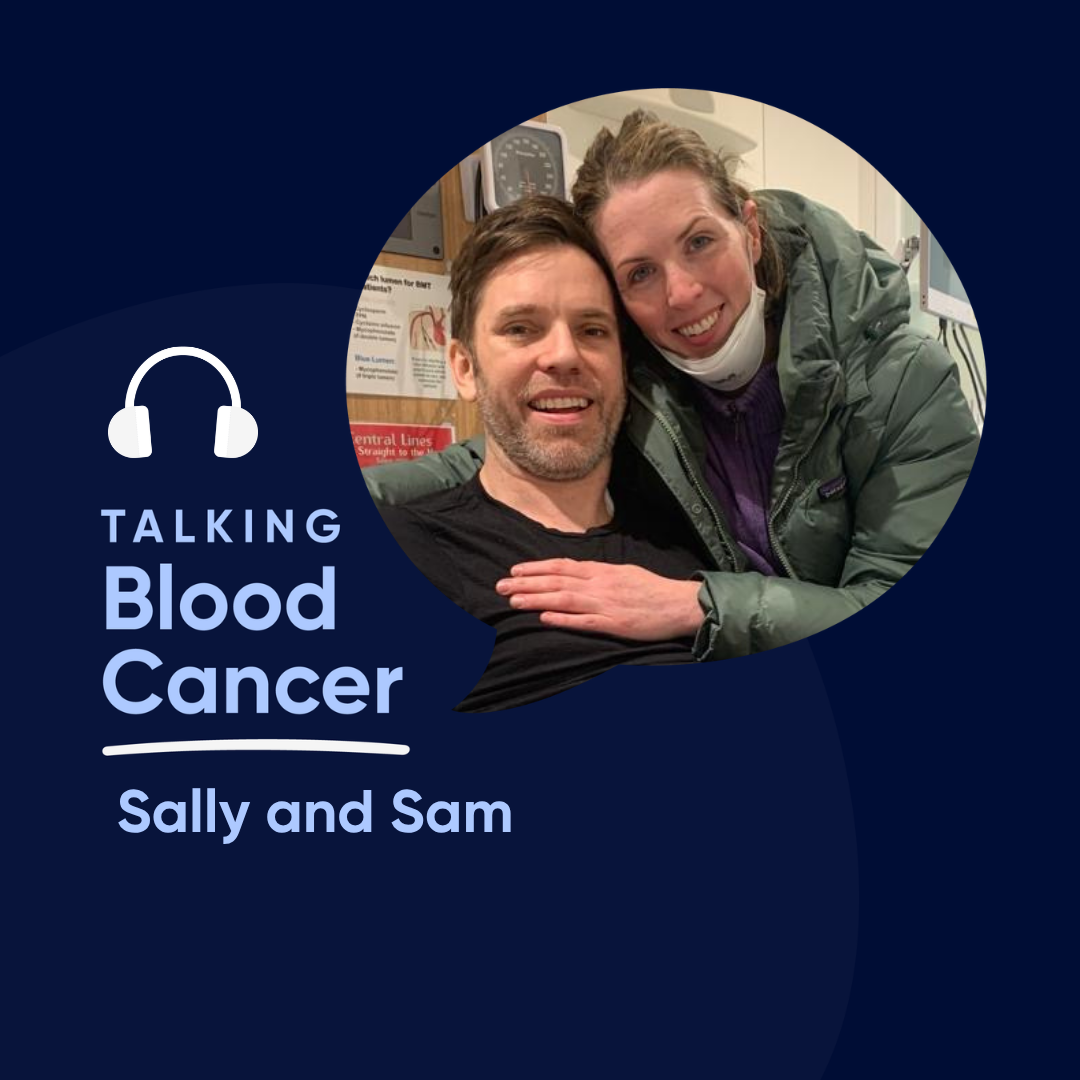
In this episode of the Talking Blood Cancer podcast, host Kate Arkadieff sits down with Sam and his partner, Sally, to explore the reality of receiving and living with a blood cancer diagnosis as a young family in Australia.
Sam shares the circumstances leading to his diagnosis of acute lymphoblastic leukaemia, describing the early symptoms, initial misdiagnosis, and the shock that followed. Sally recalls the immense emotional impact this news had on their lives, the challenges of facing such life-changing information while parenting a young child. Giving insights into the grief, denial, and anger experienced by both patient and caregiver as they navigate the uncertainty that comes with a serious illness.
Delving into the practicalities of seeking help and emotional support. Sam and Sally discuss the importance of honest communication, setting boundaries, and reaching out to external communities, such as support circles and online groups, when immediate friends and family may not fully understand the situation. Both emphasise the value of being able to express difficult emotions openly, and how these shared experiences with others can help reduce feelings of isolation.
They also talk candidly about the strain a cancer diagnosis places on relationships, and the importance of self-care for carers as well as patients. Touching on the added complexity of making treatment decisions and the necessity for individuals to trust their own choices in the face of difficult statistics and medical advice.
Offering perspective and support for patients, families, and carers navigating the emotional and practical realities of blood cancer. This serves to remind listeners that while the journey is unique for everyone, no one has to walk it alone.
[00:02:37] Intro
[00:02:37] Kate: Hi everyone, and I am Kate Arkadieff, your host of Talking Blood Cancer. Today, we actually have a really special episode, and it’s a little different to one that we usually do. Today, I not only have one guest, but I have two. So, in true tradition, I will get our first guest, Sam, to introduce himself, tell us a little bit about who he is, where he’s living in Australia, and what he has been diagnosed with, and then I’ll get his partner.
[00:03:05] Sam: Thank you, Kate. Really glad to be here. My name’s Sam Hayward, and I am located down in Melbourne. I had a very different life than the one I’m living now. But I was diagnosed with acute lymphoblastic leukaemia, and at the time when that came to my knowledge, I was a young parent. I was working a really good job in software development and yeah, trying to embrace that time with a young family. Which became very, very different when a diagnosis came my way.
[00:03:41] Kate: Very busy, no doubt. And who have you got next to you?
[00:03:45] Sam: I’ve got my partner, Sally.
[00:03:47] Kate: Sally, do you wanna introduce yourself?
[00:03:49] Sally: Hi, Kate. Yeah, I’m Sally McNamara, I’m Sam’s partner. What was going on for me at the time? So our baby was about to turn one. And actually, the day, I just remembered this, the day you were diagnosed was his birthday. That’s the day we were planning to have his birthday party. It was a bit earlier than his actual birth date. So yeah, I think we were both tired as new parents are, and working and parenting and getting used to it all still. I would say I was also struggling with that transition. I still felt very much in postpartum. I had quite a challenging pregnancy with prenatal anxiety and then just found it very hard to adjust. So yeah, I just felt like, ‘Oh, maybe now we’re gonna start, coming back to some kind of normal’, and then we got the diagnosis. Yeah.
[00:04:50] Kate: What an entry into finishing off the first year of parenting, to then into another chapter which looks completely different and out of your control, as is parenting. So, Sam, what led you to the doctor? Did you go straight to a GP or did you go to the hospital? What kind of unfolded for you?
[00:05:08] Sam: So in the lead up to being diagnosed, we’d started to notice that I wasn’t having great sleep. And the starting to get a whole bunch of complications through the night. That were really unexplained and given that we’re in the early stages of parenting, I was sort of going, ‘Ah, it’s just tiredness’, you know? It’s the disrupted sleep, it’s working through the rigours of being a parent whilst working full time.
[00:05:38] Kate: Mmm.
[00:05:39] Sam: And it wasn’t till probably a couple of weeks beforehand, where the symptoms, particularly facial swelling, that were presenting, were not going away and they were not getting better. So initially, I called up a GP through telehealth because at the time I didn’t think I could get away from doing the work or give myself enough time, which is a common, I guess, storyline. And then, through going to a…, work, I guess planning weekend, or like it was…, it was a couple of days…, a couple of day conference. And that was really the hinge point where I knew there’s something serious here. I couldn’t explain it. I was sleeping like maybe one to two hours a night, and my face had blown up. So that really led me to wanting to go and see a GP and sort of inquire a bit further. And the response that I got from the initial GP was muted? It was sort of, ‘Oh, we’ll refer you out to go and get a scan, have some antihistamine, sort of see how things progress’. And then, it was the very next day after I went and had that GP visit that I went to emergency after making the decision not to have our son’s first birthday party.
[00:06:56] Kate: Mmm.
[00:06:56] Sam: And it was a long four-hour wait to get seen.
[00:07:00] Kate: Wow.
[00:07:00] Sam: And then, yeah, we were kind of in limbo. Because you’re going through a lot of scans and tests to discover kind of what is actually occurring. But it was, until eight or nine o’clock at night, that some, very, very caring doctors who are in emergency, who were very delicate with kind of that information, that material…, they came in and went, ‘We’ve found something on your chest. And it looks consistent with lymphoma.’ Now, they didn’t go out and say, ‘Hey, this is ‘that’, because you don’t know, it’s still too early to tell. But it kind of meant…, that was a very different time to be in, in life.
[00:07:42] Kate: Yeah, and Sally, were you there with Sam when he was receiving that diagnosis?
[00:07:46] Sally: Yeah. I think it’s strange looking back because I had some kind of intuition something was badly wrong. I think we were both in denial when there was the facial swelling and everything. We just didn’t possibly think that…, like, how could this be serious? Yeah. How could it… So yeah, I was there in the emergency room, and I just remember when they rush in, and someone says, ‘We might have to get ready for surgery.’ And I’m thinking, ‘What?’ I thought this was gonna be a viral infection, you know, or something. And unfortunately, I’d just given Sam something to eat. So that was uh, apparently not what you’re supposed to do. But then they said, ‘Oh, no, we can’t actually operate ’cause it’s on your heart.’ And so then it became a thing of, can we even do chemo? Is it even gonna be possible to treat this because it’s covering such a vital organ? So yeah, it was just surreal as I guess it is for everyone. But yeah, I just remember that my strongest worry was, what about the baby? You know? I want him to have his dad.
[00:08:53] Kate: Yeah. And it’s almost that point of you’re like, how can this be and to be in the stage of life that you were and to then receive a diagnosis like you just have. You go, these things don’t add up. This isn’t how you’re told life is gonna unfold. And then you’re hearing it, and you’re in it.
[00:09:10] Sam: Yeah, it’s very surreal to be in that place. And I knew, well, I think we all knew that things were gonna be very different from this point onwards.
[00:09:20] Kate: Absolutely.
[00:09:21] Sally: I was just gonna say the other thing I’d say, just to round out this kind of piece, is it was also no fault at all of the medical team, but the initial diagnosis was incorrect. It looked much more straightforward until they did some more biopsies. And then it was the news of, you know, I think there was at least eight doctors that walked in, which was terrifying. And they said, ‘Oh, actually, you’re in the wrong ward. We have to transfer you now to this much more serious ward.’ Yeah, so that was just, it was really hard as well for the people around us to understand how it kept changing…,
[00:10:05] Kate: Yeah.
[00:10:05] Sally: …, and to kind of trust that they were being given the information, because I think it felt like for them, ‘Why does this keep getting worse?’ And then a few months later, it was the news of, ‘Oh, we’ve done another biopsy.’ And even though you’ve had an excellent response to the chemo, we’re really happy with that. However, your particular very rare genomic deletion means that now you’re on the high-risk path. So it was all…, felt like trap doors to me.
[00:10:37] Kate: Yeah.
[00:10:38] Sally: Yeah.
[00:10:38] Sam: Yeah, yeah, shifting sand. You never know what’s actually firm that you can be steady on. Yeah, it definitely felt like that through that…, not only the first week, but through to those, you know, first six months.
[00:10:50] Kate: Because you do…, you, you hear this news, you process it as best you can in that moment, and it’s all unfolding. You go, ‘Okay I’ve got my head around…, it’s lymphoma. What’s that?’ And I have no doubt you would’ve read up about it, Googled about it, and then to hear so many days later, ‘Actually, no, you’re on a completely different path’. And they’re very different, and the treatment journeys are very different for lymphoma versus a leukaemia. So again, that would’ve been another whole world in shift. And it’s not only you two, it’s your little baby as well that you have to consider, and think of, ‘How’s this gonna affect…?’
[00:11:23] Sam: Yeah, yeah. You kind of in a liminal place…, kind of in suspended animation really…,
[00:11:30] Kate: Mmm.
[00:11:30] Sam: Because you don’t know what to plan for. It’s very uncertain, and I think that’s one of the harder things to relay to people around you as you’re going through a significant life-altering, life-threatening experience, is that you don’t know what is gonna happen today…, let alone tomorrow.
[00:11:51] Kate: Mm-hmm.
[00:11:51] Sam: And the world…, for most people, continues on. There isn’t that same threshold crossing that a lot of people, you know, that we had to go through. Life still looks as though…, it materially, it seems to be the same, which I think is difficult to comprehend if you’re not actually intimately involved.
[00:12:12] Kate: Absolutely. How was it for you, Sally? Would you agree with that as well? Is that your take on it?
[00:12:17] Sally: Yeah, I’ve thought a lot about the emotional experience, and how it’s sort of like you get given this medical, physical treatment plan, and even mental health these days is more addressed, and there’s not so much…, it just felt like there was no roadmap on the emotional experience. Which I’m actually, I’ve got an organisational change background, so I actually went back to that knowledge, and there’s this model called the Kübler-Ross Change Curve…,
[00:12:50] Kate: Mm-hmm.
[00:12:50] Sally: …, and I believe it was actually originally developed for terminal illness in terms of how you move through stages of grief around that.
[00:12:58] Kate: Yeah.
[00:12:59] Sally: But, yeah…, it was very hard for me to be coherent enough in the distress and in parenting a baby to be able to explain to people, I’m going through this grief. Because people couldn’t understand it, because I think a lot of people felt like, ‘Well, he’s still here. He is gonna be okay.’ And it’s sort of like, ‘Yes, but our life is forever going to have this.’
[00:13:25] Kate: Yes.
[00:13:26] Sally: It’s not this fear of, ‘Is he gonna get through it?’, which was not a given, at all. And at the other side, ‘Is it gonna come back?’ Which we’re also told is, you know, there is a pretty high risk. And so I think it was just really…, we do grieve around just death, but…, yeah. And so I felt like, so those stages are…, and they’re not linear, by the way. They’re denial, anger, bargaining, depression, and acceptance. Why I’m mentioning this is because when people say ‘Ask for help’, you know, ‘Ask everyone around you for help and things’. I was in such fear and denial that it was happening. You know, I didn’t want to call the Leukaemia Foundation because I didn’t want it to be true. I didn’t want somebody to verify, ‘Your partner has leukaemia’.
[00:14:19] Kate: Yeah. This is your experience and it’s valid.
[00:14:21] Sally: Yeah.
[00:14:22] Kate: Mmm.
[00:14:22] Sally: This is actually happening. I didn’t want to.., it took a while to move out of that denial. And then I have to say, Kate, I spent a long time in anger. And I don’t think that’s talked about enough, is…, I was very angry. I felt abandoned with a baby. I felt…, which is completely irrational, of course, it wasn’t Sam’s fault, we all know that. But the fact is, I felt as a new mum, completely vulnerable and alone. Often, I would see everyone around in the ward and things, was much older. And I just had so much anger that this is so unfair. Like, what if my baby doesn’t get his dad? You know?
[00:14:28] Kate: Absolutely.
[00:15:06] Sally: So I would say it’s taken me like two and a half, the full, two and a half years to move into some more acceptance and like a lot of deep emotional processing to do that.
[00:15:20] Kate: And it’s not easy. And a lot of it too…, and what I…, could I ask, is it because so much of it is out of your control? There’s nothing in…, once this blood cancer walks into your life so much becomes out of your control. You can do everything a doctor tells you or everything that you, yourself believe in to help get you onto that path of recovery, but it doesn’t matter. So much is out of your control.
[00:15:46] Sally: Yeah, it’s the illusion of control. I don’t actually think we have control in life. But yeah, you lose that beautiful illusion that all the people your age still have.
[00:15:58] Kate: Yeah. And the illusion that your mortality doesn’t face you until you’re 80.
[00:16:04] Sally: Yeah.
[00:16:04] Kate: That’s a massive illusion.
[00:16:06] Sam: Or the fact that we are not supposed to descend…, we’re not supposed to go into the underworld…, to go into the darkness. Like the cultural story that’s around us is one of light upwards, you know, progress. Always advancing, and getting better, and more, and adding things. Which kind of goes counter to what you’d experience when you are in the depths of that crisis…,
[00:16:32] Kate: Mmm.
[00:16:32] Sam: …, and then coming out of that. Which I think is, is an important thing to acknowledge, particularly around health. Health is kind of like an individual and privatised concern. So if you get sick, then that means it’s all your fault. Or maybe it’s like some sort of transgenerational line that’s come to, you know, somebody did something, three generations ago, and it’s come to visit you…, or some other event that’s occurred. So I think it’s also important to like, see the stories that are playing out kind of from a like a wider lens and opening up, you know, the aperture of what you can perceive. Because when you’re in the dark of going through treatment and experiencing illnesses and side effects, it’s…, you are in another world…,
[00:17:21] Kate: Mmm.
[00:17:21] Sam: You’re in a time out of time, and it’s important to sort of see which stories you’re…, you’re believing in.
[00:17:28] Kate: Yeah.
[00:17:28] Sam: And which one’s resonate. Because they can be sturdy boats, but they can also be bad spells. And I think that is part of the othering nature of seeing people’s lives around us just going on as if nothing has occurred. And instead, we’re in this, you know, this initiation where we don’t know who we are, we don’t know where we are, and we don’t dunno where we’re coming back to. And to not be particularly like emotionally and socially supported in seeing, and just witnessing that. Because I think there’s also a story around, ‘This can be fixed, and if I can’t fix it, then I don’t want to participate.’
[00:18:11] Kate: Mmm.
[00:18:11] Sam: ‘I don’t want to be indebted to that, like putting in efforts around that and being close to that’. That’s a confronting place to be. Because you’re…, by the very virtue of somebody being sick, they’re prompting all the anxieties in another person.
[00:18:26] Kate: Mmm.
[00:18:26] Sam: Because, ‘Oh, is that gonna transfer with me? Or is that like someting that I need to be worried about? Do I have to change my life as a result of having an encounter with this person?’ Which I think is like an important thing to acknowledge because when you are pulled down, like you’ve got gravity into that situation, you’re gonna be clinging onto whatever.
[00:18:48] Kate: Mmm.
[00:18:48] Sam: And I know for me that all the material kind of remedies or interventions, they weren’t enough. Yes, you can have all of the physical treatments, the allopathic medicine, the complementary, and other modalities. But ultimately, there’s another thing you have to cling onto. And, in this case, it was really helpful to have a different view of stories, you know? Sometimes the ones that are slower…,
[00:19:14] Kate: Mm-hmm.
[00:19:14] Sam: That have been building over time, that have been handed down through generations. ‘Cause you know, if it’s handed down, you know, there’s some truth there.
[00:19:22] Kate: Yeah.
[00:19:23] Sam: And it’s also helpful to realise when a story that…, you know, you’re at the end of the story, you need to go and find a new story. That one got me through making that decision about whether to do a bone marrow transplant or not. And then other times, you know, which type of treatment you’re going through.
[00:19:41] Kate: Mmm.
[00:19:41] Sam: So I think that’s a helpful thing to recognise as you’re moving through these stages because a story’s only as good as your resonance to it.
[00:19:52] Kate: Absolutely, and totally. Did you have that view beforehand, or was this something that you developed post your diagnosis and being in this experience?
[00:20:03] Sam: I wouldn’t have had a conscious sort of affinity to it where, you know, I’d realise these fairytales or myths, traditional stories were actually speaking or could be reflected in my experience. But it became a bigger part of life during treatment because you’re looking for anything, you’re looking for anything that’ll offer you know, that return to wellness, that return to health. And they often provided an anchor…,
[00:20:33] Kate: Mm-hmm.
[00:20:33] Sam: …, when the world around you is looking very choppy. So, and I also found like a really helpful community that was sort of dedicated to that and those practices that could offer some space to like…, internal space from what was happening around the world.
[00:20:50] Sally: I think that’s an interesting point, Kate, is that we both found, I feel, the emotional and I would say spiritual support not in the usual places. Like, you know, Sam found it in this…, you could better explain what the community is…, you found.
[00:21:09] Sam: Uh, it’s, a um, mytho-poetic community. It’s an online one called the Fifth Direction.
[00:21:15] Kate: Mm-hmm.
[00:21:15] Sam: And they use storytelling, breath work, meditation, a lot of these grounding practices to have a deeper inquiry into, not only your inner life….,
[00:21:27] Kate: Mm-hmm.
[00:21:27] Sam: …, but kind of the life of the world. And using that as a way of working through the themes that come up in our personal lives…,
[00:21:36] Kate: Mm-hmm.
[00:21:36] Sam: …, but also collectively, to help us be in community, ultimately. Because often, the events that are happening in the world around us don’t make any sense. And we have to rely on something that’s a bit more sturdy than just where we are at.
[00:21:50] Kate: How incredible that you found that space to draw on through, whilst you were going through everything. What about you, Sally? Was yours a similar experience, or was it a touch different?
[00:22:00] Sally: Yeah, so mine was different, but I would say the feeling of it was similar. I joined…, through a friend, I joined a women’s circle that…,
[00:22:09] Kate: Mm-hmm.
[00:22:09] Sally: …, met every month. And again, it wasn’t cancer-specific, but what it was, was it allowed a depth of the human experience.
[00:22:19] Kate: Mm-hmm.
[00:22:19] Sally: You know? It was about grief, it was about celebration, it was about things that you wouldn’t normally speak to people. Kind of removing, I would say, the loneliness of those deeper experiences that we often don’t communicate. When, you know, when people say, ‘Hey, how are you?’ We all just say, ‘I’m good.’
[00:22:41] Kate: Yeah.
[00:22:42] Sally: And I think why that was particularly helpful for me was because it reminded me when I felt that pull to feel like a victim, to feel helpless, to feel like, ‘Why is this happening to me? Am I being punished? Like, why is this happening?’ To hear what was deeply challenging for other people, even though it wasn’t the same. So, you know, it wasn’t the same on the surface, but the depth of the struggle, and the feeling was the same. So it was just such a great anchor to…, nobody’s life is easy, you know, life is here to challenge us. It’s…, we can’t stay lost in that feeling…,
[00:23:23] Kate: Yeah.
[00:23:25] Sally: …, of ‘This is so unfair’, and like I said, Kate, I had many, many months, if not longer in that. So I think that’s the other thing is for me, I didn’t wanna repress that either.
[00:23:35] Kate: Yeah.
[00:23:35] Sally: You know, I took that to that circle, and I’d say, ‘I am so angry. This is so unfair. This is terrible.’ And they could all hold the space for that so that I could move through it instead of staying stuck in it.
[00:23:49] Kate: And it sounds like both of them just gave you such a different space, but different perspective as well of the situations that you were going through. Because…, although you’re walking very similarly on a similar path, but it’s a different experience for each of you that you’re travelling. And can I ask before the diagnosis, were you your go-to people to hold that space for each other when you were going through something? And then the second part of that question, was that rocked because of the diagnosis? Because, did you almost have to go, ‘We need to find it separately because we’ve got so much going on in this bubble?’
[00:24:25] Sam: The short answer is yes.
[00:24:26] Kate: Yeah.
[00:24:27] Sam: Yeah, I feel where our relationship sort of blossomed was through COVID.
[00:24:33] Kate: Mm-hmm.
[00:24:34] Sam: And there was a lot of…, sort of just us-time, kind of finding each other during that period where you didn’t have a lot of access to other people in a sort of intimate way. That meant kind of like, that was the foundation of our relationship. And we were also really young in terms of like how long we’d been together when Oscar came along.
[00:24:56] Sally: We’d only been together two years when he was born, so yeah…,
[00:25:00] Kate: Wow. Yeah.
[00:25:01] Sally: And then three years, I think, when you were diagnosed.
[00:25:05] Kate: So yeah, relatively new into your relationship. It’s still quote unquote, people would say it’s in that honeymoon stage, and then Oscar came along, and it’s…, it moved fast. You’ve been through a lot in your time together.
[00:25:16] Sally: And I was really conscious, Kate. I knew that, you know, a lot of relationships don’t survive through cancer. And I remember we openly talked about it because I was able to share with Sam, I guess the key for us was being honest to say, ‘I’m having, you know, I’m not sorry. I’m really not able to currently be a so-called rock’. I already wasn’t feeling very emotionally stable before this happened. I do also have past experiences growing up that mean that some of that was triggered through this cancer experience. So at least I was able to be aware of that, and as painful as it was, I did have to say, ‘I can’t be your everything. I can’t be the only emotional support’. So that’s what led us to, ‘Well, where is that going to come from?’ Because in some cases, we had to be honest with ourselves that we didn’t have that many people at that time around us that could hold that space. So, I think that’s another part of it. You do have to be realistic and look around and go, ‘Well, have we ever had that kind of relationship before where we would’ve shared deeper things?’ And if you haven’t, then possibly, that’s not gonna be the right place for that.
[00:26:43] Kate: Mmm.
[00:26:44] Sam: Yeah, I think there’s a misconception that when you’re going through hard times, everything bands together. It’s like, it comes together in a much more tactile way. But I think what Sal kind of highlighted is if the patterns of behaviour that have already been there in place haven’t presented that closeness, when you’re under adversity, it’s not gonna get closer most of the time. But then that would lead for other people to step in. Those that do wanna get closer, do want to encounter with what is going on that’s alive for you, that is messy, that’s like…, otherworldly. I think that’s the other, I guess I wouldn’t say ‘blessing’, but there is like something that is enriching and embodied by coming through that and seeing, ‘Okay, like different people are gonna respond to this in different ways’, and I remember having a, a conversation with a friend in the very early days just after I got outta hospital, and he went, ‘Yeah, you know, like you’re gonna see the best and worst of people. You’re gonna see the absolute…’
[00:27:51] Sally: Can I say something?
[00:27:52] Sam: Yeah.
[00:27:52] Sally: And of yourself.
[00:27:54] Sam: Ah.
[00:27:55] Kate: Yeah.
[00:27:55] Sally: As in…,
[00:27:56] Kate: Yeah, it’s so true.
[00:27:57] Sally: Yeah. As in…, and me, I say that for me as well. We’ve seen all the shadows of our own selves as well.
[00:28:06] Kate: Yeah, just because you get a cancer diagnosis, you don’t become an angel and godly-like, and be able to handle everything incredibly perfectly.
[00:28:13] Sam: Oh, it’s…, yeah, definitely. Like you kind of see all the parts of yourself that are still wounded.
[00:28:19] Kate: Yeah.
[00:28:19] Sally: Mmm.
[00:28:20] Sam: That haven’t…, the inner child that’s still wanting some sort of parenting that hasn’t resolved that. And you, often are confronting that or at least I confronted that, we confronted that in this threshold…,
[00:28:34] Kate: Mm-hmm.
[00:28:35] Sam: …, this going through treatments, and recovery, and seeing how that shaped us. How that changed us, how that awareness kind of altered our behaviour in relation to, you know, not just each other, but also to the world around us. A lot of things that you thought were important, become less important when you are faced with, you know, a journey like that. And I think that’s…, it is hard. It’s incredibly hard.
[00:29:05] Kate: You’re feeling all of this and going through all of this, and you are actually really unwell. Like you are physically unwell, and you’ve got physical side effects from treatment, and things like that. And then…, so yeah, you’re going through a lot whilst experiencing that emotional transformation or emotional upheaval as well.
[00:29:26] Sally: Mmm. And I feel like what we did have to kind of say to each other, Kate, is we’re almost living separate lives right now. You are in the hospital, Sam’s in the hospital pretty much for most of a year, right? So we were on two different tracks, and we kind of had to accept our relationship right now is not in a good place. It’s not close. So I felt like just to survive how brutal that treatment was, Sam did have to shut down somewhat emotionally. Like he had to get through it. It was like going through some kind of war.
[00:30:05] Kate: Mm-hmm.
[00:30:05] Sally: So, you know, I just wanna make sure people are hearing that. I feel like we just had to hold on, and we just had to take care of ourselves as best as we could, and get that deeper support we needed. And equally be quite…, I’m gonna say brutal, about what we weren’t gonna do, and what we weren’t gonna waste time and energy doing, and that ruffled feathers. And that was the best advice I personally had from a friend who just said, ‘Listen, your energy cup is…, all your energy’s going to Sam and your baby. And just keeping yourself going in survival. You’re gonna be in survival for a number of years. You cannot be around people or situations that drain you.’ You have to…, or where you feel unsafe or whatever it is…, or unsupported. You just have to be selfish and just focus on being around the community and the people, and fill it up. Fill it up as much as possible so you’ve got that energy to give.
[00:31:10] Kate: And unforgivingly.
[00:31:11] Sally: It was uncomfortable, yeah.
[00:31:12] Kate: Yeah, because it’s not…, I think as you mentioned at the beginning, Sam, it’s that we like things to have a positive story or feel comfortable and be tied up in a bow, and there you go, that’s it, that’s done. But doing that and putting those boundaries in place and going, actually, ‘No, that doesn’t serve me and doesn’t serve what I need right now. Although it may be better for you, but it’s not best for me.’ That’s a really hard thing to say to people because a lot of us are born natural pleasers as well.
[00:31:40] Sally: Yeah, and you have to be prepared to let people go as well. I mean, that’s been my experience, that there were some friends where I didn’t feel like I could go to their 40th’s, and you know, the friendship never recovered, and that’s okay. I’m okay with that.
[00:31:58] Kate: Yeah.
[00:31:58] Sally: It was painful at the time, but I chose my experience…, you know, Sam was in ICU around that time, in and out of emergency. I knew if I went to those events, I’d have to put a mask on and pretend that…, you know, I don’t wanna ruin somebody’s birthday. That’s not fair. But equally, I knew the expectation would be that I told the good positive cancer story, and that’s not where I was.
[00:32:26] Kate: So…, and it, you’re so right, like we don’t honestly ever answer, ‘How’re you going?’, and it’s always, ‘Yeah, I’m good, thank you.’ Not, ‘Oh, I’m terrible, thanks for asking’. Because we then end up…, when you don’t have energy, when you are in an experience like you guys were in, you don’t have that energy to give to others so…
[00:32:44] Sally: Well, Kate, it can be…, I mean, what I felt through this experience is that everything’s heightened. Like it can be that you’re in despair, and also joy. Like it can be…, I mean, I remember being in the hospital one day. I would cry, by the way, every single time, but I went into the hospital. The nurses thought there was something wrong with me. And I was getting a coffee, I was getting something for Sam to eat, and there was this beautiful orchestra playing in the hospital, and I just, I felt this overwhelming, kind of the fragility and the beauty of life. Like it’s sort of like, if you can’t fully feel the despair, you can’t fully feel the joy. And I feel like we have much more access to the joy and the being now. Like the appreciation of life, it’s so clichéd, but because we went through the darkness, and we didn’t try to bypass that experience.
[00:33:40] Kate: Mmm.
[00:33:40] Sam: Yeah. It’s like alive, I feel as though there is something that…, of waking up, of being woken or shaken, in this case, that means that you do have to hold those very visceral, polar kind of experiences…,
[00:33:58] Kate: Yeah.
[00:33:58] Sam: …, all in the same breath sometimes, and to be authentic to that. Because I think that’s the only way that you can continue to operate with the energy levels that you have. Whereas, if you can’t be authentic to it, and honest to it, that’s where it becomes a very trying situation where you are trying to measure up to these expectations or these roles or these masks that have been placed on you from your prior life, you know? And then that’s probably something that…, you know, doesn’t get a whole lot of airtime, is like realising that there have been these expectations on you, and that you should, in some cases, be coming back to that.
[00:34:44] Sally: Back to normal.
[00:34:45] Kate: Yeah.
[00:34:46] Sam: Yeah, back to a normal…, you know.
[00:34:47] Kate: Everyone’s chasing the normal.
[00:34:491] Sam: Yeah, it’s a prior existence, one where you fit in. You are like a cog going into the machine, and that’s often not going to be the case. You know, try as you might, like, you will have changed.
[00:35:03] Kate: Yeah.
[00:35:04] Sam: At least that’s my experience.
[00:35:05] Kate: I wanna just bring you back to what you said, Sam, about the joy and finding it, and tapping into it, and really being appreciative of the things around you. And I wanna ask, in both you and Sal, was it almost a daily practice? Although you were feeling these euphoric feelings, you know, with the orchestra and things, were there times and days that you almost go, ‘There…, I just can’t find anything good, I can’t’. ‘Cause I, I’m thinking of people listening, going, ‘That’s great that they could do that, but I’m not in that space.’ So, it’s…, how do we get people to help to get them to that space?
[00:35:37] Sally: I would say for a year and a half, I was in the dark. You know, I wasn’t having those, ‘Oh, I feel tremendous joy, and deep grief at the same time’. I was really struggling to get through the day, you know, and I feel like how I began to…, and I wouldn’t say I am fully there, like I would say we’re still in recovery…,
[00:36:00] Kate: Mm-hmm.
[00:36:01] Sally: …, from this experience. And we’re never gonna be the same again. But I feel like what allowed me, personally, to start to glimpse or start to have an ability to say, ‘Okay, what…, I would never have chosen this horrific experience. I wouldn’t wish it on anyone.’ And also, ‘What are the things that are now better anyway?’ Like, despite it happening. And I think what allowed me to do that is being with the grief, working with the grief, having people help me process it, like actually experiencing it. Going back to other parts of what’s happened in my life, and working through that. And often I was working through this stuff just with writing prompts and…,
[00:36:45] Kate: Mm-hmm.
[00:3:45] Sally: …, meditations, and whatever I could find, right?
[00:36:48] Kate: Yeah.
[00:36:49] Sally: That, or in my women’s circle, which was free. Like this stuff doesn’t have to cost a lot. There’s so many free resources now. You don’t even need…, for me, a psychologist actually wasn’t helpful…,
[00:37:01] Kate: Mm-hmm.
[00:37:02] Sally: …, with this because that was just talking. I more needed to, to kind of really feel it, do it, yeah. And I feel like, for a long time, I felt like this is hopeless. I’m never gonna be okay. I’m never going to feel anything but sadness. But, I think just by continuing to do that work, and I actually now see it, as it’s gonna be probably lifelong for me…, to keep doing it.
[00:37:30] Kate: Yeah. Well, you felt the benefits of it, right?
[00:37:32] Sally: Yeah.
[00:37:33] Sam: I feel as though it is, you know, there are days where I don’t wanna open the curtains, it’s real dark.
[00:37:40] Kate: Mm-hmm.
[00:37:40] Sam: And to your point, it is about fully feeling the gravity of that grief, that loss. You know, I guess there’s something in…, not only my experience, but like others that have encountered of that primary language, like we have all lost something that’s close to us, that’s true to us. And being able to feel that in its weight, and to sit with it is really hard. But to move on from that, or to undercook it doesn’t allow you to feel those like elevated emotions. ‘Cause otherwise, you know, everything’s gonna be muted.
[00:38:19] Kate: Mm-hmm.
[00:38:20] Sam: You can only feel like this absent sensation of, of being numb. So I think that for me, there was a lot of, sort of, going into the somatic kind of feeling into breath work or meditation or yoga or, um…, writing.
[00:38:27] Sally: You did also…, Sam has been going to this again, not at all a cost thing. This weekly celebration and grief circle, where it’s like everyone just shares what’s here, let’s clear it together, let’s just be human together.
[00:38:54] Sam: And I think that’s a transformative element to be held, and be seen with whatever you’re showing up as not to be fixed. Just to be witnessed in the totality of your experience. And to like come out of a, a one-to-one relationship…,
[00:39:13] Kate: Mmm.
[00:39:13] Sam: …, into one to many, so that you can be in…, I think it’s communitas, as in like everybody showing up has a version of the truth. They are not having your experience, but their experience may have a reflection that you need to hear, that you need to sort of feel, and that can show that you are not alone. Which I feel is something that in the depths of the experience, you can get stuck in. I definitely found moments where you feel as… like I felt as though I’ve only ever felt this. Like, there’s nobody else who could empathise with what’s occurring right now, and doing that monthly ritual of coming back to this space, and sharing, opens that up. Opens the aperture of your own lens up a little bit so you can go, ‘Oh, okay. The experience…, I’m part of like a much bigger experience’. And you know, like, yeah. We are going along together in parallel, but their parts of the story kind of will fit into what you are experiencing at the same time.
[00:40:24] Kate: How powerful.
[00:40:26] Sam: Yeah, it is. It’s tremendously powerful to be able to do that. Because prior to the world changing, I didn’t even know that was possible.
[00:40:35] Kate: Mm-hmm.
[00:40:36] Sam: I didn’t have that felt sense of being able to go to a place and being held. Which is such a, a human quality that we’re yearning for when I kind of had to take stock of where I was being held particularly when I became a parent and I felt like a, you know, this ache of loneliness. Which in that first year of parenting leading up to being diagnosed was very apparent, and it was kind of not really knowing how to access that. And I think that’s something that, you know, in our experience, we had to go and find. That is something that you are not going to get offered by your treating doctors. As you’re…, you’re going through experience, you may get support groups. But I found that they can be very stuck in the medical aspect of, ‘Oh, what’s your diagnosis? Where are you at?’ Kind of like what choices. And it’s, it becomes quite mechanical, and it’s also trying to like…, look for a fix. When in a space like a, a grief and gratitude circle, nobody’s looking to offer a fix. It’s just to be…,
[00:41:42] Kate: Held.
[00:41:43] Sam: To be seen, to be heard.
[00:41:45] Kate: And it’s so…, I say that to a lot of my team. My background is social work, and I now support a lot of the case managers that are here at the Leukaemia Foundation. Sometimes they go, ‘We know we are making an impact, or we know we’re doing this and helping this’. And I always say, never underestimate the power of holding space, and sitting in the mud with somebody. And sometimes that’s not even saying anything, but just allowing a person to be, and to show up their authentic self, and how they’re feeling in that moment without judgment that can shift things that have been stuck for so many.
[00:42:23] Sally: Couldn’t agree more.
[00:42:25] Kate: I am very conscious of time with that, we’ve almost spoken for an hour. And near the end of each episode, we always ask our guests to share some golden nuggets or some awesome words of wisdom that we would leave with our listeners, and I am taking a stop take, and I think you’ve beautifully weaved so many throughout this episode. But I would like to offer you the chance to give some words of wisdom, golden nuggets before we end.
[00:42:54] Sally: I think the main thing I want to say to the partners is…, you are allowed to have your distress, and your sadness, and grief, and you know, don’t let anybody tell you otherwise. Because it seems to be there’s a real…, feels almost like a moral failing, if you, as the partner, carer are saying, ‘I’m not okay’, or ‘Actually, I need you to also see my experience’.
[00:43:24] Kate: Mm-hmm.
[00:43:25] Sally: It almost feels like, ‘Oh, you, you’re not allowed to. That’s selfish or something’.
[00:43:30] Kate: Mm-hmm.
[00:43:30] Sally: If I say what this is for me, then that’s selfish. But I think we really need to remove that shame and stigma because it has a huge impact on your own health, the stress of this experience. And I, I don’t understand how we can tell partners, ‘Oh, it’s not about you. Just be strong’. When you’re literally facing the death of the person you care about the most in the world. It doesn’t make sense. So I think, you know, make sure that you’re in the frame, and that you know as much as you can in your relationship, share what’s going on for both of you.
[00:44:08] Kate: Mmm.
[00:44:08] Sally: And it’s not about saying ‘What I’m going through is worse than you’. It’s like you can both have the tough experience. So yeah, it’s not a competition and we need to just change this idea that just because you deeply love somebody that you are kind of happy to be a carer or you’re happy to be in this experience. It’s…, there were many days where I absolutely did not want to be in this experience.
[00:44:35] Kate: Mm-hmm.
[00:44:36] Sally: And no amount of love was gonna change that. And I’m here because of love. I’m still here, but it doesn’t mean that there weren’t many times where I just thought, ‘This is too hard. I don’t know how I’m gonna stay.’
[00:44:51] Kate: Thank you for that. So beautiful and honest and will resonate with so many people, and it is an unspoken feeling that I know many carers feel. So thank you for giving a voice to that.
[00:45:03] Sam: Yeah, that was beautiful. For me, I don’t think I really spoke about this in the episode, but there’s something, as the person who’s at the centre of the situation, the experience…,
[00:45:15] Kate: Mm-hmm.
[00:45:16] Sam: …, that is the point of encounter. You are the captain, you’re the bus driver, you are the person that actually is in charge, and I feel as though that it’s very easy to forget that, and put your reliance in all of the other helpers. Whether they’re doctors, whether they’re alternate therapists, whether they’re complementary therapists, you can put your hope in them. But there’s, there is a point in time where you will have to make the choices and be okay with that. And that’s important because each person is having their own unique journey, their own unique experience. They are one of one. And when a lot of stats are getting pulled out about, you know, whether this is curative or whether that is going to lead to some sort of positive outcome. It has to be weighed against your…, how you’re uh…, feeling towards that and what you trust, what you have faith in. Which I think is important, because it’s really scary when you are being posed very frightening statistics.
[00:46:31] Kate: Mmm.
[00:46:31] Sam: …, which are pulled from like massive bodies of data, and those not being…, put into context of your life, and what you are going through. You know, I remember having a conversation with a specialist right at the hinge point between things going along as normal, and then things becoming very different after receiving some genetic testing results back. And he was actually honest, which was surprising and went, ‘You know what? I can’t tell you whether you should do this or not. Like it’s sort of 50-50.’
[00:47:06] Kate: Mm-hmm.
[00:47:06] Sam: ‘There are 50 Sams that should do this treatment, and then there are 50 Sams who should not, and ultimately it’s your choice. I can strongly recommend that this might be helpful, but ultimately, it comes down to who you are, and what you value.’ And I think there’s also another aspect of realising kind of what is important to you. ‘Cause going down these fork in the road moments…, is quality important to you? Like, how you live? Or is it quantity? You know, like the amount of years, but does that mean it’s, amended, you’re stuck in bed or, you know…,
[00:47:42] Kate: Mmm.
[00:47:42] Sam: You’re on extreme amount of medication for a very long time or the rest of your life? So I feel as though that’s something that often doesn’t get talked about, but it is really important for somebody who’s going into a cancer experience or is still in. Still in the cancer experience, ‘cause you can take up that role at any time. You know, I know for the first three months, I was very much looking outside of myself, going, ‘Oh, okay, this is what all these people are saying or is the best way of moving forward’, but then there came a time where you have to actually realise that you are the centre.
[00:48:23] Kate: Yeah. I just can’t say how powerful that is because there are so many people that struggle, and are scared to step into their own choice and their own values, and stepping against the grain of what the norm is or what’s usually prescribed. And sometimes it’s really scary to be brave and do that. And, not saying that the other isn’t just as brave, that’s not it at all. But it’s to go, ‘Okay, I’m actually gonna choose something that really aligns with my values and, and what I want’. And it…, both sides of the coin are a gamble, aren’t they? Because at the end of the day, nobody knows which one is going to serve you to your purpose and what you desire and your outcome.
So yeah, I think we’ve covered lots of ground, and I can’t thank you enough, but I always wanna ask, is there anything else that you think is worthy for the listeners to hear or to leave, or do you think that that’s it?
[00:49:21] Sally: I just wanna say, if you’re listening to this, I’m sorry. I’m sorry that you’re in this; it’s really one of the most traumatic experiences I think life can bring you. Whether it’s you or your partner, or your sibling, or parent or child.
[00:49:38] Kate: Mm-hmm.
[00:49:39] Sally: I just…., it’s a heartbreaking experience.
[00:49:41] Kate: Yeah, it really…, and lonely as well. And it’s why this podcast formed was because there were so many people that I would connect with, and we would hear from and say, ‘I’m so lonely and worried and scared, and I just wanna hear another voice or another story who gets it’. And I think what beautifully you guys have done today, and it’s so unfortunate, and I am sorry that you get it, but by you guys getting it and sharing it with us here today, I know it’s going to really be so impactful and important for people to hear and move forward with, so thank you for all the wisdom, the honesty that you’ve shared, and I appreciate you guys.
[00:50:25] Sam: Thanks, Kate. The one thing that I, I probably didn’t touch on, but I would also say, I’m sorry that you are going through this experience as well as, as Sal here. Like, it is horrible. It is an uncontained encounter with death. It’s something that doesn’t have any basis point in the life that you’ve lived till this point in time. And yeah, it’s frightening.
[00:50:55] Kate: Mmm.
[00:50:55] Sam: It’s frightening because it is so close to you know, a material end, and the choices that you’ll have to make are, are hard. And, there’s no easy way around that. You know, all of…, I think when we were going through it, all of the choices were bad.
[00:51:10] Sally: Oh, yes. They were all bad.
[00:51:13] Sam: There were no good choices.
[00:51:14] Kate: Yeah.
[00:51:14] Sam: Um, but I think there’s something else in these experiences that is not just personal. And that’s why I brought up the initiation part, because Francis Weller, who’s a well-known grief worker and psychotherapist over in the States, has this essay in his new collection of essays called ‘In the Absence of the Ordinary’, and he deems these encounters with death as rough initiations, not to sort of talk about the severity? Just the fact that they’re not contained. But yeah, and they’re generally associated with trauma. So it’s not just a, a cancer diagnosis. It could be a, a breakup, somebody else dying, a job loss. You know, these moments where life changes, and because that nature isn’t held and we don’t know where we’re going back to, it’s hard to see when you are all by yourself in the darkness, that you are going to ultimately offer some medicine to somebody else. And I guess that’s part of reason coming on this podcast, the fact this podcast exists, which is a beautiful thing, a beautiful resource, is to be able to offer that human medicine back to the waiting village.
[00:52:34] Kate: Yeah.
[00:52:34] Sam: In the traditional kind of like understanding. So I think it’s important to also hold that. It’s like there is medicine, there’s also this very dark experience that somebody’s going through. So yeah, I think that’s what I could leave, offer as a signpost.
[00:52:51] Kate: What a beautiful signpost it is, human medicine. I absolutely love that, and it is a beautiful dose to have…, I’ve received today from you guys. So thank you so much for your time.
[00:53:03] Sam: Thank you, Kate.
[00:53:04] Sally: Thanks, Kate.
[00:53:05] Outro