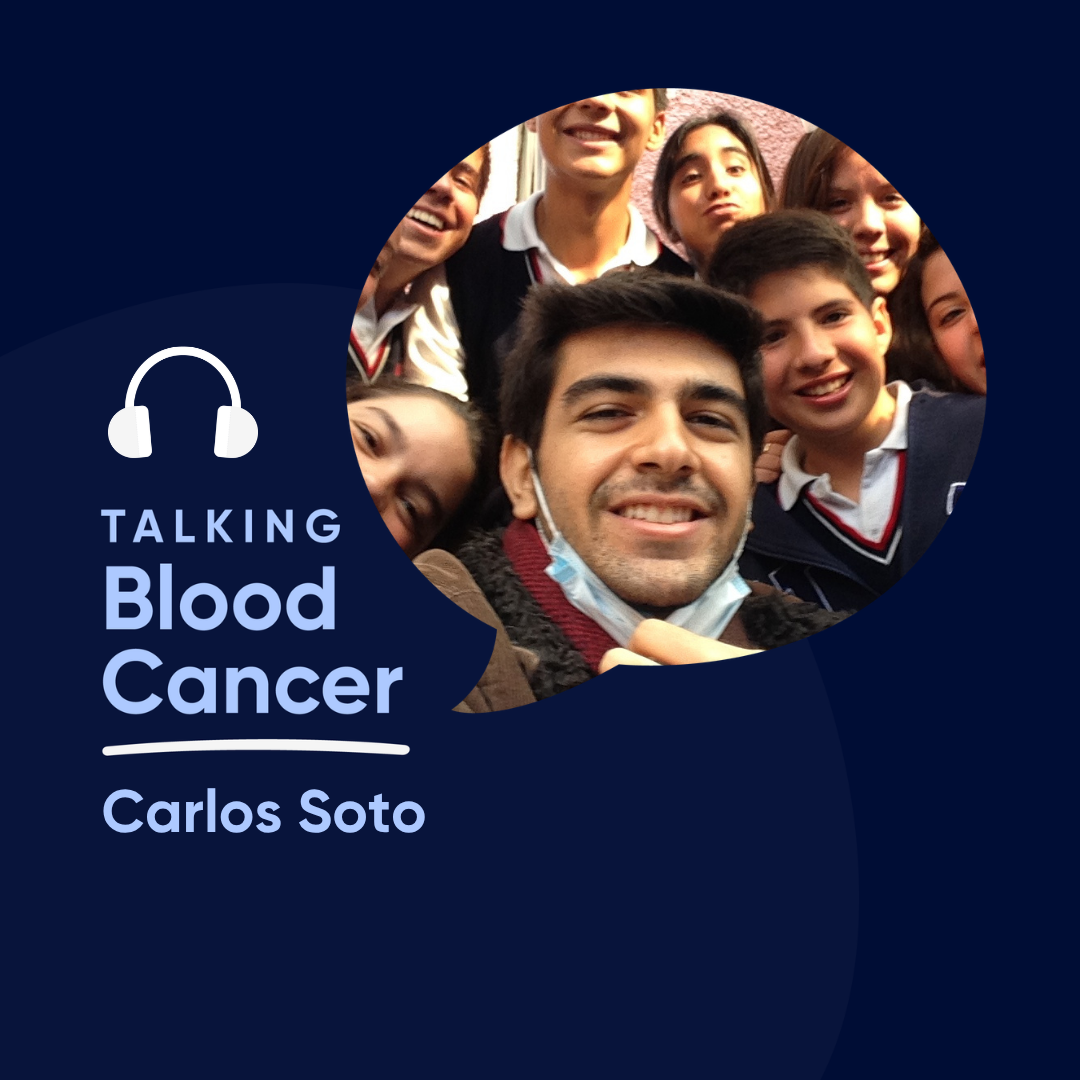
In this episode of the Talking Blood Cancer podcast, host Kate Arkadieff sits down with Carlos Soto to discuss his experience as a bone marrow transplant survivor after being diagnosed with aplastic anemia at the age of 20. Carlos details the challenges he faced following his diagnosis in Mexico, the difficulties in finding a diagnosis, the struggle to access treatment, and the reality of funding his own life-saving procedure due to limited healthcare coverage for unrelated bone marrow transplants.
Carlos describes the emotional and physical challenges of living with a serious blood disorder, from experiencing extreme fatigue to coping with periods of isolation and depression. Explaining how community support, family, and fundraising were essential in securing the funds needed for a bone marrow transplant from a donor in Germany, and highlights the complicated logistics and emotional ups and downs that came with the process.
Talking about his long recovery following a transplant, including ongoing health management, coping with side effects like blood clots, and the importance of continued medical follow-up and self-care. Carlos shares how techniques like meditation and mindfulness helped him navigate difficult periods, and he reflects on the role of gratitude throughout his journey. They discuss the impact of family, particularly the vital support from his mother, and how Carlos took personal responsibility in managing his health after transplant. Concluding with Carlos encouraging others to consider registering as bone marrow donors, noting how simple acts can give someone a second chance at life.
[00:00:00] Introduction
[00:02:37] Kate: Hi there, and welcome to Talking Blood Cancer. My name is Kate, and I have a very special guest today who I’m very excited to share this conversation with. I will let him introduce himself, but as we always do on this podcast, I ask the guest to introduce themselves with their name, where they’re located, how old they are, and also what they were diagnosed with. So I’ll hand it over to you.
[00:02:58] Carlos: Hello, Kate. Thanks so much for inviting me. My name is Carlos. I’m originally from Mexico, but I moved to Australia, Melbourne specifically, six years ago. I am a bone marrow transplant survivor.
[00:03:14] Kate: Wow.
[00:03:15] Carlos: Yeah.
[00:03:16] Kate: And what did you have your bone marrow transplant for? Can I ask?
[00:03:19] Carlos: I was diagnosed in 2013. I was 20 years old when I was diagnosed for aplastic anaemia and…,
[00:03:31] Kate: Yeah.
[00:03:31] Carlos: It was a bit of hard time back then finding what was the actual diagnosis. So the doctor first told me that it could have been leukaemia, and then just receiving the leukaemia news for your first time when you’re 20 years old. Well, it doesn’t matter which age you probably hear that, but it will be horrible. It was impactful. I remember I was with my mum somehow, I was never…, had to go to the hospital or anything like that. I was considered myself a very healthy and good student, use to do sports, all types of sports, and all of a sudden I start feeling horrible. I start feeling a little bit tired. I couldn’t walk more than…, not even a block, and I was already very exhausted of just…, remember also like standing up. And I felt like a little bit of a dizziness when I stand up, and then my head would hurt me a lot, and I was like, ‘What’s happening?’ I don’t know. I, I’ve never thought it was gonna be that…, that bad until I did my general studies, you know, and it was…. Yeah, the doctor just came, and after a few studies…., like at the first…, my GP told me, ‘You know what, you have to go to the hospital immediately. You have to check further. ‘Cause those labs are not necessarily good.’ So then once I went to the hospital and they redo the labs, just to double check they were correctly. That’s when they did not allow me to get out of the hospital. They were like, ‘Welcome to the hospital. You’re gonna stay here for a long time.’ And I’m like, ‘Wait, what do you mean?’
[00:05:07] Kate: Wow.
[00:05:08] Carlos: What’s the…, what are the…, what’s going on with my labs or what’s going on with my…, when you, you saw my haemoglobin going down to, I don’t think it was like four? Four haemoglobin and then like platelets. They were on the…, very low, very, very low.
[00:05:23] Kate: Mmm.
[00:05:23] Carlos: Like 8,000 platelets, that we were supposed to have a minimum of 150,000. So, nah, they didn’t allow me to stand up or do any sort of effort. And I was standing, I was standing, and they put me in a wheelchair, and he is like, ‘You don’t stand up, and you don’t have to do any effort because your platelets are so low.’ So then you can…, you’re in a risk of having a…, I don’t know, anything.
[00:05:46] Kate: A bleed out, yeah. And were you by yourself? Like being 20, and as you said, you…, you hadn’t ever been in a hospital environment before. I mean that in itself would be overwhelming, I imagine, on top of finding out news.
[00:06:01] Carlos: Yeah, totally. My, I was with my mum, so…,
[00:06:04] Kate: Mm-hmm.
[00:06:04] Carlos: …, the first time after they rectified the labs and the first news to us was…, my mum is a single mum, so I’m a single child in terms of my mum part. So it was very tough, very hard from both to hear that we, well, it was either leukaemia or aplastic anaemia. Then…,
[00:06:26] Kate: Mmm.
[00:06:26] Carlos: …in the first time we received the news, and then I stayed in the hospital for over a month. ‘Cause they had to do a biopsy to take my bone marrow sample, and after the biopsy results came, they confirmed it was aplastic anaemia. So by first, aplastic anaemia, you would’ve thought, ‘Ah, well it’s anaemia.’ I will probably just get a few packages of iron or whatever, and they’ll be out of the hospital in less than three days. But no, at the end, when you go research, it’s anaemia…, aplastic anaemia will be kind of like a leukaemia, but without cancer. So it’s kinda like your bone marrow or sometimes even different ’cause leukaemia, you can fight it with chemo. While aplastic anaemia, you cannot necessarily do chemos. You have to go to a different sort of experimental…, I did some experimental treatments, which did not work.
[00:07:22] Kate: Ugh.
[00:07:22] Carlos: And after two years in February 2015, I had to go through a database. ‘Cause as a single child, I did not have any siblings. So no one could have be a match for me to, to be a bone marrow transplant recipient. So yeah, it was a challenge. It was a lot of emotions involved within depression of being a 20-year-old guy that was starting his university, and all of a sudden you have to stop. You’re not allowed to go anywhere close to anyone, you have to just remain isolated. It was like I would’ve done my COVID-19 like earlier. I don’t know. It was…, COVID-19 was like, ah…,
[00:08:01] Kate: You were in isolation before.
[00:08:02] Carlos: Yeah, exactly.
[00:08:03] Kate: Mmm.
[00:08:03] Carlos: I was in isolation. So it was…, it was tough. But fortunately I did my, my bone marrow transplant was in Mexico. So back there, you don’t have such Medicare or anything like that. So it’s either you have a private health or…,
[00:08:20] Kate: Mm-hmm.
[00:08:21] Carlos: The public sector would not cover anything related with a bone marrow transplant that is a non-related one. You know what I mean? Like…,
[00:08:29] Kate: Okay. Yeah, yeah. Related cells, is that what you mean?
[00:08:33] Carlos: Yeah. And like, like if, you have any siblings and they match, then they will do it. But…,
[00:08:40] Kate: Yeah.
[00:08:40] If, If you don’t have any siblings or someone that can match you, then they wouldn’t do it. Like you’ll be just…, they will try to keep you alive by putting…, I used to go to the hospital every three weeks to get blood transfusions and platelets transfusions. So I used to compare it to the gas station to get blood and try to feel…,
[00:09:00] Kate: Top up.
[00:09:01] Carlos: Yeah, top up and, and feel slightly better. ‘Cause it wasn’t feeling good. It was just a little bit better.
[00:09:06] Kate: It was maintaining.
[00:09:07] Carlos: Maintaining. But even after a week, I was feeling bad again. So, yeah.
[00:09:11] Kate: How un…, I mean, as you think about the Australian healthcare here and how the government will fund, no matter which transplant. Which is absolutely…, it is amazing. And it’s what you need, and it’s not your fault that you didn’t have any siblings. You know, and it’s,
[00:09:26] Carlos: Yeah.
[00:09:26] Kate: It’s your circumstance, and sometimes here, people in Australia, I know, ’cause obviously that’s where I work, but people can have multiple siblings. I remember when I worked at the Royal Brisbane, there was a man there that had 10 siblings and not one was a match.
[00:09:37] Carlos: Yeah.
[00:09:38] Kate: And it really is just the luck of the draw, and wow, that’s incredible. So did you have private or were you…
[00:09:46] Carlos: No, no, no, no. I had to go through a whole self-funded sort of events. I had to create a lot of things so I could…, what I did was I had to go through a private association. That association, they had a national database and also an international database. So that database is where all bone marrow transplant potential donors just register, and if they could have found me a match, then I had to pay about 60,000 US dollars. So that was the price. Paying 60,000 US dollars to bring that bone marrow transplant. Like it’s, it’s not…,
[00:10:28] Kate: It’s not even to have it.
[00:10:30] Carlos: Not even to have it. Like it’s to only to transport it into Mexico. So I had to create some…, I don’t know how it happened, but thanks to social media as well, Facebook did a great job and family, friends gathered together, helped me do fundraisings and we were able to achieve the 60,000 US dollars plus the hospital and anything that had to be involved, it was probably about a hundred thousand easily.
[00:10:58] Kate: Carlos, that is just mind-blowing, and I’m thinking of the stress of trying to do that while also being unwell, being young, and then as you said, dealing with depression on top of that. But fighting so hard for your life to live and also to fundraise for your life.
[00:11:16] Carlos: Yeah, you know, that was a rough sort of moment, but somehow, I had this mentality of going all in and try to, I remember going also to all types of churches, Catholic churches, Christian churches, like any sort of religious events or stuff like that. And I remember asking the people like, ‘Hey, can you let me talk? I just wanna ask some help. This is my diagnosis. This is the amount I got. I have to get $60,000 in eight…’, because I had a timeframe as well, because once they found my match, I had to pay to bring it over. And that timeframe was maybe, I think it was three months. So, within three months, having to get first of all the 60,000 US dollars, getting it within three months, that was incredible. And, we did it like I was so blessed and so grateful with all my friends and family that gathered together. I, I remember creating bracelets, that those bracelets were able to sell them all over Mexico and sometimes even the US as well, they went over there.
[00:12:17] Kate: ‘Cause where was your donor?
[00:12:19] Carlos: My donor was originally from Germany.
[00:12:21] Kate: Lots of um, donors come from there.
[00:12:23] Carlos: Yeah, they have the biggest bank, database pretty much.
[00:12:27] Kate: So from selling bracelets, knocking on church’s doors, you were able to raise that money in three months, and while still also receiving treatment. And they do say, you can feel the essence of your village around you when you’re hit with hard times. And I imagine from your story, that’s what you would’ve felt, you would’ve felt the strength of your village.
[00:12:51] Carlos: Yeah, definitely. It was very um, hard time, but very grateful that we did it. And, you know, also having the risk of, once you… Okay, we were able to raise the money and then what? Everythings that involved into bringing that bone marrow transplant that…, at the end this person would agree to the processes and after the processes, transform them in a clean and suitable way that can arrive from overseas to here, and then me being ready so I could receive the bone marrow…, Oh my God, it was so many things.
[00:13:26] Kate: Yeah.
[00:13:27] Carlos: I, I had, before the transplant, I received like very strong chemos…,
[00:13:31] Kate: Yeah.
[00:13:31] Carlos: Chemotherapy and that’s what they do to, in order to reset your bone marrow transplant, and then you can receive the new one. So yeah, that was um…, stressful.
[00:13:41] Kate: Did you do anything to prepare your body for that? Like before the lead up? Like, did you exercise, did you…?
[00:13:48] Carlos: I…, no, they did not necessarily allow me to exercise myself. But you know what? I had to go through a lot of meditation, I learned to do a yoga that…, it’s called Qi…Qigong. It kind of like a Chinese yoga sort of thing. And I learned to do that ’cause you kinda like an easy way of calm your mind or distract your mind and try to be focused on that…, your body knows, and your body will do the best for you, will accommodate the new bone marrow. You know, it’s…, I don’t know, I, I, I had to play with my mind and try to fake it till you make it, pretty much. And…,
[00:14:26] Kate: Absolutely. I would say to people preparing for a bone marrow transplant is really like preparing for a battle. Not only do you prepare your body, you know, by you doing movement and exercise and stretching and things like that, but also preparing your mind. It is a battle, and it…, as you, potentially can contest to is that it’s sometimes the mental battle and the mental strength that you need is the biggest…,
[00:14:51] Carlos: Yeah.
[00:14:51] Kate: …, challenge that you have to overcome.
[00:14:53] Carlos: Yeah, that’s right. And once you receive the bone marrow transplant, like it’s not easy ’cause you have to prepare also from the ups and downs. I…, once I received the bone marrow transplant, they…, there was a high risks of me losing the bone marrow somehow, and I had to get more medicine. But mentally, it’s also horrible to know that after doing all that, to raising all that amount of money and being in place, that you can lose that bone marrow in…, so quickly. So the doctors did a great job as well. They did everything to keep…, and to increase my blood levels and to keep it in, the perfect sort of medical way possible. Had a lot of issues in terms of…, in the first chemos, they had to remove my gallbladder. And then I went to surgery a couple of hours before receiving the bone marrow without any sort of defences, like white blood cells. I had none of them.
[00:15:54] Kate: None.
[00:15:54] Carlos: So it was very risky. ‘Cause even if I went through a surgery where they could, any bacteria, any sort of small little thing can…, could have killed me. And then receiving the bone marrow by itself. So we, yeah, there you go. I think we took a lot of risks, but somehow we made it.
[00:16:10] Kate: Yeah, you did. And then can I ask, was there a sense of pressure thinking, ‘We’ve done all this, we’ve got this far, we’ve raised this money, and now…,’
[00:16:19] Carlos: Yeah.
[00:16:20] Kate: As you say, ‘It’s all on me to help this work.’ Well, not on you, but you know your bodies.
[00:16:24] Carlos: Yes, yes, of course, of course. You feel pressure in terms of you want to feel better, you think that you will be normal or what you remember to be normal in like weeks, but that’s not the process. Like, it’s a long process. It took me…, after the bone marrow transplant, it took me two years to feel back to normal or to go back to my normal exercise without having to feel agitated or to be able to go back to school, to go back to my social life, it took me a long time. ‘Cause you have to take very good care of yourself in terms of minimising risks, minimising any people that would be sick or something that can…, ’cause you are depending on your diagnosis, but your immune system is suppressed on purpose with some medications, and you have to take yourself very serious too. Or you go with the, even your friend, you cannot see your friends if they’re sick. You cannot necessarily go outside. It’s a big risk, at the end, within that period of time, unless you’re lots…, unless your doctor tells you otherwise, at the end everyone picks or…, everyone has their own battle. And for me was two years after, so I had to prepare that two years, preparing myself and sometimes feeling depressed because my blood counts were going down again, and ‘Oh my God, now what happened?’ Now I’m losing it again. So I, I was in risk of losing the tissue maybe like three times. So in three occasions I had to go back to the hospital, and restart again, kind of like the process.
[00:18:11] Kate: Wow. I think it’s so powerful that you say that. To acknowledge that just because you have the bone marrow transplant and that you get out of hospital. And for us here in Australia, we very much talk about this magic hundred days. And that people sometimes tend to think that, ‘Once I’m past that hundred days…,’
[00:18:26] Carlos: Nah, that’s not it.
[00:18:28] Kate: Yeah, the journey to begin to heal, and me being back to…, no one can see this, but quotation marks, ‘normal’, is not always necessarily the truth…,
[00:18:38] Carlos: It’s not.
[00:18:38] Kate: …, not always the truth.
[00:18:39] Carlos: Yeah, that’s right.
[00:18:40] Kate: And I think it’s so powerful that you say that care did take you two years, and it was a rough two years in that time. But you did eventually get back to what you love, and being active in society again.
[00:18:51] Carlos: Yeah. Yeah definitely. I’m so grateful. Now I’m married. I have a beautiful wife after 10 years. So I…, my bone marrow was in February 2015. Now over 10 years, no complication after those two years, of course. But now, I’m happily married and have a newborn as well. So something that you probably wouldn’t think when you’re strolling, before, during that time, I’ve never thought I was gonna have a kid, or I was gonna…,
[00:19:23] Kate: Or be in Australia?
[00:19:24] Carlos: Or be in Australia.
[00:19:24] Kate: Did you think you were going to be in Australia?
[00:19:25] Carlos: No, not at all. Not at all.
[00:19:27] Kate: Yeah, wow. And during that two years, can I ask, you said that you dipped in and out of depression and…., what got you through those moments? What got you through those moments of despair, dark days?
[00:19:39] Carlos: You know what, like definitely a…, lots of self-help…,
[00:19:44] Kate: Yeah.
[00:19:44] Carlos: …, books. Keeping my mind distracted, that’s the hardest thing. Keep your mind distracted. Like in terms of into positive. ‘Cause you can go very easily into a negative loophole of going anywhere and just going…, everything is gonna be dramatic, every…, ‘I’m gonna die or what’s gonna happen if I…’, ’cause that happened to me. You know, after three times that I was about to lose the tissue or the bone marrow, then I felt like any single thing could have been wrong. Or you feel like, ‘Oh my God.’ But it’s hard. Once you feel that, it’s, yeah, okay, well I, I accept that I’m worried about my health. Go check first, ’cause you have to go to the hospital no matter what. If you have any fever or if you have diarrhoea after your bone marrow transplant. Those are the two things that you have to go straight to the hospital to check that everything is fine with you. Don’t leave it for a…, another time. Like it’s serious, and you don’t want to mess with bone marrow.
[00:20:40] Kate: And I know that hospital is the last place that you wanna be…,
[00:20:44] Carlos: That’s right.
[00:20:45] Kate: …, after being in hospital for such a long period, but they’re there to help you, and…,
[00:20:49] Carlos: Yeah.
[00:20:49] Kate: You’d rather get on the issue while it’s relatively small or just beginning, rather than having to try and chase your tail ’cause you’ve left it…,
[00:20:57] Carlos: Yeah.
[00:20:57] Kate: …, unfortunately too long.
[00:20:59] Carlos: Yeah, but definitely books, TV shows, comedy TV shows, something that could distract my mind and focus it into a positive way. And meditation, learn meditation, my Chinese yoga, that helped me to keep myself distracted. I try to study online, but it was hard. It’s tough times when you are not feeling well. And yeah, maybe going back to walking and, and slightly do sports again. That was one of the things that I could have get my life back together and feel better.
[00:21:38] Kate: Yeah, and have a sense of control as well, like in purpose is that something also that was important to you during that time?
[00:21:45] Carlos: Yeah, yeah, definitely. Something that I always wanted to…, my mum, originally didn’t want me to have the bone marrow transplant because the risk involved in the bone marrow transplant, it was quite high, maybe back 10 years ago. But my chances of surviving was kind of like 50% and, that 50%, you had to divide it into lots of different things that could happen. So, keeping your mind…,
[00:22:11] Kate: Yeah.
[00:22:11] Carlos: …, focused on a very small percentage of chances to survive, it’s hard…,
[00:22:18] Kate: Yeah.
[00:22:18] Carlos: …, but it’s not impossible. So…,
[00:22:20] Kate: Yeah.
[00:22:21] Carlos: I think I was always in my mind like…,
[00:22:24] Kate: Yeah.
[00:22:24] Carlos: ‘Let’s just do it and see how it goes.’ But always…, it is not how it goes. Like focusing on the best of the outcomes.
[00:22:30] Kate: Yeah. And you’re so right. It’s for a lot, it is. There are huge risks in a bone marrow transplant, and nobody knows what the outcome is going to be and the chance of being able to live. And I’m staring at you today, and it is an absolute assumption, but you’re living well, and that’s the goal you went in for, and that’s what you wanted to achieve, and I’m very glad you took that risk.
[00:22:52] Carlos: Thanks so much, Kate. I am, I’m glad too. And also, you know what I’m very grateful and every day I always practice gratefulness. That’s something that helped me as well. Like every single time before my bone marrow transplant, when I was receiving blood transfusions, they’re from donors all around. And every time that I receive a blood transfusion, I always thank the person that beat that extra effort of donating the blood, and same thing happened once I received the call from the doctor telling me that they found a match for me. I went on my knees, and I was like, ‘Oh, thank God.’ I was like, I just went on my knees and, ‘Thank you, God. Thanks life for giving me another opportunity’. And today, I still say thank you every day for that bone marrow transplant and for that person in Germany. His name is Thorsten, and I’m so grateful for him. Yeah, we’re in contact now. I haven’t met him, but yeah. I’m so excited to meet him. But we’re in contact through social media, Facebook, and Instagram, but…,
[00:23:57] Kate: How did you find him?
[00:23:59] Carlos: I was a volunteer in the association that helped me found him. After two years, you’re allowed to get in contact with your donor.
[00:24:13] Kate: Yeah?
[00:24:14] Carlos: So yeah, they asked me, ‘Hey, do you want to know who your donor is?’ And I was like, ‘Yeah, of course I am.’ And they asked him first if he was okay to share his contact details or whatever. So he…, we could be involved, and after he’s saying yes, then they tell me, ‘Yeah, okay, this is your contact. You’re free to be in contact.’ And since then, yeah, we, we’ve been in contact. I haven’t get to to go to Germany to visit him or him to come over here, but uh, well eventually we are definitely programming to meet up.
[00:24:46] Kate: To connect.
[00:24:48] Carlos: Yeah.
[00:24:48] Kate: I was speaking with someone last year who was thinking they’re coming up to their 10 year anniversary of their bone marrow transplant. And they were thinking of connecting, but they’re very hesitant to connect with their donor. What was it like for you to reach out to your donor? Was it…, how were you feeling? Were you anxious? Were you lost for words?
[00:25:10] Carlos: Yeah, yeah, definitely. Lost my words. I started crying ’cause I remember also, my mum was with me, so she encouraged me. Of course, me, I was so…,
[00:25:20] Kate: Yeah.
[00:25:20] Carlos: …emotionally grateful. And it was a great moment to finally meet him. Like him, probably…, Thorsten was like, ‘Okay, now that’s fine. I mean, it wasn’t that hard.’
[00:25:30] Kate: Yeah.
[00:25:30] Carlos: He was saying, ‘No, it was hard…, It wasn’t that hard. I had, I just had to take a train down to that place and stay there for just under observation. But it was very straightforward, and I went back to my home the next day’. And I’m like, ‘Oh, thanks so much. You have done such a huge difference in my life. You have given me another opportunity to live.’ And you know, my previous life wasn’t similar to, you know, what I’m feeling after the bone marrow transplant. Like the bone marrow transplant generally make your life back to where you, or at least…, yeah, definitely like back to normal. Like my bloods are normal, like I don’t have to go back to get any blood transfusions anymore, nothing. I can say I’m completely healed and healthy, and I’m so grateful. So yeah that time when I first talked to him was very emotionally beautiful.
[00:26:26] Kate: And as he’s saying, just so simply, ‘Oh, I just caught a train, and I just had to be observed.’ It’s…,
[00:26:31] Carlos: Yeah.
[00:26:31] Kate: The impact of that simple act of kindness that he gave to a complete stranger. And then what he’s given you the gift of, as you say, a second chance of life is absolutely incredible.
[00:26:44] Carlos: Yeah, and I think now the thing is try to encourage people that hasn’t registered yet or that he’s thinking of registering. It’s definitely…, try. I know it’s not an easy thing. Do a little bit of an extra mile and provide your details and get yourself a swab, so you can be in the database in terms of DNA matching for other in Australia, because what you want as well is we want to have a bigger database right in Australia. I know Australia database is not very big. So yeah, I will definitely encourage anyone that is listening to give a little bit of an extra mile and knowing that you have the opportunity to save someone else’s life. It could be a child, it could be a teenager, or it could be another person, but definitely encouraging to, to give us another chance.
[00:27:39] Kate: And you’re right. It…, what it is you’re giving a human another chance, regardless of their age.
[00:27:45] Carlos: Yeah.
[00:27:45] Kate: You’re giving a human another chance of life, and it is a simple act. And what I didn’t realise for a long time, and…, is that you do have to be under 35 to register to jump on that database. And I think that, if there is anyone, as you say, that is listening, to just jump on. And it’s not that you potentially even will like look at your story, you know, of helping someone within your own home country, but helping someone across the world that to be able to donate, and you look at how hard you fought to even be able to receive those donations, and those cells, it really is an absolute courageous story. And I really do hope that it gives lots of people the encouragement that they need to start that conversation if they’re over the age of being able to register with their people in their lives that are able to jump on and register.
[00:28:34] Carlos: Kate, that’s right.
[00:28:35] Kate: I know you said in that two years, but…, and I’m thinking that you’ve moved country as well during that time, but after that two years, did you have any side effects, or have you noticed…, were you on steroids, did you have any joint issues, or anything like that?
[00:28:49] Carlos: Yeah, yeah, yeah, yeah, totally. I did. So the steroids made my blood clot. So…,
[00:28:59] Kate: Okay.
[00:28:59] Carlos: I had three episodes within different timeframes, but after six months of the bone marrow transplant, I was on a high doses of steroid um, Prednisone, and those lower my…, how do you call, like bone thickness? Or like, so…, my bone density, yep. And apart from that, I also started to clot. So I got some pulmonary…, I forgot the name or…, in medical name, but anyway, I had clot stuck on my lungs, and it was…
[00:29:38] Kate: In your lungs, did you say?
[00:29:39] Carlos: Yeah, all of a sudden I, I couldn’t breathe or I had a very hard time breathing. I was normal, completely normal. And then all of a sudden I couldn’t breathe properly, and I was like, ‘Oh, I think I’m having a heart attack’, or something like that. ‘Cause I feel kinda like a pain in the chest, and it was hard to breathe. ‘I can’t really breathe, take me to the hospital.’ We were in Mexico City in peak hours, anywhere that you go to any hospital, you probably take two hours. So I remember my mum was driving so fast trying to sneak between the traffic to get me to the hospital, and I had to calm myself. They saw me, they took some x-rays immediately. They found I had some, like lots of clots in both lungs and in the middle there was, they were a little bit obstructing. They were like, ‘Ah, have…, we have no idea how you’re still standing here, but just get this blood thinners straight away’. And I’m leaving with blood thinners after that because it happened twice. And then a third time two years ago as well. But it was a little bit of a negligence for myself that I kinda like stopped taking the blood thinners. I thought I was fine. I thought I was not…, it’s been so long. I’ll probably be alright. I don’t necessarily need, ’cause I had the smaller dosage of the blood thinners, so I said maybe I wouldn’t need them, but I guess I do. Yeah, I learned my lesson. I went to the hospital again, and I was in New Zealand back then. I was like, ‘Oh my God’, yeah. No, crazy. But I’m so grateful that I’m still alive. I’m still making it. So be careful. Try to pay attention to your doctors, and just whatever they say, do it. Do it as they say.
[00:31:24] Kate: Yeah, and I think it’s, you know, in the message of that, what I’m getting is that although, yes, time may have passed and you may have…, I wanna say move forward. I don’t wanna say move on ’cause you can never move on from something.
[00:31:35] Carlos: Mmm.
[00:31:35] Kate: But yeah, move forward with life, but the experience and sometimes the side effects of the transplant is always there… Doesn’t, as you say…,
[00:31:44] Carlos: Yeah.
[00:31:44] Kate: Like for you, it’s been many years down the track and you, you thought, ‘Oh, I don’t need that anymore.’ But it’s still, it’s kind of always that reminder that, ‘Oh, no, you’ve still got some side effects that still are around, even if they’re underneath and grumbling that you might not necessarily be aware of.’
[00:32:00] Carlos: That’s right, Kate. That’s right. Yeah. Now we have to be aware of those side effects ’cause, um…, they can turn into a very bad moment.
[00:32:10] Kate: Yeah, absolutely. And it sounds like your mother was such a pillar of strength, and really, you said it was just you and her and that she was there and driving you crazily through the city of Mexico to get you to where you needed to be, and fundraising for you. Was she that to you? Was she that pillar of strength?
[00:32:29] Carlos: Totally.
[00:32:28] Kate: And then I think…, how did she let you go to move to another country? Yeah, how was…?
[00:32:33] Carlos: Yeah, my mum was always a very…, like my main pillar. But in that special moment it was tough. Can you imagine? My mum had to do a lot of things, going…, not only that, but she makes sure…, you know, I was right once I was in the hospital. ‘Someone has to take care of you. Someone has to be there’, but at the same time she had to work. So can you imagine like dealing with life and taking care of a only son that, oh, it doesn’t matter if it’s an only son, anyone at that.
[00:33:06] Kate: The one you love?
[00:33:07] Carlos: Yeah, the person…, the one you love, it’s hard. So she made it happen, and I also gave her a lot of confidence in terms of ‘Mum, you know, I’m fine. I will call you or doctor will call you, but I’m fine.’ I’m still…, it’s a matter of waiting at the end. It’s not, this process is not…, it’s an easy one. So you go do your thing, then you can always come back and see me, and we’ll be in contact every time. So I also gave her confidence that I was fine. Like ‘I’m fine. I feel well, and I’m not gonna…, ’cause you also…”
[00:33:38] Kate: Nothing drastic is gonna happen.
[00:33:39] Carlos: Yeah. And you also need to make sure that you’re receiving…, pay attention on everything. I had to set alarms for my medicine so I can take my medicines in the right time, exact time. But that’s on you. Even if you’re carer, or the nurse or you cannot give that full responsibility to the doctors, or to the nurse, like you’d have an instruction, and that instruction, you have to be responsible of taking it…,
[00:34:06] Kate: Yeah.
[00:34:06] Carlos: …, in the right direction at the right time. And so I was very…,
[00:34:10] Kate: You have a part to play in it too.
[00:34:12] Carlos: Yeah, I was very disciplined, and I told them, ‘Oh, no, I’m fine. This is my medicine.’ She could see. So at the end she was, ‘Okay, well this guy is…, at least is doing what he’s been told…,’
[00:34:23] Kate: Mmm.
[00:34:23] Carlos: ‘…, by the doctors.’
[00:34:23] Kate: Yeah, ‘He’s taking responsibility’.
[00:34:23] Carlos: ‘So that gives me confidence as well of me going to work or going to appointments here and there’. And that’s also part of that I share with guys that haven’t gone through a bone marrow transplant, or the ones that are currently… That, take responsibility of your own, what you can do for you, which is in this case, taking the medicine at the right time, and yeah, not leaving it for later. ‘Oh, I fell asleep, or I felt tired.’ Like, you were gonna feel tired. You’re gonna be sleepy. You’re gonna have a bad time. But you have to be disciplined because at the end, scientifically, you can tell that the medicine will make better effect. There’s a reason why you have to take it every certain amount of hours.
[00:35:09] Kate: Yeah, absolutely. It’s scientifically proven, and it’s mapped out to an absolute art form as to why they prescribe what they do. And you’re right, it is really important to stick to their schedules and to maintain the doctor’s orders. And you’re right. If you can and do have that ability to do, you should. ‘Cause no one looks after yourself better than you, really.
[00:35:31] Carlos: That’s right. Kate.
[00:35:32] Kate: And so you said that when you moved to Australia, when did you come to Australia?
[00:35:37] Carlos: I moved to Australia in 2019, right before COVID.
[00:35:39] Kate: Right before COVID.
[00:35:41] Carlos: Yeah.
[00:35:41] Kate: And you chose Melbourne of all things?
[00:35:43] Carlos: I chose Melbourne, that’s right. I came to study a um, business degree of the…, I studied law in Mexico, and then I came to study a business degree. I had a friend here and yeah, it was very nice. I love Melbourne. There’s so many things to do, culture, there’s beach, there’s…, the weather is a bit crazy right now. Today is a 43 degrees day.
[00:36:07] Kate: Whew.
[00:36:07] Carlos: And then tomorrow we’ll probably go down to 10 degrees. So it’s a weird weather.
[00:36:11] Kate: Yeah, unpredictable. And when you came to Australia and set yourself in, did you connect yourself with the treating team? And by that I mean whether it’s a GP…,
[00:36:21] Carlos: Yeah.
[00:36:22] Kate: …, or anything, did you have medical records?
[00:36:24] Carlos: Yes.
[00:36:24] Kate: Was that important for you to set yourself up in your community with support?
[00:36:27] Carlos: Yeah, yeah. Definitely. When I came here…, also, I got stuck in COVID.
[00:36:33] Kate: Yeah.
[00:36:33] Carlos: We couldn’t go out anyway, so I had to go through…,
[00:36:35] Kate: Yeah.
[00:36:35] Carlos: …, and GPs, and take every six months, at least, I get a full blood count tests and check that everything is fine. The GP also I, I ask the GP to give me a referral to a bone marrow doctor specialist that can keep up with me or follow me up, and he did, and I see him every year. But my GP, I try to see him every six months at least, just to make sure everything’s fine and any other things that could involve, but not necessarily related with the bone marrow transplant. I also have follow-up from haematology due to the clots.
[00:37:17] Kate: Yeah. Wow. And with all of that how…, and you said you see every…, you get your blood test every six months, and then you see the haem (haematologist) every year. Do you get any anxiety? People talk about scan anxiety or checkup anxiety. Do you get any?
[00:37:30] Carlos: Oh, you…, I got over it. I got over it like after… Still there, of course, but it’s a definitely…, it’s a thing. You feel anxious, you feel horrible. You are scared of, ‘Oh my God, now what are the bloods going to be like?’ It’s a hard time because reminds you all that you have leaped through, but at the end, you have to tell yourself that’s the best way of keeping you in the best shape, so…,
[00:38:01] Kate: Mm-hmm.
[00:38:01] Carlos: I have been feeling better after these years. Like now, I don’t get to be that anxious or that stressed whenever I go to my bloods. But of course, there is always a little bit of a doubt or a little bit of…,
[00:38:15] Kate: Worry.
[00:38:15] Carlos: Yeah.
[00:38:16] Kate: Because it’s that moment that you’re going to get that news and, you know, you’re putting yourself in that position to beat your body, to be under review again, and you’re about to get its report card, and it’s…, again, you have no control over what the answers are.
[00:38:30] Carlos: Yeah.
[00:38:31] Kate: Yeah. And so you’ve had a beautiful baby. A beautiful baby girl. Um…
[00:38:35] Carlos: Yeah, I met my partner here in Australia.
[00:38:38] Kate: Yeah?
[00:38:39] Carlos: She’s Australian. She’s from the Mornington Peninsula,
[00:38:42] Kate: Yeah.
[00:38:43] Carlos: And we’ve been together over two years.
[00:38:47] Kate: Mm-hmm.
[00:38:47] Carlos: And we’ve been to Mexico together. She has met my family. She got pregnant, and we got our baby, Scarlet, yeah, the 18th of October.
[00:39:00] Kate: Oh, beautiful.
[00:39:00] Carlos: So we are enjoying a beautiful time as a family. And yeah, and we’re very happy. My wife is a very strong woman. She’s a teacher, a primary school teacher.
[00:39:14] Kate: Mm-hmm.
[00:39:15] Carlos: And so she, she takes good care of me.
[00:39:19] Kate: She keeps you in line.
[00:39:20] Carlos: She has some patience.
[00:39:21] Kate: Yeah, and did you know, if you don’t mind me asking, and please tell me if you don’t wanna answer, but they do speak about how infertility can happen, post bone marrow transplant. Was that something that you experienced or were you blessed that not to be your, your path?
[00:39:36] Carlos: I heard it, but to be honest, I kind of like didn’t really pay attention to it. And at the end, I said, ‘We got pregnant’, but my wife…
[00:39:45] Kate: Yeah
[00:39:45] Carlos: …, sometimes, ‘Wait, we didn’t get pregnant. I got pregnant’. But yeah. No, definitely. I completely heard of it, and I know some sort of chemotherapy has also a thing in um
[00:39:56] Kate: Mm-hmm.
[00:39:56] Carlos: …, infertility. But I mean, I’m the live reason that, that did not stop me at least.
[00:40:03] Kate: Yeah, yeah, yeah.
[00:40:04] Carlos: And I’m grateful that I was able to…,
[00:40:06] Kate: What a miracle.
[00:40:07] Carlos: Yeah, exactly.
[00:40:09] Kate: What a miracle she is.
[00:40:10] Carlos: Yeah.
[00:40:10] Kate: Well, you fought very hard and all of our blood cancer patients do. And I think it, it goes to show that everybody’s story is so very different. And everybody’s journey as to where they are today always looks very different, and I really thank you for sharing your story. I don’t think from memory, we’ve had many aplastic anaemias come onto the podcast, and it is very different to somebody who has been diagnosed with an acute blood cancer, um, at times ’cause the lead up to potentially…,
[00:40:43] Carlos: Yeah.
[00:40:43] Kate: …, needing treatment looks very different and for patients that haven’t had any chemotherapy that are an aplastic anaemia patient, and then sometimes head straight into bone marrow transplants, it can be really shocking ’cause they’ve got no idea what they’re in for, at all.
[00:41:00]Carlos: Yeah, yeah, that’s right. And also, you know what I heard a lot, and that’s the reason why they decide to do the bone marrow transplants. Well, kind of like within the two-year period after I was diagnosed, is ’cause some of the aplastic anaemia can turn into leukaemia. So the easier or the fast…, well, of course, I know that also those experimental treatments, I’m not sure if they still experimental or, at least they’re now more streamlined. But at least the ones I did, I remember, they did not work. And some of them, they do work. So if they do work well, of course, you don’t have to go through the bone marrow transplant which at the end. It’s kind of that, it’s a risky factor, but at the end, it’s…, if it’s the only option, if it’s your best option, I think you should trust the process and be prepared for that process and thank that process to exist at least.
[00:41:58] Kate: Yeah, yeah. As you said, you, you thanked every donation that went into your body, and also, I get no doubt your bank account as well…,
[00:42:05] Carlos: Yeah, totally, of course.
[00:42:07] Kate: …, to get you there. You know, you practice thankfulness and gratitude every day, and I really do believe that is so powerful. It really sets the soul up for a really great, positive position. You know, of course, it’s absolutely not to be toxic positivity, but there is the ability to be aware and sit in reality of what life potentially could look like, but also to be grateful for where you sit and, and what you’re receiving as well.
[00:42:31] Carlos: Yeah, yeah, definitely. Definitely, Kate. Well, thanks so much for, giving me also the opportunity to be able to speak out and share this story with other people that can listen to it and other people that can be potential donors as well.
[00:42:47] Kate: Yeah
[00:42:47] Carlos: So that would be a very…,
[00:42:50] Kate: I know that you have beautifully woven some golden nuggets throughout the episode, and we do ask the guests if there is any words of wisdom that they would like to share…, if their main message to anyone listening. Is there anything you would like to end on?
[00:43:05] Carlos: Yes, of course. I’m translating it a little bit ’cause I…, it sound better in Spanish.
[00:43:11] Kate: Well, you can say it in Spanish and then we can try and…,
[00:43:13] Carlos: I’ll say it in Spanish then we’ll translate it.
[00:43:15] Kate: Yeah, we can.
[00:43:17] Carlos: El que no se mueve, se muere. And that means the guy…, that if you don’t move, you die.
[00:43:25] Kate: Yeah.
[00:43:26] Carlos: So you have to move. You have to keep moving and keep finding options. ‘Cause if you stay still after anything, you know any…, like in this case, after horrible diagnosis, if you stay still, you won’t necessarily find new paths or find ways for you to heal or…,
[00:43:48] Kate: Yeah.
[00:43:48] Carlos: …, find ways to feel better or something. So I think that’s my…, yeah.
[00:43:25] Kate: Forever move forward. And that is, honestly, it’s a beautiful message, and we couldn’t end it any more perfect. And I, I really thank you for your time, for you sharing your story and your words of wisdom, because I have no doubt it is going to be so impactful. It’s such a great message for so many people that are living with, or living alongside a blood cancer. So, thank you.
[00:44:16] Carlos: Thank you Kate, and, um, all of the best. Thanks so much for inviting me.
[00:44:21] Kate: My pleasure.