In this episode of Talking Blood Cancer, host Kate Arkadieff welcomes Trudy Marr to share her experience as a mother caring for her young son, Bobby, who was diagnosed with B-cell acute lymphoblastic leukaemia at just three and a half years old. Providing a first-hand look at the journey from early symptoms and the process of seeking a diagnosis, through to navigating hospital systems, and the daily reality of being a parent-carer in a regional community.
Trudy Marr shares her insights into recognising when something isn’t right with your child and advocates for the importance of trusting parental instincts, especially when navigating various medical opinions. She describes the shock and rapid changes that come with a childhood cancer diagnosis, and the emotional and logistical challenges that families face, especially those who must travel long distances for treatment.
Covering the ongoing impact of cancer beyond the completion of active treatment. Trudy Marr explains the concept of “survivorship,” highlighting how life changes for the child and their family after treatment ends. She details the lasting effects of cancer treatment, including physical, cognitive, and social challenges, and shares how important it is for parents and carers to remain advocates for their children as they continue to grow. They also explored the unique difficulties faced by regional families, including travel demands and limited access to support services close to home. Trudy Marr discusses her current work in advocacy, aiming to improve long-term survivorship care and support for children and families affected by blood cancer.
[00:00:00] Introduction
[00:02:36] Kate: Hi there, and welcome to Talking Blood Cancer. I am Kate, your host, and today, I have a really special guest on. It is a little bit different than the stories that we do usually host. It’s a different perspective. We have the story of a mother whose son was diagnosed. So as we always do, I will ask the guest to introduce themselves, who they were caring for, what they were diagnosed with and also where they are located in Australia. So I will hand over it to you.
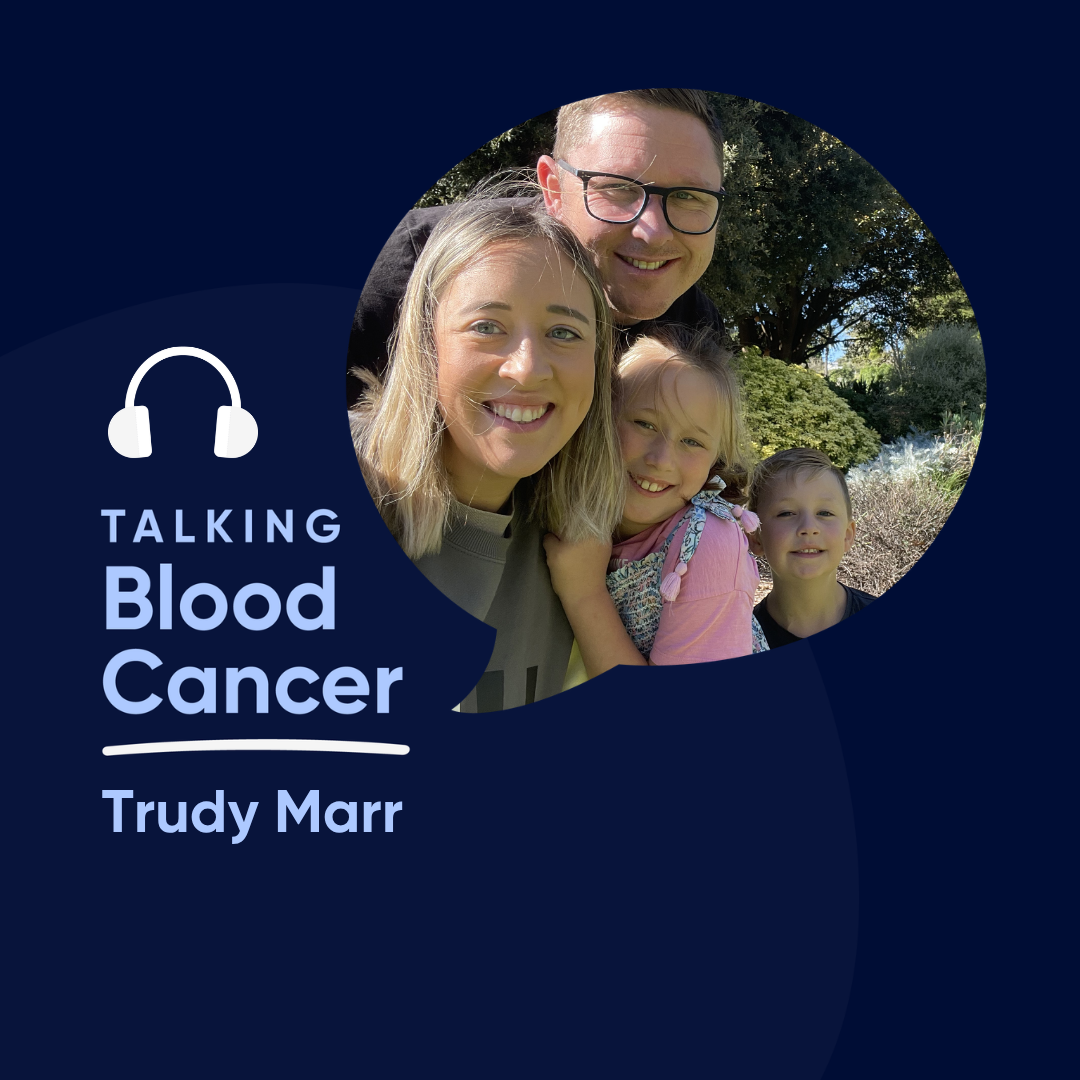
[00:03:01] Trudy Marr: Thanks, Kate. My name is Trudy Marr. My son, Bobby, was diagnosed with B-cell acute lymphoblastic leukaemia, or B-ALL, back in May 2022, when he was about three and a half years old. We are based in Warrnambool, which is in Southwest Victoria, and I live here with my Andrew, and my daughter, Andy, and obviously my son too.
[00:03:26] Kate: Being three and a half, life, I have no doubt, how old was Andy at the time as well?
[00:03:31] Trudy Marr: She had just, two weeks prior, I think turned six, yes, yeah, she had just turned six.
[00:03:36] Kate: Yeah, so in the parenting trenches, from what it sounds like, what was kind of happening around that time for you and your family to go, ‘Hmm, something’s not quite right’?
[00:03:46] Trudy Marr: Yeah, a lot of people ask us, you know, ‘How did you know he was sick? What made you think to take him to the doctors?’ And I think, you know, back then, he was…, he was three. He had just started three-year-old kinder and, my daughter, she just started prep. So brand new school, brand new phase for everyone. And it was almost that, because, I think Bobby was in kinder sort of three days a week, and she was at school five days. It was sort of this, I don’t know, that fresh point of, oh my gosh, I’m kind of moving out of the , you know, someone’s always at home, or this or that, or the bits and pieces that go along with kids that are under five. But we were almost sort of just getting into that groove. But I think was the March, I believe, I might have even been earlier than that, where, he just wasn’t right, he was losing a little bit of energy, but at the same time it would be short lived, it would be long enough for you to kind of go, ‘I just don’t know if he is very well’. And then all of a sudden, he’s running around kicking a footy, wrestling with his dad, just being his mischievous three-year-old self.
[00:04:44] I remember saying to the kinder teacher one day, I said, ‘What is Bobby going during the day? What are his energy levels like?’ And said, ‘Oh, you know, you see, he’s a bit tired, but as soon as there’s something good going on , he jumps in and he’s, he’s all over it.’ I remember one time she actually called me and said, ‘Oh, I just don’t think Bobby’s right. Can you come and pick him up?’ And I said, ‘Yeah, I’ll be there, 10 minutes.’ And I thought, you know what? I’m going to take him, if he’s bad when I get there, I’m going to take him straight up to ED and get him seen. And to the point where I completely forgot about this until now, I went home and I packed an overnight bag and went to the kinder to pick him up. And I walked in and he jumped up, ran straight over to me and just started, ‘Mum, you’re here.’ Then he started doing, running rings around me and then I said, ‘Oh, we’re gonna go.’ And he said, ‘Oh, just five more minutes of play.’ And he was running out and the kinder teacher looked to me and said, ‘I promise , he was not this energetic five minutes ago.’
[00:05:38] And that’s what he was like, he was just really up and down. But, I suppose it got to this point where I thought, gee he’s pale. I remember him walking up the stairs one day and getting a fright because his lips were white. I thought ‘Oh gosh, this is not good’. And my friends were thinking, is he anaemic? You know, has he got a really bad cold or he had a bit of a cough? But I took him to the GP and to cut up probably a long story short, I took him to a GP who wasn’t our GP, and I want to state that because our GP is fantastic and the minute he saw him, things started moving for us. But we saw this GP who basically said, ‘He doesn’t look clinically pale, he looks fine.’ I said ‘Oh, you know I’d really love to get him checked out,’… ‘Oh he seems fine.’ I said, ‘Could we get a blood test?’ It was almost like it was an insinuation that I was being a bit cruel to a three-year-old by asking for a blood test. Then you kind of question yourself and, ‘Oh, okay, I won’t get a blood test.’ And then the next, and she said, ‘Phone me in a few days if he’s not better.’ So I phoned her a few days later, and I said, ‘I really, I think we should just probably go ahead with his blood test. I think I would love to be able to do that.’ And then there was this insinuation that, you know, once the blood tests came back and they were all fine, if I still wasn’t, you know, satisfied, we could do a paediatrician appointment, but they would likely say that he’s fine. And it was an awful feeling to feel that you think, ‘I know my child. I know exactly what he is usually like, and this is not it.’ So we spent about two weeks, I think, going from various…, pathology place to pathology, no one could get blood out of him.
[00:07:01] Kate: Really?
[00:07:01] Trudy Marr: Which was the big issue, and you know, in hindsight, it’s because he probably didn’t, didn’t…,
[00:07:04] Kate: I mean, that’s alarming in itself.
[00:07:07] Trudy Marr: Yeah, well, I mean, he was three. He was not up for sitting down nicely and cooperating, to their credit. But, even when people did get in, they just weren’t really being able to draw anything. And finally, one person got a little tiny piece by that point. I’d managed to get into our GP, it’s about two or three weeks later, and I said, ‘Oh,’ I said, ‘He’s pale.’ And our GP said, Ken, his name is, and Ken said, ‘Yes, he’s very pale.’ And he knew something was going on, I think. Well, I know he knew something was going on, but clinically, he was quite well, there was nothing alarming to him that required urgent care, but he said, ‘You know what, I want a paeds referral.’ So we got a paeds referral. This was all on the Tuesday, on the Wednesday, the paeds called and said, ‘We’ll give your first appointment, it’s in about four weeks.’ And I said, ‘Oh, okay, I’ll take it.’ But I phoned the GP straight away just to get a message to him saying, ‘Look, you said urgent within the week. I can’t get in between the next four weeks.’ So I was waiting for a call back. And the next day, the Thursday morning, Bobby walked into our room, and he was just so lethargic and just said, ‘Mum, can you pull me into the bed?’ And so he could get up onto our bed, but he just couldn’t. And I could see in his neck, his little pulse was just beating so hard on his throat there.
[00:08:22] I thought ooh, this isn’t good. And we just said, ‘You know what, we’ll take him down to ED.’ But you feel like you’re skipping the queue, I thought, oh, I’ve got a GP telling me that he’s absolutely fine. And then another one saying, ‘Let’s get him a paediatric appointment.’ Then the paeds saying, ‘Look, we’ve seen the referral, a month is fine.’ And then your mum instincts going, my kid is not well…,
[00:08:42] Kate: Not okay.
[00:08:43] Trudy Marr: He’s not well. That day was a whirlwind.
[00:08:45] Kate: The struggle that you have between, as you say, knowing your child and then knowing, people are saying he’s okay, but I’m staring at him, I’ve known him, I birthed him. Things are not okay.
[00:08:56] Trudy Marr: Things were not okay. And I remember taking him to ED, and I was doing the whole, if he doesn’t need to be here, I can take him home, you tell me if you think he’s alright, I won’t sit and wait, etc, and we got taken in fairly quickly, which is in and of itself, usually never a great sign. The nurse was looking at him, going, ‘He’s not acting like a three-and-a-half-year-old.’
[00:09:17] Kate: Mmm.
[00:09:17] Trudy Marr: At 8am, running around, he should be running around this place.
[00:09:20] Kate: Yeah.
[00:09:20] Trudy Marr: And even the ED doctor said, ‘No, I’m, I’m happy that he’s here.’ And they got blood out of him, which was great. And that day was surreal, because by I think 8am we got in there. Later on that day, I think we got, the paediatric doctor came in, a registrar, and said, the blood results have shown that there’s an infection, so we’ve sent his blood off to Melbourne. And I just looked at her, and I said, ‘You’re saying infection, you mean cancer, don’t you?’ Don’t think she was expecting my question, and she said, ‘Oh, I don’t know. Look, that’s one possibility we’re looking at, but there’s nothing confirmed.’ And I said, all right, okay, I’m a planner, if there’s one thing about the medical profession that I can look back on now that I go, I just don’t have time for that…, it’s the sugar coating of information and the buildup.
[00:10:02] Kate: The buffing?
[00:10:03] Trudy Marr: Just tell me. Just tell me.
[00:10:05] Kate: Yup.
[00:10:05] Trudy Marr: Bobby’s medical team know about me, and they just, they’ll give it to me straight.
[00:10:09] Kate: Yup.
[00:10:10] Trudy Marr: But, you know, they can’t assume everybody absorbs information like that. So I just went straight into…, ‘cause Bobby, he’s safe, he’s on the bed, he’s being looked after by doctors and nurses and, everything, and I go, okay, well…, cancer, that’s not good. Might not be, but it might be.
[00:10:24] Kate: And what made you think that? What made you ask that question and raise it?
[00:10:28] Trudy Marr: I don’t know. Instinct, maybe? I hadn’t doctor googled anything, hadn’t done any of that. When she said infection, I just thought, no, it’s not an infection.
[00:10:37] Kate: This is bigger.
[00:10:38] Trudy Marr: It’s bigger than infection.
[00:10:40] Kate: Mmm.
[00:10:41] Trudy Marr: And then they said he needed an X-ray, and in my head I thought, oh my gosh, they want a chest X-ray. He’s gonna have, you know, in my head, there’s going to have tumours all over his chest, or something like. I didn’t know anything really about different types of cancers, so I, I would never have guessed leukaemia. But I was thinking, ‘Oh, this isn’t good.’ And then, I heard them talking out in the hallway, and, you know, not my proudest moment, but I absolutely eavesdropped because I knew it was about my child, and I knew I would hear them talking a lot more.
[00:11:05] Kate: You do what you need to.
[00:11:07] Trudy Marr: They’re a lot more direct to each other than they would be, and they were basically saying that he can’t leave his room, doctors and nurses have to…, anyone going into the room needs to mask up. It’s not safe for him to be out and about in the hospital, and I thought, ‘Oh my gosh.’ You know, one part of me was thinking, does he have such an infectious disease that other people are going to get sick?
[00:11:24] Kate: Yep.
[00:11:25] Trudy Marr: But in actual fact, he was just severely neutropenic, which is, you know, really low neutrophils, so he had no immune system. And it was just dangerous for him to be outside of the room in case he caught anything…,
[00:11:34] Kate: Yes.
[00:11:34] Trudy Marr: … Essentially. We had the chest X-ray, and by this point, you’re just sort of sitting there going, what is my life about to turn into? My husband’s in and out. Because he’s in the morning, and he’s like, ‘You’re right, I’ll go on.’ ‘Cause I think we kind of knew something’s about to shift in our lives. And as much as you kind of go, ‘Let’s just drop everything, and focus being on here.’ We both had jobs, we had another kid, we had other bits and pieces going on. I remember saying to him, ‘Andy’s got a dress up tomorrow at school, and I was supposed to buy the stuff today for her first prep dress up’, which was the most important thing in the world…,
[00:12:07] Kate: Yup.
[00:12:07] Trudy Marr: …To a six-year-old who just started school. So I was doing all of those sorts of things as well. And then we got taken up to the paeds ward, and I remember this paediatric consultant coming in and sat down and said, ‘Oh, so you took Bobby in today because you thought he was sick.’ And I knew she was going to do what most doctors do, they, they sort of make you tell your story again and go through it. And then, I don’t have time for this, I said, ‘Yep, I’m sure you know the story, I’m pretty sure something’s wrong with him, so I need you to tell me what it is.’ And then she went straight into, sort of my way of communicating, which was great, and said, ‘You know, they think he’s got leukaemia, which is a blood cancer, they won’t know what particular type until we get him down to Melbourne.’ But then just sort of left it at, ‘He’s got leukaemia’, probably just to give me space to absorb that line that no mother or father or parent ever wants to hear.
[00:12:57] And I just…, I looked back at Bobby, who was just paler than pale, lying on the bed, hadn’t really been awake most of the day, and I said to her, ‘Is he going to die?’ And I think, again, for the second time that day, a doctor looked at me as if ‘That’s not the question I expected you to ask me.’ But she said, ‘No, no, leukaemia is very treatable.’ And, you know, you speak to the oncologist at RCH and, no, no, no, leukaemia is curable. Obviously, there are a wide variety of different things that need to come into consideration for treatment plans and what level of leukaemia, et cetera, et cetera. And it’s not curable for everyone…,
[00:13:35] Kate: Mmm.
[00:13:35] Trudy Marr: … and I’m very, very aware of that. But generally, medically speaking, they’ve said, ‘No, no, no, leukaemia…,’ And I almost went…, and I went, ‘Okay, well, now we’re in project management mode.’
[00:13:45] Kate: Yeah.
[00:13:45] Trudy Marr: I’ve got it in my head that he’s sick. He’s very sick, but he’s not going to die. But there’s a very long way between today and however long down the track. And yes, there’s what’s happening today, but there’s so, there’s so much, so much else going on, you know? We’ve got to get this done, right? going to Melbourne. We live three and a half hours away. Okay, are we all moving to Melbourne? Is it just me moving to Melbourne? Well, there’s no way it’s my husband moving to Melbourne because I just couldn’t, I couldn’t allow it. I just, there’s just no way I wouldn’t have been able to do it. And I thought, well, I can do some remote work, so I’ll have to move those meetings tomorrow because I won’t be able to make work tomorrow, that’s for sure. Oh my gosh, what time is it in Scotland? I need to call my dad. You know, where’s my daughter? Will I get to see my daughter before I have to get on this plane to Melbourne tonight? Who’s going to finish my daughter’s costume for tomorrow, which, you know, shout out to my best friend Nikki, who just pulled something together in four hours because she’s just an absolute…, gun on a sewing machine and a Cricut machine…,
[00:14:41] Kate: Thank God for a village.
[00:14:41] Trudy Marr: It was just all those things that kind of go through your mind. But you’ve also got, you know, a very sick child in front of you. And, I think by eight o’clock, we were on a plane to Melbourne. And, I went up by myself with him in the plane, got to ICH and he’s in that scary room in ED with all the machines, you know, the room that you can go, ‘Never want to be in that room.’
[00:15:00] Kate: Well, we’ll avoid that one, but there you are.
[00:15:01] Trudy Marr: Yes.
[00:15:02] Kate: You’re in that room.
[00:15:03] Trudy Marr: Yeah. I’ll take one of those little side ones with the one bed and the no machines, please. But we were in there, and I’m learning about blood transfusions because he had a hemoglobin of 37. Which is, you know, very close to organ failure. The kid had been running around, jumping on a trampoline and going to kinder the day before, and the nurses and doctors are going…,
[00:15:24] Kate: How he didn’t pick up a bug in that space, anyway?
[00:15:27] Trudy Marr: Yeah.
[00:15:27] Kate: Daycares are the, are the petri dish of bugs and…,
[00:15:31] Trudy Marr: Exactly.
[00:15:32] Kate: It’s incredible.
[00:15:34] Trudy Marr: Yeah. It turns out, a couple of days later, he had the flu, and so he had picked up…, and so that’s why his body was so sick. He picked up a bug, and that was kind of what made us realise that he was sicker than sick. Sicker than just a cold. Yeah, I think I got up to Melbourne, I was sort of standing there, watching all these people work on him, and he was so tired. He loved the plane ride down, he thought that was really cool. He loved the ambulance. Throughout the whole day, when he was awake, he was in really great spirits.
[00:16:01] Kate: Yeah.
[00:16:02] Trudy Marr: I’m probably glossing over a lot of what happened for Bobby and really sort of talking about this from a carer point of view. But I just remember this nurse came over to me and I’m sort of, I think, standing there watching it all unfold because for me I thought, I need to know exactly what’s going on. I was taking in, every time they took his temperature, ‘Okay, why are you monitoring his temperature? Why is that important in this situation? What is a neutrophil? What, what is…,’
[00:16:26] Kate: You were sucking up as much information as you could, because also the information gives us control as well, it helps balance…, that you have an understanding of what’s going on in the situation.
[00:16:36] Trudy Marr: Yeah, and this nurse came over and said, ‘Have you got anybody here with you?’ And I said, ‘Oh, my husband…,’ And I said it so nonchalantly, I said, ‘Oh, my husband and daughter are coming up tomorrow, so it’s just me and Bobby, we live about three hours away.’ And she just looked at me, she obviously heard what the story was, and went, ‘Oh, gosh.’ And within minutes, there was a social worker sort of sitting next to me. And I remember thinking, I don’t need a social worker right now. The last thing I need is to have to go through my day and tell a complete stranger what happened. But it was sort of the most, I don’t know, it was just a really good way to process what had happened that day. And I’ll…, I’ll forever be grateful for that nurse, who had that thought of, you know what, this is, is somebody…, you know, just give me cup of tea and some sugary biscuits, just to kind of get something into me. And it was, yeah, I’m sitting there with like blood all over my jeans, because when they tried to get blood out of him, he wriggled and it poured everywhere that morning. So you can imagine the scenes, it was just, I wasn’t…,
[00:17:31] Kate: Yeah.
[00:17:31] Trudy Marr: …Wasn’t looking my best, but nor did I care. And then…,
[00:17:35] Kate: ‘Cause you’re living someone’s worst nightmare. You know, like what you’ve painted is a parent or anybody, you don’t have, have to be a parent, but someone that loves someone…, that’s your worst nightmare to watch unfold in front of you, for the person you love, you know? And so many people listening, a hospital cup of tea, and those Arnott’s two packet biscuits do to bring you back into your body, and almost just centre you and go, the world’s very busy, the world’s very crazy at the minute, but we’re just going to breathe. And just focus on that styrofoam cup of tea and those two little biscuits and just…,
[00:18:07] Trudy Marr: Mm-hmm.
[00:18:07] Kate: …, bring you back into your body.
[00:18:09] Trudy Marr: I was going to say, don’t forget, it’s the styrofoam, yeah.
[00:18:11] Kate: It is. It is. It is. Yes. So…,
[00:18:15] Trudy Marr: Yeah.
[00:18:15] Kate: Yeah, that’s beautiful that that nurse did that and that social worker, cause it is just to hold that space for you, even though you don’t know you need it held. But today you’re telling me that that was so impactful and, yeah, amazing.
[00:18:28] Trudy Marr: Yeah. We met the oncology team the next day in the ED, and I will never forget that meet. A whole crew of them came in. They’re not lone wolves, those oncology teams, they come in as a pack, and there was just one of everything. And, Di Hanna is the doctor, Bobby’s oncologist, and she’s just, you know, forever being, I know it’s her job, but I’ll forever be indebted to her and the team for what they did. But I remember her walking in and telling us a little bit about what would happen, that she would meet us on the ward later when we were all settled. But that if she could give me one piece of advice, sort of, from day one, is to be Bobby’s advocate. That you know, ‘You are part of Bobby’s medical team. He’s three, can’t articulate what he needs or wants to a degree that everybody will generally understand. So you, you are his advocate.’
[00:19:11] Kate: How powerful is that? That’s so powerful.
[00:19:14] Trudy Marr: I didn’t believe it to begin with. I thought, ‘Oh no, no, no, you guys know what you’re doing. It’s okay.’ Within, I think 20 minutes, you know, you can see something happen. You go, ‘No, we’re not doing it this way. No, that’s going to be more of a hassle.’ And you just almost have to set your boundaries really, not to get in the way of treatment, absolutely not. And, you know, you have to take on what people are saying, but it’s about asking the questions, and I chose to educate myself very early on in the piece. You know, in the first few weeks, okay, I know that if his temperature gets to X, we’re likely on our way towards a fever.
[00:19:45] Kate: Mm-hmm.
[00:19:45] Trudy Marr: If his oxygen saturation levels are something, if his BP’s at something, if I asked every single morning what his blood results were and I wanted them, and I kept notes of them. Not that they wouldn’t tell me if there was something going on with his bloods, but I wanted to be able to know, okay, I’m seeing this trend in that blood level. Last time that happened, this happened. So I’m going to get myself ready for that. Sure enough, more often than not, it would happen, and it’s all in hand, but I was prepared for it. And I’m not a medical professional by any stretch of the imagination, but I probably just have a high level of health literacy.
[00:20:13] Kate: Mm-hmm.
[00:20:14] Trudy Marr: And I’m really thankful for that because it sort of held me in good stead.
[00:20:19] Kate: Could I ask how you balance that? And I am assuming the fear of being a parent and potentially losing your child. I know that that doctor gave you that comfort that it’s curable. But I know for many of the parents I’ve sat with, it’s the fear of almost sometimes not wanting to educate because they don’t want to know anything bad or they don’t… How did you balance that or did you have that experience at all or you just went straight into educating yourself?
[00:20:44] Trudy Marr: I went straight into educating myself. I think that, maybe, I didn’t so much kind of block the idea that he might die out of my head. But I certainly didn’t give it airtime in my brain. And I was basically trying to go, you know what, that’s a possibility, but so is major complications with this chemo he’s about to get. So is an allergic reaction to this drug that they’re trialling. He was on a clinical trial, you know. So are so many of the other things, even with like a blood transfusion, you read all of the side effects, and you kind of go…, there is no alternative to what we’re doing. The alternative is I don’t educate myself, and I don’t understand what’s going to happen or I say, ‘No, we’re not going to this treatment path.’ And if it wasn’t treated, he would, he would die. There was no choice in the matter. So, just my brain in general, I feel that if I am as educated as I can be or if I have as much information as I can, I can process it, and I’m able to process lots of information that comes at me from all sorts of different directions and be able to take that on and make informed decisions, you know? We didn’t just have an oncologist, we had a dietitian, we had, you know, a physiotherapist, we had a social worker, we had a neuropsychologist, there was teams of people. Then there was this kinder teacher at RCH and his play therapist, and everything in between to make sure that he had this sort of holistic, you know, he was going to be sick for a while.
[00:22:04] And, you know, had some really, really bad days of treatment or, I say bad in terms of, you know, side effects, you know, whether it was vomiting or really lethargic or this or that. And he had all those lumbar punctures and different procedures that he was going through. But generally on quite a lot of other days, had he not had, you know, four syringe drivers on a pole next to him, and you were just chatting away to him, you wouldn’t know he was in hospital or sick. So it was really important for me to kind of keep a routine going for him. So we, we did do a little bit of school with him and we played and we did puzzles. And when we were allowed out of the room, when his neuts were above a certain level we would take him down and look at the fish. And, we had our little, you know, every time he had chemo, he was really on steroids for a while. So the salt factor was huge. So, you know, hashbrown from Macca’s downstairs was always on the agenda. But for me, just being able to have all that information, educate myself, know what we had to do to get him through, as best we could. Not just get him through, but get him through but also make sure he had everything he needed along the way.
[00:23:03] You know, he didn’t always because I wasn’t perfect, and you can’t be. And you just kind of have to give yourself a little bit of grace. You’d know yourself, something goes on with somebody in your family and everybody’s messaging you, always, wanting the updates, wanting this, that, and the next thing. I put some really clear boundaries in place where I said I don’t message people after 8pm, other than my husband, because I just need some rest. I need to binge watch something on Netflix, and just, he’s asleep. I just need to pretend I’m not in this world for an hour. Not that you can do that because you’ve got people in and out of your room, but, um, just kind of putting those…
[00:23:37] Kate: But try your best.
[00:23:38] Trudy Marr: Yeah, yeah exactly. We had his and hers kids. We kind of made the decision because I couldn’t run every decision past my husband. It was physically impossible. So, I think we had a minor disagreement early on, going ‘What do you mean you’re doing that? You didn’t tell me.’ And then I’d say, ‘But you didn’t tell me that you were doing that with Andy back home.’ So we went, you know what, this is going to work. I trust you with decisions there, and you trust me with decisions here. And it was the best thing we did. And we saw each other on weekends, because my daughter was obviously in school, so he’d pick her up, he’d come down, he’d try and get there for dinner on Friday night. We’d spend the weekend together and off they’d go on Sunday afternoon. But it was exhausting, and we did that for about eight weeks to begin with. I’m skipping over a lot of the treatment stuff because I think treatment is one part of a journey. So he was in treatment then for, up until January 2025, so I think it was, what? Two…, just shy of three years of active treatment. And a lot of back and forth because, you know, being a regional family, it’s an extra toll on kind of going back up and down the road.
[00:24:41] Kate: Oh, it’s such an extra layer.
[00:24:42] Trudy Marr: Yeah, but you do it. You don’t think about it. You do it, and yeah, so he rang the bell in January 2025, which was just 15 months ago.
[00:24:51] Kate: Wow, and as we know, you and I’ve discussed beforehand that treatment ends, in quotation marks, it ends, but life continues. And life was continuing alongside a treatment journey. How did you ease back into life, or what does life look like now for you? You, yourself, went through a lot.
[00:25:09] Trudy Marr: Mmm. Life, I don’t, don’t want to sound dramatic, but life won’t ever really be the same again. He’s well, right, he doesn’t have cancer, it’s gone, but if he sneezes too many times in a day, do I think it’s back? I mean, it’s…, sneezing’s not going to be the first sign of it coming back, but anything that happens, I can’t help where my brain goes. And, he had whooping cough two weeks ago, which was horrible. I’m thinking, ‘Oh my gosh, here we go.’ So, he’s still a little bit immunocompromised.
[00:25:38] Kate: Yeah.
[00:25:39] Trudy Marr: He’s just about to have his final lot of vaccinations to get him back to fully vaccinated.
[00:25:44] Kate: Mmm.
[00:25:44] Trudy Marr: So this last 12 months has just been kind of navigating the transition of him having a fever. I remember the very first time he had a fever. During treatment, if he had a fever over 37.5, then he had to be at the hospital within about 20 minutes on IV antibiotics and, you know, anywhere up to about 48 hours in hospital minimum, for any time he had a fever. And on the 6th of January, after he had his last dose of chemo, that magically stopped. You don’t have to do that anymore. You just don’t do that anymore. And you go, okay, that’s interesting. And I remember the first time he had a fever, and I went into him, and I was checking his temperature, and he said, ‘What are you doing?’ I said, ‘Oh, buddy, you’ve got a fever,’ and he just, I wish it caught him on camera ‘cause he just shot right, he almost gave himself whiplash, and I said, ‘Buddy, buddy, remember, remember what we do?’ And he said, ‘Oh, we don’t do anything.’ I said, ‘No, we don’t do anything. Yeah, I just I give you some Panadol, and we’re just watching you.’ This is regular mums take temperatures of regular kids and give regular Panadol. And this is just like a regular kid today. And he went, ‘Okay, right.’ But I think that he’s still a little bit on edge, and he talks about treatment. He talks about how he’s better, but not all kids get better. Which is, you know, quite deep for a six-year-old, and that, he talks about looking after himself, he has scars from where his port was.
[00:27:02] But he, he remembers his treatment quite fondly. He just remembers being allowed to watch a lot of TV, and being allowed to play games a lot. But I mean, he was a kinder-age kid. So he sort of compares it to go, ‘Now I have to go to school.’ But I was trying to explain to him, you would never have been in school anyway. So it’s, it’s not really the point. But for him, could he give some sort of kid cultural reference of something that happened while he was growing up in that sort of four, five, six-year-old space, as well as a kid who was in the hospital? No. But could he describe to a nurse a step-by-step way of accessing a port or taking bloods or, yeah, he can absolutely do that.
[00:27:35] Kate: Yeah.
[00:27:36] Trudy Marr: He’s very, very intuitive. He’s very caring, quite a sensitive kid in terms of…, he’s very in tune to what other people are going through. But he’s also very hilarious, and he’s like the class clown. So I suppose, life won’t be the same again because you kind of always just have this, ‘Oh, okay, is he all right?’ But also kind of going, I gotta let you live, and you will live your life. But also on the flip side, he is now in the phase called survivorship, which he will be in for the rest of his life because he’s a survivor. So all the way through paediatric and then he will be under the care of an oncologist, essentially, my understanding is, is for forever, right through into adulthood.
[00:28:18] Kate: Mm-hmm.
[00:28:18] Trudy Marr: Checks will get less and less. And when he’s 18, he’ll get, you know, passed over to the adult setting for an annual blood test and things like that. In that sense, things are never normal. But I think, when you finish treatment, you go back home, you get your routines, there’s no interruption, there’s less interruptions from unplanned hospital visits, and there’s no daily cutting of medication, and the constant part of your routine…, that all finishes. That’s when you start getting told of, and that’s when you start realising, okay, all the meds are out of his system, and he’s coming back to a baseline…, what are the long-term effects of the treatment that was so necessary to save his life?
[00:28:56] Kate: Absolutely.
[00:28:57] Trudy Marr: But are so harsh on a child’s body. I mean, they are pumping kids with…,
[00:29:03] Kate: Mm-hmm.
[00:29:03] Trudy Marr: Necessary, don’t get me wrong, but poison. And you know, long-term effects will happen. About a thousand Australian children and adolescents are diagnosed with cancer every year. Treatment is saving lives every single day.
[00:29:17] Kate: Yeah.
[00:29:18] Trudy Marr: But life after treatment is where I think people talk of less. ‘Oh, you’re fine. Oh, you’re cured. Brilliant.’ You know, you hear your other guests say, that’s when the meals stop…,
[00:29:27] Kate: Yeah.
[00:29:27] Trudy Marr: …, coming ‘round. That’s when the messages stop coming. That’s…, you know, it’s not true for everyone.
[00:29:31] Kate: Yeah.
[00:29:31] Trudy Marr: And we have just the most beautiful support system, even to this day. And there are long-term effects that, if you’re not close to me, if you’re not in my sort of circle, and you see me every day, and you talk to me, and you understand my kids, and you’re part of my kids’ lives, you wouldn’t necessarily look at Bobby and go, ‘He has long term health impacts as a result of his cancer.’ And the stat is that nearly 80% of childhood cancer survivors experience one or more late effect, whether that’s physical, cognitive, psychological. They might emerge during treatment, shortly after, or well into adulthood. And I think there’s a stat that there’s that one in three childhood survivors, when they get into adulthood, they can’t engage in the workforce. So I think, when we’re looking at some of these things, for Bobby…, Bobby lost the ability to walk during treatment. The chemo stripped the protein from his muscles. We knew it was going to happen. So he lost the ability to walk, but he also lost all the muscle…, putting his muscles, across most of his body. So he learnt to walk, but three years of treatment really has taken its toll on his body. He has muscle weakness, so we had him assessed, late last year, just to kind of go, ‘Okay, he’s almost a year out of treatment, let’s get this…,’ And don’t get me wrong, did I bawl my eyes out at the end of an OT assessment, where they were like, we’ve got some work to do, and the guilt of not bringing him in sooner, and her going, ‘When? When would you have brought him in, Trudy? Like you just…, give yourself…,’
[00:30:58] Kate: Exactly. I’m so glad she said that because that’s exactly what I was thinking “when? in all of this”.
[00:31:03] Trudy Marr: You know, he’s got weakness in his ankles…,
[00:31:05] Kate: Yeah.
[00:31:05] Trudy Marr: …, legs, wrists, shoulders. He has no core muscles, lying in a bed for a long time is going to do all those things to you. And you’d never know watching him walk around, and we’ve got a team of people working with him, not daily or weekly, but we have our people. So there’s an OT who works with him, and will see him every few months, because my husband and I do his PT with him…, I was going to say daily, but let’s not lie, nobody does the exercises daily and as, you know, we just…, it doesn’t happen.
[00:31:30] Kate: There’s a life in between.
[00:31:31] Trudy Marr: But he’s a busy seven-year-old.
[00:31:33] Kate: Yeah.
[00:31:33] Trudy Marr: So he’s probably getting a lot of exercise outside of structured sit-ups, and planks, and all sorts of things that you never thought you’d have to do with a seven-year-old.
[00:31:41] Kate: Exactly.
[00:31:42] Trudy Marr: But it’s affected his coordination, his pencil grip, his speed, agility. And sometimes, he sees a physiotherapist, he’ll see an OT, where we’ve got a couple of other bits and pieces happening around him. But this is all at added costs for parents, there’s no real support once you finish.
[00:31:59] Kate: Yeah.
[00:31:59] Trudy Marr: I mean, don’t get me wrong, could I get him appointments up at RCH, in the public system? Absolutely. That is a six-hour round trip, in the car, for a boy who is supposed to be exercising, not sitting idle for six hours in a car, to do a half-hour appointment. That’s a day off work, maybe an overnight accommodation, depending on the time of the appointment. It’s not feasible.
[00:32:17] Kate: Absolutely.
[00:32:17] Trudy Marr: Time off school, time out of education, which, you know, he’s lost a lot of already.
[00:32:22] Kate: And friendships and social.
[00:32:23] Trudy Marr: Yeah, absolutely. School activities, and the whole thing. So…,
[00:32:26] Kate: Yeah.
[00:32:27] Trudy Marr: We are incredibly lucky that his school has been just the most fantastic support. They can’t do enough for him. You know, the school of less than 200 kids and this little kid walking into prep right in the middle of cancer treatment, doesn’t have an immune system, comes with, you know, sheets of ‘this is what you need to know about my child.’ And, you know, yes, it’s their role to make sure that they accommodate children, but it’s, it’s a lot for someone.
[00:32:52] Kate: Absolutely.
[00:32:53] Trudy Marr: And they’ve been so great. He’s had a bunch of teachers across the three years. And they watch over him, they knew intuitively when to call me when he was looking like he was getting sick. Planned excursions around when he wasn’t supposed to be in a planned visit in hospital. They’ve put together, you know, alternative resources. So if you can imagine, weakness in your wrists, no core strength, pencil grip, really bad. He also has some short-term memory issues. Trying to teach a kid to read and write, trying to teach my kid who’s like, ‘Ugh, school.’ It is…, to read and write with that cocktail of issues. But for the supports that they have put in, there’s no way he would be where he is, and we do a lot of work with him at home, that poor kid doesn’t get holidays off readers. He does them, most days of life, because we know that he needs to kind of keep going. But the adjustments that they’ve made for him, so that nobody else around him would notice that he is having adjustments made around him is just phenomenal.
[00:33:53] Kate: Really special.
[00:33:54] Trudy Marr: But you have to fight for every single one of these. Not with the school, but as a parent, you have to advocate for these things. There’s no national survivorship kind of program. And so, we’re not unique at all by any stretch of the imagination, and that’s part of the problem. There are so many children, so there’s way more children surviving cancer than there used to be.
[00:34:14] Kate: Absolutely.
[00:34:16] Trudy Marr: Navigating illness, and when you’re, especially for us you’re really far from home, that’s something that I’m really working towards now. I’ve come up for a year, as I’ve kind of said it, and I’m really looking to move into a lot more of an advocacy space. I’m part of the Leukaemia Foundations’ Lived Experience Engagement Program. I’m doing bits and pieces, coming onto this podcast, and sort of raising awareness about survivorship. Anything we can do to highlight to people that cancer is not a short-term thing, childhood cancer is not a short-term thing. And survivorship is the longest part of a childhood survivor’s treatment journey, and it just, it doesn’t get near enough.
[00:34:55] Kate: And it is because that everybody wants that goal of having the child to survive the cancer diagnosis, which is of course, what we want, we still want. But it’s, as you said before, when people go, ‘Oh yeah, you’re done, right? Like you’ve finished treatment.’ But no it, it all continues to unfold as you said, it is the longest experience that they will have and blessed that they do have it. But it comes with its set of challenges and, you know, as you say, it comes with challenges that people can visually see at times, but also those ones that can’t. Like, if you don’t know your son, you don’t know that he doesn’t like to be touched on his port and things like that. There are things even within children, or even adults as well, let’s be honest, that your body internally locks into your…, from a cellular level, you know the trauma and he knows the trauma that he’s gone through. But he can’t even process it yet at this age. And that happens with adults as well. We know so on a cellular level, our bodies have experienced something. But we can’t process it yet. So not only is it all those physical signs, but it’s also all those mental…,
[00:35:58] Trudy Marr: Yeah.
[00:35:58] Kate: …, those mental challenges that people do face post-treatment and…,
[00:36:01] Trudy Marr: Yeah.
[00:36:02] Kate: Carers as well, and parents.
[00:36:04] Trudy Marr: And I think the good thing is, is that there’s a change coming, I feel. I mean, the Leukaemia Foundation are part of this. There’s an organisation called the Children’s Cancer CoLab, and it’s fairly new in its inception, but it’s a fantastic organisation, and one of the streams that they are looking at is survivorship. And there, there is a survivorship reference group, and I, I’m very lucky to be part of that. I’m very privileged to be part of that as one of three parent advocates on there or lived experience consumers, and it’s got…,
[00:36:33] Kate: Wow.
[00:36:33] Trudy Marr: …, representatives from key charities like the Leukaemia Foundation, the key hospitals, research. It’s fantastic, and what we’ve just developed…, a position statement, and we’re calling for survivorship to be a core part of every cancer care plan, every roadmap, every research agenda, not just an afterthought. It is becoming far more prevalent, the long-term effects that we’re seeing, and, you know, really putting a call out for holistic mental health support, early financial guidance, better education and vocational reintegration, getting kids back into school. I mean, I was probably lucky in that he was going into prep when he finished treatment. So he didn’t miss a section of school where those, you know, friendships are formed and…, but you’ve got kids who are missing out on, say, grade 6 and year 7. And you know, I couldn’t imagine that you’ve left school in grade 5 and all those primary school connections and then moving into high school and all of those things.
[00:37:30] Kate: I was just going to say, I know Ash Bell, who was on the podcast and is one of our case managers here at the Leukaemia Foundation. She explained exactly that she was diagnosed between the ages of 11 and 12. You know, those really foundation years of building those friendships. And she said, when she came back into school, and when they’re in high school, she’s like, I was still wanting to play with Barbie dolls ‘cause your life kind of…, you don’t grow up socially as your friends naturally do when you’re surrounded by that. And she said, I was back here, and I was like, ‘What is this world I’m in?’ And it felt so very different, and then being pulled out all the time for appointments and needing to travel is…, that, that is a challenge that people forget about. That you have that experience and that, as you said, the appointments, yes, they lessen, but they’re still there, and the disruption of social connection and education…,
[00:38:18] Trudy Marr: Yeah.
[00:38:18] Kate: …, is still apparent for children.
[00:38:19] Trudy Marr: And I shout this from the rooftops, when you add the additional obstacles of living in rural and regional communities…, I’m very aware that I live three hours away from Melbourne in a fairly decent-sized regional city with access to a hospital that can provide the care that Bobby needed during treatment that I didn’t have to go to…, not for treatment, but if he had a long term visit, I could go there. There were so many families I met at the hospital at RCH that couldn’t go home. So we went home after eight weeks. These kids couldn’t go home for a year because they didn’t live within 20 minutes of a hospital that could provide…, that carried the antibiotics, that could provide that coverage when they were sick. So they stayed there for far longer than we did. And, you know, limited access to specialist services. That additional financial, and travel, and then all those gaps and follow-up care. I think I’m just really proud that The Children’s Cancer CoLab and, and everybody that’s in that sort of consortium, that we’re recognising the distinct challenges faced by rural and regional families. And I personally want to see a cancer framework, a childhood cancer framework that extends support well after treatment, kind of provides that support and hope.
[00:39:36] Kate: Mmm.
[00:39:36] Trudy Marr: And just really ensures that no family faces this really long part of the journey alone. No matter where they live, and, as much as you kind of go, ‘Oof, having a kid with cancer, I would never want that.’ We are blessed to have kind of come through the other end, and I still have my little boy, and I know families who don’t, and it is incredibly the worst, but you also kind of come out of it with this sense of, you’ve met a whole cohort of people you would never have met in your life. You have an understanding of things that you never wanted to have an understanding of ever before. But if I can use…, if there’s anything that kind of good that can kind of come out of it, in any bad situation, I kind of always try to look for what was positive out of that, and there was a lot. There was a lot of things that came out of it, but one of them would be that I feel I am in a position mentally, and, you know, within my family unit, where I am able to go, ‘You know what, I don’t want to shut this.’ Because some people do. I don’t want to shut that part of my life off. Some people, to heal, they have to go, ‘You know what, that’s done, I don’t want to revisit that.’ Whereas I’m okay to, and I will do it in ways that I’m able to, but if I can advocate and get some changes that would make this journey one bit better for families that will inevitably have to go through this, right? Wouldn’t it be lovely if no one had to go through this again? That’s not the reality right now. Maybe it will be one day, but it’s not right now, and if my voice can bring some benefits or make some changes, then that’s what I’m here to do in this phase of my life.
[00:41:02] Kate: I just think back to the piece of advice that that doctor gave you in that room at the very beginning.
[00:41:08] Trudy Marr: Yeah.
[00:41:08] Kate: As she said, ‘Be your child’s advocate.’ And you have listened to that and ran with that to incredible places. And I know that there are many parents that will be listening and also as well, like when things happen in certain areas, and certain age groups in the children’s, that it does end trickling into the adult section, because obviously, those children grow into adults. So the work that you’re doing and the advocacy that you’re doing, not only for your child, but for the children that are in this experience or who will experience this, I just can’t thank you enough because it is such an important topic and a phase in the experience that needs light to be shined on. So thank you so much.
[00:41:48] Trudy Marr: Thank you.
[00:41:48] Kate: It’s incredible what you’re doing. You have given some beautiful golden nuggets, but we always do ask, are there any pearls of wisdom, any golden nuggets that you could give to somebody that is sitting potentially in your position now, or when their child was first diagnosed, or even just as a carer to whoever. Is there any words that you would like for them to hear?
[00:42:07] Trudy Marr: Kate, I knew you were going to ask this, and I did write something down, but was about that piece of advice I gave at the beginning about, you know, you are part of your child’s medical team. You have a say in the decisions that are made. Gather as much information you can, ask as many questions as you have, and advocate your heart out for your child, no matter what age they are, do that alongside them if they’re that older, and through every phase, because by the time you get to survivorship, you’ll be great at it, you’ll have practised it enough, And it’s when you’ll need it the most. I think because it’s the bit that we’re in the longest, and I think, maybe I’ve underestimated how much advocacy I will need to do when Bobby becomes a teenager. Or when he’s transitioning into sort of tertiary education, if that’s where he goes, or what that looks like. Because I think maybe I’ve underestimated how long I will be doing this for my child. But I think, yeah, that advocacy piece is a huge piece. And I think for me, from a carer perspective, and I haven’t spoken about it today, but having that support around you, I just had the best support network around me. I was really lucky to have a husband who was just by my side through every single second of this. A daughter who was an absolute trooper, and there’s a lot I could have said about siblings in all of this, but, you know, someone else has a story about that, but it’s definitely not unseen. But just having that support, but making sure you have your boundaries and making sure you look after yourself, cause it is a very, very long road, and you need to be there…, to be part of it.
[00:43:40] Kate: That’s perfect. And I can’t thank you enough. And I hope that we, as the Leukaemia Foundation, can help also continue to pave that wave, that you’re so very much busily on to improve the experience of survivorship. And I know that it is very much in our strategy to make that part a little bit easier in the years ahead. And also too, that for those families in those regional areas as well, you know, we see that, that is how we began here at the Leukaemia Foundation, is because we could see the need, and we could also see how impacted that regional, rural families were by blood cancer. And we hope to change…, I know we can’t change it all, but we hope to be able to change a part of it in the future. So I think with powerhouses like yourself, we’re well equipped. So, thank you.[00:44:26] Trudy Marr: You’re very welcome. Thank you.