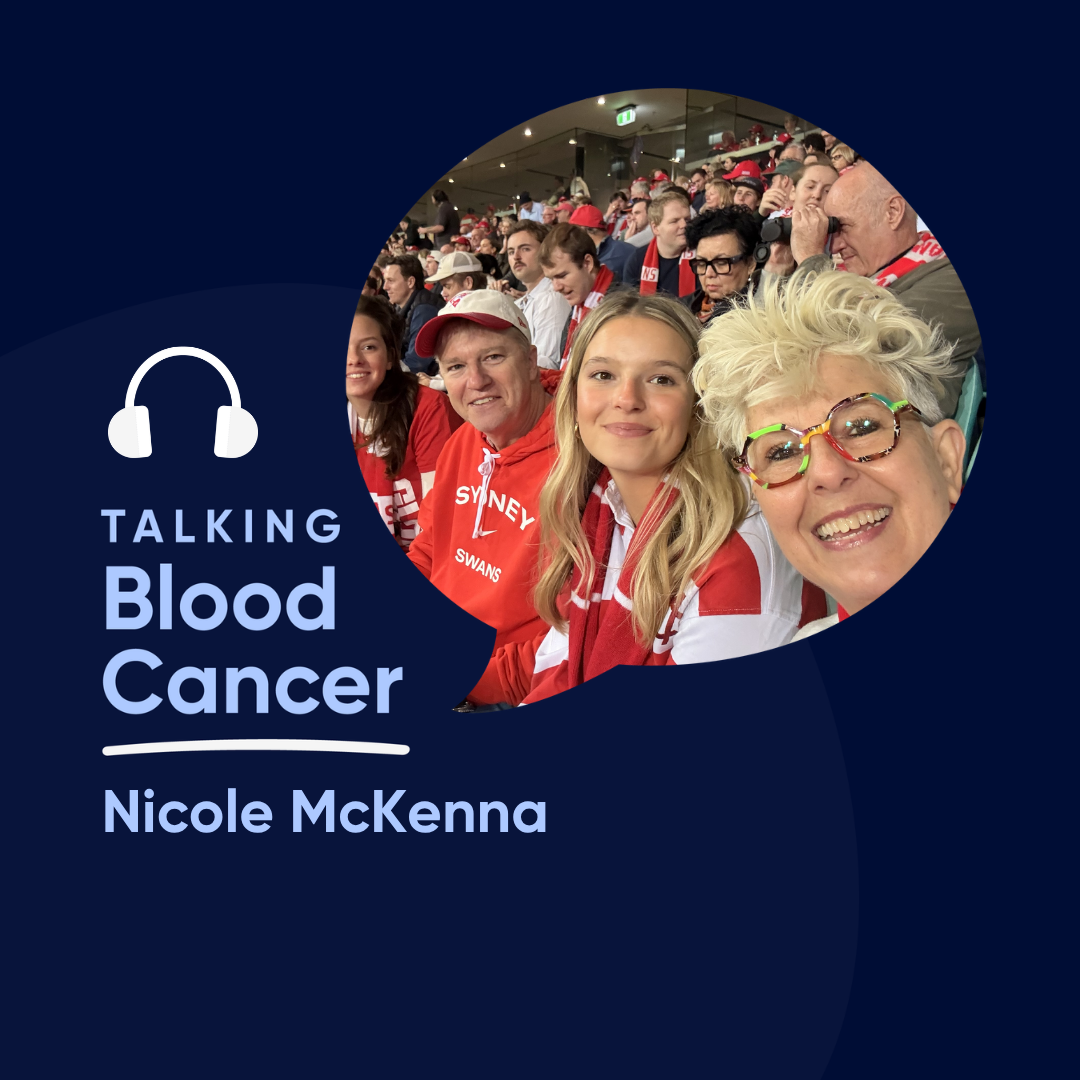
In this episode of the Talking Blood Cancer podcast, host Kate Arkadieff speaks with Nicole McKenna about her experience following a diagnosis of acute myeloid leukaemia (AML) in 2018.
Nicole discusses the lead-up to her diagnosis, recalling how subtle blood changes were initially attributed to perimenopause before her condition was fully understood. She highlights the importance of trusting her medical team and avoiding potentially confusing or distressing online searches, sharing her strategy of focusing on information from her doctors. Nicole describes the emotional impact of her diagnosis, especially the challenge of communicating the news to her family, particularly her two daughters who were teenagers at the time.
They explore how Nicole and her family adjusted to life after diagnosis. Nicole talks about the essential role her wider community, friends, and even her pets played in supporting her. Outlining Nicole’s time in hospital during intensive treatment and stem cell transplant, some of the physical side effects she faced, including hair loss and a tough recovery period, and the ways she found comfort in small, familiar routines. Nicole and Kate discuss the importance of specialist psychosocial support following treatment, and how building connections with others who have lived through similar diagnoses can make a meaningful difference to emotional recovery. Nicole now uses her experience to support others and advocates for providing a patient’s perspective to health service improvement, reminding listeners of the value of shared experiences and community.
[00:00:00] Intro
[00:02:36] Kate: Well, everybody, thank you so much for tuning in today and listening to our episode of Talking Blood Cancer. I’m really excited and feel privileged to host this episode today. And as we always do, we will let our guest introduce themselves. So, I will ask our guest to introduce their name, where they’re living in Australia, what they were diagnosed with and when, and who is in their support network.
[00:02:58] Nicole: Thanks, Kate. So, hi, uh, my name is Nicole. I live in Paddington in New South Wales, and I was diagnosed with acute myeloid leukaemia in 2018. And my support network is…, I have a partner, I have two now young adult children who weren’t so young adult at the time of my diagnosis. And actually, what’s amazing about the support network, I think is, that there were a whole bunch of people who rose to the occasion in ways that I couldn’t have anticipated. That became a support network in all sorts of different ways. I think it’s not just the people that are close to you, the ones you love, and who are your direct family…., it’s actually the broader community that are part of you. But also my sister, who was my donor, who was very important, and her daughters, my animals…., I mean, it’s kind of crazy the people that lift you up during such a crazy time.
[00:03:54] Kate: Wow. And, you are so right there that you hear the things that, takes a village to raise a child, but it also takes village to live in and feel that support around you, and it’s sometimes in those darkest moments, it is when you feel them or you don’t, or the least…,
[00:04:08] Nicole: Mmm.
[00:04:08] Kate: …, the people you least expect to come and support you are there as well. So what was kinda happening around diagnosis for you, or pre…, before you got diagnosed?
[00:04:18] Nicole: Well, yeah, I think pre is more interesting in some ways because honestly, you could have knocked me down with a feather when I got the final diagnosis. So I was diagnosed in June of 2018, but actually, back in around September of 2017, I was perimenopausal, I think.
[00:04:35] Kate: Mm-hmm.
[00:04:35] Nicole: And I remember going to my GP and saying, “I want to kill everybody in my family and everyone around me. I’m going insane.” And she said, “Maybe we should do a blood test. Maybe you’re perimenopausal.” And of course I was, but what they also found was I had really low neutrophils, which I now know more about than I ever did before. More about all the intricacies of blood. And at the time they were kind of like: “Oh, you know, that’s not too unusual. You have some kind of benign idiopathic neutropenia, and that happens from time to time. We’ll monitor it.” And so they monitored it, and every three months I would have blood tests, and it was always…, it kind of went up a bit, and then it went down a bit. But it was never really in the normal range. And toward the end of that year, the GP and I spoke and said, “Look, I should probably go and see a haematologist.” So I did. I saw a haematologist and, again, I had a million blood tests and cultures, and it was insane, and physical examinations and stuff. And really, again, it was like, “Let’s just monitor this. It’s…, we’re not sure what’s going on here. Again, think it’s some kind of benign neutropenia.” And I went along with that as you do.
[00:05:44] Kate: And how were you feeling at that point? I mean, did you know what a haematologist was or was for?
[00:05:49] Nicole: Oh, yes. I definitely did. I understood all of that, and I was forthright in making sure I saw a haematologist, and I had a lot of questions. But honestly, it didn’t even occur to me that there was something seriously wrong with me. I always just assumed that there was some chronic thing going on and it would come good. I…, I’m the biggest optimist. I always think things are gonna be okay, sometimes crazily so. But I really never thought there was anything seriously wrong. And I remember in around March, I saw…, ’cause I was seeing the haematologist every three months, and she said to me something like, “Oh, but it’s not leukaemia.” And I remember thinking, “What the hell are you even talking about, ‘it’s not leukaemia’? Of course it’s… Like, why is that even on your radar?” And I honestly, one of the things, Kate, that I have never done and I would recommend to others is I never, ever Googled or, and now it would be AI. I never looked up, what’s going on here? What are my symptoms? And did the Doctor Google. I was always very deliberate about getting my advice and my support and my diagnosis from my specialists and my doctors. And I know a lot of my friends were very keen when I was finally diagnosed going on that. And I would say to them, “If you have to do it, that’s for you, but I do not wanna hear anything other than amazing stories that will lift me up and give me hope. ‘Cause I know I’m different to others. Everyone’s different. You’ve got your own physiology and biology. Anyway, so March…, I saw her, she said that. I was like, “What the hell?” And we’re going to the Gold Coast for a holiday, I think in April, and one of the things she said to me then was, “If you get a fever of 38.5 or above, you need to go to emergency. “So I was like, “Okay, that’s not ideal, but I seem to be fine.” And then I think I changed a bit and thought, “Oh, what’s going on here?” And come June, I was about to go and see her again for my three-month checkup, and I had a lump under my arm, and I was like, “This is not good.” And that was when I started to think there’s definitely something going on. And so I saw her, I think, maybe on a Friday or a Thursday, and I had an ultrasound, and it turned out that was just a staph infection, I think. But because my neutrophils were so low, my body wasn’t able to fight my infection.
[00:08:03] Kate: Mmm.
[00:08:04] Nicole: And so she then sent me off… And by that time, my blood had come back to her, and my neutrophils were zero, and I also had blasts in my blood. And so I knew then. But again, I didn’t go online and find out what that meant because I was going to go on the Tuesday to have the bone marrow biopsy. And I remember walking to that biopsy. It was a Tuesday. I live in Paddington, so I could walk to St. Vincent’s, which is where I had the biopsy, and it was the most glorious sunny day. And honestly, I was walking to this procedure that I didn’t really understand at the time, thinking, “Oh, how lucky am I that I can walk from home to this place…,
[00:08:42] Kate: Mm-hmm.
[00:08:42] Nicole: …, and have this procedure.” So I had that, and then I was meant to see her, I think of the Friday of that week, and I had a call on the Tuesday afternoon from her practice saying, “Oh, she’s actually not able to see you on Friday now. She’s really busy. Can you come tomorrow?” And I knew then, that there was something pretty serious going on. And I remember my husband was in Singapore, I think, working at the time. And so I called one of my friends saying, “You know what? I think something’s going on here. Do you wanna come with me when I go?” And so she came, and on the Wednesday I had the diagnosis, and then Thursday I think I went into hospital, and Friday I started treatment. So it was like bang, bang, bang. There was no mucking around.
[00:09:23] Kate: Yeah.
[00:09:24] Nicole: Mmm.
[00:09:24] Kate: And then to sit in that chair and get that news, you kinda had known for six months, or so, that something was grumbling…, you weren’t quite sure. But to hear that news, how did it land? You know, people speak about the world stopping, and they’re just not then taking in any more information or…
[00:09:42] Nicole: I probably didn’t take in all of the details, and my friend was there, and she was sort of making notes. But I was incredibly calm. And I, wasn’t like I didn’t cry or I was… Honestly, I felt like adrenaline completely kicked in, and all I could think about was… I remember I had a receipt from Coles or something and a pencil, and when I’d finished seeing her, I think the appointment was like 4:00 o’clock in the afternoon, and so it was getting dark early, and my friend went home. And I then wrote a list on the back of this receipt from Coles of all the people I had to call and all the things I had to do. And really it was thinking…, and I remember sitting in the car and calling the principal of my daughters’ schools to say, “This has happened. I’m gonna talk to them tonight. This is obviously a disaster, but I wanna stay calm. And they are gonna need your support and the support of the people at the school.” And she was fantastic. And I called my sister and… the girls are the hardest. So at the time, I have two daughters. One was in year 12 or HSC in New South Wales that year. So it was the middle of the year. It was like five minutes away from when they do trials, and then the younger one was in year 9. And that for me was the absolute hardest thing. Honestly, as a parent, I’m sure, people are the same. I really just thought, “Oh man, how am I going to talk to them? How am I gonna explain this to them in a way that is honest?” Because I wanted to be honest, but also hopeful. Because I also felt hopeful, partly I suspect because I didn’t quite know what I was in for, but partly also because I’m just naturally optimistic. And I genuinely just, I really thought, “This is terrible, but it’s gonna be okay.” Crazily, that’s what I thought.
[00:11:26] Kate: It’s not crazy because, as you say, if that’s your innate, reaction and the way you view things and situations, it’s not crazy. It’s not crazy at all.
[00:11:35] Nicole: Yeah. I went home and I called my husband. I think he was really in denial because I remember him saying to me something like, “Oh well, I don’t think I can get a flight home. Like…” But I don’t think he realised, I think he was completely in shock, and he didn’t appreciate what I was telling him almost…,
[00:11:52] Kate: Mmm.
[00:11:52] Nicole: Because he literally got on a flight and was home first thing the next morning. But… And I had one of my nieces coming up…, you can imagine. I mean it was chaos.
[00:12:00] Kate: Yup.
[00:12:00] Nicole: Because I knew I needed to go into hospital the next day and the girls were still getting older. I think Isabella was 17. But you know, they were still kids and, she was doing the HSC, and Mia…, it was just a nightmare bringing everyone together so that I could go into hospital and then also sending a million emails to all sorts of people, to say, “Look, this has happened. This is what’s next. I don’t know anything much else. And of course they get this email and they’re like, “What the hell is she talking about?” And clients, ’cause I run my own business, so I was sending them message saying, “I’m really sorry. I’m going to hospital. I’ve got leukaemia. I don’t know what that means, but I won’t be working for at least the next six months.” So I thought, it was certainly longer than that. And I was like a woman with a mission. I just, I mean, I look back and I’m in awe of myself. I was just like commando. I just sent out the emails. I made the phone calls. I was so calm and it was extraordinary that the way adrenaline kinda kicks in and all I could think about was the kids. And, how am I gonna protect them and how am I going to make sure that everyone’s gonna, rally around them and support them. Because I thought I can cope. And I think that’s one of the things too, Kate, with a serious illness like leukaemia. In some ways, for me anyway, and I know I can only speak for myself. I don’t know what others experience is, and I would never pretend to speak for them. But I feel like the people who love you the most, I feel that it’s really hard for them because they’re not you. You’re in it and you’re being treated, and you’re in the hospital, and you’re living it, whereas they’re looking at you, watching you. They can’t really do anything. They’re scared, and it’s really tricky for them to navigate that situation that they find themselves in. So I really feel for the carers and the families because as much as it’s horrible being a patient you feel like you’ve got control in a crazy way, even though you honestly don’t. It’s hard to explain, but anyone listening out there will be like, “Yep, I know what she means”.
[00:13:59] Kate: Yeah. Because it’s you, as a patient, things are happening to you and there’s this process that you know of X, Y, Z that this’ll happen and this’ll happen, and you may feel really crappy at one point, and then you’ll come up. But as a carer or a loved one or a support person you’re witnessing that, and there’s nothing you can do to make it better. And that in itself is really hard, it’s a hard slog to watch the person you love go through some really hard moments.
[00:14:29] Nicole: Absolutely agree. Because you’re also managing the fear of their mortality…,
[00:14:34] Kate: Yes.
[00:14:35] Nicole: …, seeing them vulnerable certainly in my case, I am someone who is…, I get a lot of things done in the day. I’m very kind of action-oriented.
[00:14:43] Kate: Well, clearly…,
[00:14:43] Nicole: And so…,
[00:14:44] Kate: …, post a diagnosis, you were.
[00:14:44] Nicole: Yeah, no, I mean, it was crazy. But seeing me…, for them knowing that I was gonna be… And of course, as you get sicker and you’re in hospital and they see you in a way they haven’t seen you before, and it’s very difficult, I think. So I’m quite concerned about the people around the person who is unwell and, how they’re supported, because I think the better they’re supported, the better they’re able to support the person who they love in a way. So it’s, a funny old thing.
[00:15:11] Kate: Yeah. And then to throw in, I guess, titles and roles, you know, you’re a mother, you’re a wife, and you’re a business owner. It’s…, all of that too is shifted very quickly…,
[00:15:22] Nicole: Yes.
[00:15:22] Kate: …, once the diagnosis comes into your life and it’s an unwelcomed…
[00:15:26] Nicole: Most unwelcome.
[00:15:28] Kate: Yeah. And it’s…, that too is such a quick shift that you have to mentally get your head around. And as you said, you were diagnosed on a Wednesday, in hospital by a Thursday, and receiving treatment. And you go in 48 hours, you’ve got this other title that requires you to do so many other things, and it means that, as you say, mortality and things are at risk, and you’re having to start treatment for something that has completely shocked you. And that mindset and shift has to happen really quickly.
[00:15:59] Nicole: It’s from literally…, from one day to the next. There were all sorts of things that had to be cancelled, like there was a holiday we were meant to go on. I mean, all sorts of things just changed literally overnight.
[00:16:10] Kate: Mm-hmm.
[00:16:10] Nicole: And you move from the world of being a person who’s well to a person who’s sick, and everything changes. And you only know what it’s like to be a sick person when you are…,
[00:16:21] Kate: Mm-hmm.
[00:16:22] Nicole: ‘Cause everyone else goes about living their life and you would expect nothing different. But having had that experience, you’re changed forever because you understand, in a way, that it brings you incredible wisdom and perspective, I think.
[00:16:34] Kate: Mmm.
[00:16:34] Nicole: I mean, this sounds crazy, but there are gifts that come with serious illness like that, when you recover, that are…, you’re better. I certainly think I’m better in a whole range of ways because of that experience. Even though it’s not a pathway you would ever wish on anyone to gain perspective and wisdom, but certainly it is a pathway to that, I think.
[00:16:55] Kate: Mm-hmm, yeah, so very true. And it’s… I couldn’t have said, you know, well, I haven’t walked that road, so, you know, it’s, um…,
[00:17:01] Nicole: I hope you never do, Kate. I don’t recommend it.
[00:17:03] Kate: Yeah, it’s not… Yeah, as we know, it doesn’t discriminate. And, um…,
[00:17:07] Nicole: No.
[00:17:08] Kate: It’s so hard, and I think you mentioned your girls and that quick transition of getting that support around them. Did you try and manage everything for them as normal as possible, like obviously their schooling, et cetera, whilst you were in hospital? ‘Cause as a mother, I’ve spoken to some mothers who have been diagnosed recently, and it’s…, they’ve spoken about that real pull of going, “I need to do treatment for myself so I can be here for my children in the future. But how do I let go of that rope and of that maternal instinct to connect and support them whilst I’m going through one of the biggest challenges?”
[00:17:48] Nicole: Yeah. I feel like in some ways because my girls were a little bit older…, so, they were still kids, 14 and 17. I think Mia was 14. There was part of me that felt you have loved them and supported them and created the world that they live in all of their life, that there’s a lot in the bank account in relation to them and their capacity and the people around them that they’re gonna be okay. I did know that, but I certainly made an effort to talk to particular people, and certainly the friends of each girl…, the parents were very conscious of, “Okay, how can we have a sleepover? How can we take them out on an activity? How can we do different sorts of things?” And, as I said, my nieces and family members who would come up and spend time with them. So there was a whole range of different little touch points and moments of love and support that buffered them from that situation. And I did have a conversation with each of them to explain what was going on. And then the other thing that I did, which…, every year on their birthday since they were quite little, I’ve written them a letter, and it’s in a Moleskine notebook. And so I write them a letter, and it talks about the stage that they’re at and who their friends are and what our relationship’s like, and all sorts of things about where they’re at that moment in time. And they don’t have the letters. They keep being written in the book.
[00:19:09] Kate: Mmm.
[00:19:09] Nicole: And so I always thought, oh, when Bella’s 21, I’ll give her the book. But then, of course, she turned 21, and I was like, “No, I’m not ready to give it to you yet. Maybe when you’re 25, so we’ll see.” But I also wrote, before I had my transplant, I wrote each of them an extra letter in that book…,
[00:19:22] Kate: Mm-hmm.
[00:19:22] Nicole: Where I…, oh man, because of course I didn’t know what was going to happen at that time, and it was a letter to them just trying to like literally extract all of my wisdom as a mother and a human and put it in that letter for them because I didn’t know whether or not I would come out of the transplant…,
[00:19:42] Kate: Mmm.
[00:19:42] Nicole: …., and I’d be okay. And so, I did things that kinda helped me cope…,
[00:19:48] Kate: Yeah.
[00:19:28] Nicole: …, as well with what was a really uncertain future. And luckily, they still don’t have the books because I still haven’t given it to them. You know, I’m still writing those letters every year, and I have continued to. But I think, doing things that help you cope and help you support them in a way that lifts them up as much as you can, but doesn’t compromise the fact that you are a sick person…,
[00:20:10] Kate: Mm-hmm.
[00:20:11] Nicole: And you need to be treated.
[00:20:13] Kate: Yeah, absolutely. And what a beautiful thing to do, regardless of having a diagnosis or not.
[00:20:20] Nicole: Even if you’re not sick, I recommend it to every woman I know. I mean, or man, you know? I mean, write a letter to your kids on their birthday every day and give it to them when they’re grown-ups.
[00:20:28] Kate: Yeah, and ’cause time is never, it’s never promised, it’s always borrowed.
[00:20:32] Nicole: Correct.
[00:20:31] Kate: And that’s a beautiful thing to do to impart some wisdom to your children, and especially in written…, they can’t argue back with it, so…
[00:20:40] Nicole: Correct. Correct. And the funny thing about it too is when you write those letters, you write them in the voice of the age of the child. So when I go back and look at them, the letter I wrote to them when they were 10, it’s very different to the letter I wrote recently when one turned 21 and the other turned 25. It’s so interesting to see that evolution in your voice and the relationship you have with your children as they become young adults.
[00:21:05] Kate: Mmm, how amazing. That is incredible. So if you’re willing to speak about those… You know, you spoke about the community that you created around your people, but what were those early days, early months for you in hospital? Did you have to spend a lot of time in hospital?
[00:21:22] Nicole: Yes, I did. I spent… I mean, as people will know, with AML, you are so vulnerable to infection, and the treatment is so full-on…,
[00:21:33] Kate: Mmm.
[00:21:33] Nicole: That you must be an inpatient in hospital. You can’t be an outpatient. So I had three long periods in hospital. I had the first one in June. So I was there at the end of June, and I came out maybe the third or probably around this time, way back in 2018, for the first round of chemo. And that was probably the second worst. I think the worst was the transplant for me.
[00:21:57] Kate: Mm-hmm.
[00:21:57] Nicole: But that first round was also very difficult ’cause you’re in hospital for a long time. At that time, I was at St Vincent’s before the new haematology ward had been established, and so I was in a room with three other people…,
[00:22:09] Kate: Mmm.
[00:22:10] Nicole: …, which was good and bad. I met the most fantastic woman, who was a sister of charity, who had lymphoma, who had the most incredible stories to tell, and I loved getting to know her and hearing her story. So that was also a real blessing of the experience. But being in a four-bed ward when you’re that sick is not ideal. And I got a bit of a…, I had a bad reaction and had a severe infection while I was there and had to be treated with antibiotics. And, again, I…, over time, when you’re in hospital, and you feel that your white blood cell count is improving, you notice it in yourself each day. You feel a turning point, and you think, “Okay, I think I’m turning the corner.” And I had three or four weeks, and then you go home, and I certainly did. And that was when… I can’t… Some of it mashes together as to the conversations I had, and I changed specialists. I moved from the original haematologist to a different one while I was in hospital…, was lovely, and then ultimately to John Moore, who was my specialist for the transplant down the track. So that was the first period, and then you come home. And by then, I think I knew… one of the things I was very conscious and deliberate about, I think, was I never looked ahead too far. So I always thought, “Okay, I’m gonna deal with this first round of treatment. I’m not gonna think about whether I need a transplant. Most people do, but maybe I will, maybe I won’t, and probably I will. But I’m not gonna deal with that now because that’s in the future. Right now, I just need to deal with what’s happening to me now.” And it was a really good strategy for me, because it meant that I was quite self-contained around that period of time. And I focused on what was happening then and there and dealing with it then and there, and going home and enjoying being home.
[00:23:55] Kate: The way that you could go and what can happen, the answers and options are endless.
[00:24:01] Nicole: Correct.
[00:24:02] Kate: And as you’ve said, you don’t know where you’re going, and our mind, I know from research, it loves an answer. So…,
[00:24:10] Nicole: Yeah. So I’d keep pulling her back.
[00:24:12] Kate: And you know what? That’s it, right? You do have to pull your mind back, and people think it’s subconscious that they have the ability to go, “Nope, I’m coming back, back to the present moment,” and, “Nope, I’m gonna stop that thought. I’m gonna put a full stop there.” But others, it can be really innate for it to run wild and to create…,
[00:24:28] Nicole: Yeah
[00:24:29] Kate: …, fear, anxiety, and you can become on this spinning wheel. But it’s that trick, isn’t it, of learning how to pull it back, and it’s…,
[00:24:36] Nicole: Yeah.
[00:24:37] Kate: Only practice that can help us manage that.
[00:24:39] Nicole: Absolutely. And I would try, and when those sorts of things were happening, I couldn’t stop the thoughts, but I reminded myself that they weren’t facts, they were just thoughts.
[00:24:50] Kate: Yeah.
[00:24:51] Nicole: And who knows what’s gonna happen in the future? I think it’s gonna be okay. But for now, let’s just deal with the month of July, and I’m about to go home. That’s amazing. And let’s see what’s gonna happen next. And, in some ways, my ignorance was kind of helpful because I remember around that time the coordinator at St Vincent’s was talking about donors, and I really didn’t quite understand that was almost certainly the next thing for me. My sister certainly did. She was already agitating for being considered as a donor. She, is quite a bit older than me and so she was on the cusp of when they don’t normally use you as a donor, but she’s a formidable person and she insisted and thank goodness she did because she ended up being my donor. But I wasn’t really thinking about that stage. I was just thinking about, “Okay, I’m done now. I’m gonna go home. I can see the animals, I can be with the kids, I can get back to normal.” There’s a million lasagnas and casseroles and I mean literally. One thing I would suggest is, the, sick person will have a lot of lasagna so if you can mix it up a bit that’s not bad. But we got lots of homemade all sorts of amazing things. So literally, I mean it’s almost eight years later, and I reckon there’s probably still one buried in the freezer. But they were all acts of love and the people around you are so desperate to… They don’t know what to do either.
[00:26:07] Kate: Yeah.
[00:26:07] Nicole: And so they, do the best they can to show you they love you and they care about you and they’re thinking about you. So it does bring out the best in people, it really does.
[00:26:15] Kate: It does. And it sounds like you had that natural ability as well, and I think it’s a great message for people and into practice, is to look for the positive in those moments. Like as you said, you looked at July and going, “Okay, well I get to go home and I get to see my dogs. I get to start to feel normal, sleep in my bed and not have a nurse alarm bell go off,” et cetera. So it’s…
[00:26:36] Nicole: Oh, yeah. And get that blood taken out of the port every day. That’s the other thing that’s cra- you know…
[00:26:15] Kate: Very early too.
[00:26:41] Nicole: Yeah, very early and you’ve got… the port out is also… I had one in my upper chest and, it’s pretty awful, but it’s much better than the alternative, which is, getting blood taken every day. But, you do feel very different to the way you feel in normal life, and that’s hard. So not having that anymore when you go home, ’cause they obviously remove it, is fantastic.
[00:27:05] Kate: Mm-hmm.
[00:27:05] Nicole: But I think a tricky thing is you look very different after that first round of treatment. You know, you’ve lost your hair and I, I didn’t like the idea of a wig. It was not my vibe. And so I just went without any hair and, that was good for me. But the problem was not so much me, but other people. They don’t quite know how to deal with it. And even the people, you know, your friends and so forth, there’s all sorts of different reactions from people, and I think you have to be ready for comforting people. I mean, other people cried way more than me. Like, the number of friends and even distanty friends who I comforted ’cause they saw me and they were like, “My goodness, Nicole, what…” They didn’t say this, but I know in their head they were like, “What the hell’s going on?” And they were deeply upset. And so you find yourself, and again, people listening will know exactly what I’m talking about, comforting them, saying, “Look, it’s okay.” And it’s funny because you think, “For heaven’s sake.” But again, it’s difficult, I think, for people who are well to deal with the idea of your mortality. And I think for some people like, surprised me in that they couldn’t quite deal with it very well, and so I wouldn’t see them at all. And I understood that. I knew it wasn’t personal. I understood that everyone copes in different ways, and I kinda created space for the different ways of people coping. So some would bring meals rather than come and see me, and that was fine.
[00:28:25] Kate: Mm-hmm.
[00:28:25] Nicole: Because sometimes you honestly, you didn’t feel like seeing anyone anyway. I would often just like, send an emoji or…, you’re not at your best, it’s fair to say.
[00:28:33] Kate: Absolutely. And it…, you’re so right, and I think in society, we always think…, I can’t speak for everyone, but we, as humans hope that when we hear news of someone having an extremely challenging time, a diagnosis, a loss, in, et cetera, that we would present in a way that is supportive. But sometimes it’s not…, because a lot of the time, let’s be honest, when a situation happens, a lot of the time we’ve never been in it before. So it’s our natural reaction to react and it’s hard when you’re on the receiving end of that. And we do have to remove our expectations of people because we’re only in control of our own response, reaction…,
[00:29:16] Nicole: Correct.
[00:29:17] Kate: …, emotion, not others. And it is…, it can be really disappointing to go, “Oh, I thought that person would’ve shown up or been okay…,
[00:29:27] Nicole: Yeah.
[00:29:27] Kate: Or sat with me in my mud, not me then having to support them…,
[00:29:31] Nicole: Yeah.
[00:29:31] Kate: …, in their reaction, and…
[00:29:32] Nicole: Yeah. But, but of course, the counterpoint for that though are the people that surprise you.
[00:29:37] Kate: Yeah.
[00:29:38] Nicole: And so for everyone who… And it’s not even a d…, it’s not disappointment, or maybe it is, but as I said, it’s often not personal, it’s just…,
[00:29:46] Kate: Mmm.
[00:29:47] Nicole: They don’t have the capacity. They want to look away, because they’re scared. They’re scared of what might happen to you, and they’re scared that maybe that’s in their future. I mean, it can trigger things. There’s so much going on, and so it’s…, you just try not to make judgments because you can’t…, you don’t know what’s going on in their head.
[00:30:05] Kate: No.
[00:30:05] Nicole: And so on the corollary of that, though, are the people who surprise you, and that you may not even know very well, but that are really good at it, and send you… I remember one friend sent me a really beautiful card and a…, an old programme from a Wham! concert back in the 1980s. I used to love Wham! when I was a young person and, it just made me smile because it was such a, thoughtful thing to send, knowing what he knew about me. And another friend who would visit me in hospital, who is actually a close friend, but she was just very good at…, she had a pretty demanding job, and so she would come later in the evening, and we would just be there for 15 or 20 minutes or 30 minutes or whatever it was, and I didn’t have to pretend that everything was fine.
[00:30:50] Kate: Mmm.
[00:30:50] Nicole: I could just be, and we would just… Because despite the fact that you’re feeling unwell, you don’t wanna talk about being sick. I wanted to hear what was going on in the world, and I wanted to hear about people’s holidays. I think people that are doing great things, they feel “Oh, I don’t wanna tell you that because, you can’t do it.” But actually for me, I was so happy to hear about people’s holidays and all the great things that were happening in their lives, because I wanted to just be normal as much as I could in the circumstances.
[00:31:18] Kate: Yeah.
[00:31:19] Nicole: And so hearing about those things was normal. That’s what we’d normally talk about. We wouldn’t sit there thinking, “Poor Nicole, you’ve got leukaemia , you might die,” kind of thing.
[00:31:28] Kate: Yeah.
[00:31:28] Nicole: It was like… So it’s hard to explain.
[00:31:31] Kate: Yeah. Well, you’re wanting an escape from your reality, ’cause that is the real cruel thing that happens with cancer and a serious diagnosis, is that the world still continues outside of you.
[00:31:41] Nicole: Correct.
[00:31:42] Kate: Your world may have stopped, paused, or be moving slow motion now, but it still all carries on around you and you still wanna be a part of that.
[00:31:49] Nicole: Yeah.
[00:31:51] Kate: You don’t wanna…
[00:31:51] Nicole: Absolutely
[00:31:52] Kate: For some time you are a bystander, but you still wanna be an active bystander.
[00:31:57] Nicole: Definitely, and actually, one that reminds me that when I went in for the second… So they were still looking for a donor. My sister hadn’t been shored up as a donor yet, and I went in for a consolidation treatment.
[00:32:07] Kate: Mm-hmm.
[00:32:07] Nicole: Because they wanna make sure they keep you in remission. And I remember one of my young clients had text me saying, “Oh, I’ve got this crisis, you know, at work, and, I’d love to talk to you.” And I’m like, “Yeah, come in.” ‘Cause that second time in hospital, I felt pretty good.
[00:32:21] Kate: Yeah.
[00:32:21] Nicole: The consolidation…, I didn’t feel that sick, and it was actually pretty easy. And I said, “Come on in.” It was so great. She came in and, you know, she was young and, it didn’t really phase her how I was looking. And we just talked about her crisis at work and what was going on, and it was great because it was just kinda normal and it reminded me that’s in my future again. Like, This is a moment, and it’s a long moment, and it’s awful, but it’s gonna end.
[00:32:44] Kate: Yeah.
[00:32:45] Nicole: And so let’s just keep… That was before the transplant, which was pretty awful, I’ve got to say. I certainly didn’t feel like that at that time. But that middle stay in hospital was not too bad. It was maybe three weeks. It was a bit quicker. I came home, and I think I had… I think it was maybe in September, so six weeks ’cause my transplant was in October of that year, and I think I had six weeks at home. And it was so lucky because it coincided with my daughter, all of the events associated with school the valid end of year, speeches and celebrations and formals and all that kind of stuff. And so it’s not ideal being there when you know you’re about to have a transplant and, you know, you’re not looking amazing. But it was still great to be able to have that time at home with her and, to be there and celebrate those milestones. So I feel like even though it was a terrible experience, there were elements of it where I feel like I was so lucky. Even being, being in hospital with other people that had come from regional areas and, you know, that’s hard. I live in Paddington, so I live 15 minutes from the hospital. My kids went to school. You know, literally they could have walked up and seen me in hospital if they wanted to. So how lucky was I to be in that position where I had everyone so proximate? And so it does, again, I mean, it sounds cliché and maybe a bit annoying, but, I really did try and count my blessings. Like all the things that were worth being grateful for and celebrating, even in the midst of what was horrible.
[00:34:13] Kate: Yeah. And you’re right. And as you’ve said, there was still really horrible parts of it, like leading into the transplant you’ve spoken and touched on a bit, and it’s, it is an active mindset being positive. We can very quickly slip into that negative, and I think it is healthy at times, to have those emotions and let them out, and feel what you need to. But it’s almost going, “Okay I need to then pour positivity in.” And it’s sometimes I say to people, and I even say it to my children, and I’ve said it on before, you may not believe it, but we’ve gotta keep saying it to then help our bodies remember, “Okay well, yeah, there are some positive things out there.” It’s almost that muscle resilience stretching, to practice that mindset.
[00:34:57] Nicole: Yeah. And I think like for me, it is a natural thing to do.
[00:35:01] Kate: Mmm.
[00:35:01] Nicole: Like I feel like I’ve got a lot to be grateful for in life. And even the diagnosis, I didn’t think, “Oh, why me?” It was like, “Why not?” It’s one of those things, it’s like you spin the wheel and it just happened to land on my number.
[00:35:14] Kate: Mm-hmm.
[00:35:14] Nicole: I mean, when I was in hospital, there was a kid, he was 19, in hospital with me, like why him? I mean, he’s a baby. That was insane. So, it’s one of those things. But I certainly don’t want to pretend that, I was just like Pollyanna and this is… it was not like that at all. I mean, that first hospital stay was awful and the transplant stay, I mean, that’s hard. You have the nasogastric tube, and I got a thing called…, man, I can’t think of the name of it. That’s crazy. It’s maybe m…, it’s scrubbed for my memory bank, but it’s basically where the membranes in your throat and your mouth from the chemo before…,
[00:35:49] Kate: Mucositis?
[00:35:49] Nicole: Mucositis, that’s the one. Beautiful. And apparently you have a 10% chance of getting that and I, lucky me I did get it despite eating a million ice chips before the transplant. And so that I was really sick, and I had to have opioids…, and to manage the pain, and so forth. So that was a really low time and during that time I was really honest with people saying, “You know what? I don’t really feel… I don’t feel like visitors. Please don’t come. It’s not that I don’t love and adore you, but I’m not in a fit state. I just need to be miserable and to just feel horrible and just be here.” And even the kids at the time, I don’t think they came in much during that time because I said to my husband, “Look, this is not ideal, so I think, let’s manage that sensibly.” And he would come in instead and they would, come in less. But again, even with that there was a point, and I still remember almost the night when I thought, “I think I’m turning the corner.” And as soon as that happened again I could…, it was like the light just started to come through and I’m like, “Okay, I know the way this goes every day as your neutrophil levels increase, things are getting a little bit better.” And that’s what happened and here I am. And I don’t know how much time, left we have, Kate, but that period of, getting out of hospital after the transplant and being home and there’s a long period of time where, you don’t realise how depleted you are until you look back. And look at yourself and think, “Oh, I thought I was really great.” And I look back and think, “Man, you had a long way to go.” And I think, for me it was probably almost two years before I did any kind of proper work again after that, just getting back into a zone and feeling well and coming off all the… The other thing I, I think I found tricky, and it was a bit of a downer, was when you are discharged after the transplant, it feels like a duffle bag full of drugs that you need to take afterwards. And I was completely blown away, like antivirals and antibiotics and like a cornucopia of medicine. And I remember thinking about that and talking to the pharmacist, who was just the loveliest man. I just…, thinking, “Oh man, okay, so I finished the treatment, but, this is my future.” But again, eight years later, I don’t have any medicine.
[00:38:10] Kate: Yeah.
[00:38:10] Nicole: So other than the things I would normally have, if I have a headache and stuff like that, but again, really lucky, and I have a bit of graft versus host disease, I’m not the same as I was before, but I’m also eight years older. And so it’s hard to discern how much of that is leukaemia and how much of that is just getting older, and it’s probably a combination of both. And so I certainly don’t work the way I did before, but I’m still working in the business part-time, and I’ve got more people helping me, and I don’t have the same energy levels as I had before. But it’s still…, I still am running on, pretty good numbers and feel good. And there’s a lot to look forward to, I think.
[00:38:48] Kate: What I do love about what you’ve said, Nicole, and it’s so honest, is that a lot of people they think they go through transplant and they go, “Oh my God, that’s it. I can get back into it.” But what I love that you mentioned is that it took you two years. Two years to begin to return to work. That in itself is…, I think is post-transplant, that’s when the real healing and real rebuilding begins.
[00:39:14] Nicole: Yeah.
[00:39:14] Kate: And what I always like to say to patients and families is that what you’ve been through has been extraordinary, and it wasn’t just, “Oh, we went in and you broke your arm, and we did some plaster and it was that.” No, it was so much more. It was so much more than that, so we need to respect that it takes the effort, but it takes time to rebuild.
[00:39:37] Nicole: It really does. And also, that period afterwards…, I remember, the specialist that I had, John, I mean, he’s such a, such a good man. I mean, almost universally, the clinical and non-clinical staff at St Vincent’s are just the best people in the universe. The nurses I would walk over broken glass for. Even the people that used to wheel me to, you have a million PET scans, and you’re poked and prodded and, it’s just a, full catastrophe. But they were so kind and so… They were just so lovely, and it made it, a much better experience. But I remember John, ’cause initially you see the specialist every week, and then every two weeks, every whatever it is. And now I think I see him once a year. But one of the things I struggled with was I was scared of a relapse because I knew that if it relapsed, that was not ideal. And so I was very scared of that, and I was trying to deal with that and try to manage that and he’d suggested to me very gently, I mean, he was, the consummate diplomat, that I maybe wanted to see the psychologist at the Kinghorn who was a specialist in cancer care, which is unique. As people know, it’s a different kind of thing. And I was always, “Oh, no, you know, I’m fine. I’m all over this.” But I wasn’t all over it at all, and he knew that, but he didn’t push me. And I remember eventually, and I can’t remember exactly when it was, but I did go and see the psychologist at the Kinghorn, she was just so excellent because she understood in a way that probably a regular psychologist wouldn’t who works just in the general community on general issues. She understood that fear of relapse and that tension that goes on in your head. It’s a different kind of tension than when you’re being treated because when you’re being treated, you don’t think about relapse. You just think about surviving. It’s a very active, but afterwards it’s like, “How am I gonna figure this out?” He was very sensible to know that he couldn’t tell me what to do, but to push me along gently, guide me, and so I saw her, and I think I saw her a couple of times, and then I spoke to her on the phone. I haven’t for a long time now, but it was just so helpful. And so I thought that I had it all together and that it was enough for me to talk to myself, but it actually wasn’t. And it’s only looking back now that I realise how important it was that I had those conversations with her.
So I’d also encourage people, if you’re feeling that way, and there’s that access provided, people that are specialist in this particular area, it can just be so helpful. And I certainly found it super helpful, to go and deal with, talk to someone also honestly about how you’re feeling, that vulnerability, that fear of…, whether it relapsing. And also you notice everything in your body afterwards as well, every bump and lump and… even now, all these years later, you can’t. But I’m very aware of it. And I’ve also got a great GP who is just another beautiful, wonderful person who I probably see her every month. And sometimes, it’s about random things that are happening in life generally, coughs and colds and stuff. But that history and that continuity of care has also been really helpful for me.
[00:42:46] Kate: Mmm. And I think as you said, when…, just go back, that touch of speaking with that psychologist is that it’s an independent person from your own network.
[00:42:57] Nicole: Correct.
[00:42:57] Kate: So they don’t have any emotional ties to you, they don’t have any biased opinions, which is fantastic. And what that allows you to do, it’s a free space of judgment, that you can say the things that you might not openly say out to your family…,
[00:43:11] Nicole: Yeah.
[00:43:11] Kate: …, your husband, your children, your friends. Because as you’ve said before, you don’t wanna have to support them through their reaction.
[00:43:18] Nicole: Correct.
[00:43:18] Kate: And I think that it’s so important that people do have that outlet. And I’ve had it when people have called the 1800 number here at the Leukaemia Foundation and spoken to one of our healthcare professionals, and they go, “Oh my God, I’ve never been able to say that out aloud because…,
[00:43:35] Nicole: Mmm.
[00:43:35] Kate: …, I was… a fear of what that would do for a family member.” Or speaking with someone, as I’m sure you experienced, it allows you to release things that you didn’t even know were locked in your body, and the fear that you held. Because let’s be honest, what a cancer diagnosis is.., it’s a trauma…, a traumatic experience.
[00:43:54] Nicole: Definitely.
[00:43:54] Kate: And it’s important that we get those emotions and thoughts out, because that is also a part of the healing. That’s the head work that nobody else can really direct unless you drive that bus, which is the hardest, I think, to do.
[00:44:07] Nicole: Correct. No, I agree. And I think too in that hospital experience, I met people along the way who were also going through that, and ridiculously one of them doesn’t live far away from me, and I see her from time to time. And the kind of conversations that you can have with people who have experienced what you have are very different to the kind of conversations…Because you just, when you know, you know, and whatever that happens to be in life. And so, even talking about death, and I know, I’ve talked to many people about that. It’s important to be able to have the conversation.
[00:44:41] Kate: Mmm.
[00:44:41] Nicole: Because it’s a possibility, and so you wanna talk about that. And I know a, a particular friend who thought that really might be a possibility, and it turned out that it wasn’t. But it was really difficult for them to find others in their world they could talk to about it, because no one wanted to talk about that as a possibility, because they thought by not talking about it, then it was definitely not gonna happen. Whereas it wasn’t gonna change anything, but for that person, it was really important to have the conversation. So I think, that psychologist, that other people with lived experience, but again, you don’t wanna go down the pathway if that’s all you ever talk about.
[00:45:16] Kate: Mm-hmm.
[00:45:16] Nicole: But it’s just moments. It takes a village, you know, going back to the very beginning. You need different people that provide different sorts of support and can have different kinds of conversations with you. And your family are, there’s a particular kind of conversation you have. But really when it comes to your mortality, your vulnerability, that’s something…, certainly you don’t want that to be a conversation you have with children that are young because you want to protect them from it. And if you have to have it because that’s the outcome, then you have it when you have to have it, but you don’t wanna have it any earlier than that.
[00:45:49] Kate: Mmm.
[00:45:49] Nicole: It…, because it’s, not their job to kinda have that conversation with you, and they’re not gonna provide what you need. You need to find your people to do that with.
[00:45:59] Kate: You’re so…, that’s so right. As you say, it does take a village, and…,
[00:46:02] Nicole: Yeah
[00:46:03] Kate: …, a village, there’s all lots of jobs and roles within a village.
[00:46:06] Nicole: Definitely. Definitely.
[00:46:07] Kate: And it’s about sourcing that for yourself. And it is hard, that that’s…, it’s so tiring to do. But it’s…, once you’ve got the flow and the swing of it, that the benefits that one receives are huge. Would outweigh it.
[00:46:21] Nicole: Absolutely. I mean, one other thing I think that’s been really great for me is now that I’m recovered, I guess, I’ve got a business that does a range of sort of professional support functions, but there’s a big pro bono element of that. And one of those within that kind of limb, I do a bit of pro bono with Peter Mac, and with Leukaemia Foundation too to a certain extent. But more with Peter Mac, where you provide that lived experience lens on different projects that they’re working on, because researchers are really important as a clinical people, but there’s a particular lens that someone who’s experienced that situation that bring to the table that is super helpful. So that’s been another great way to kind of leverage and use the wisdom or the good elements of what’s happened in a way that’s really constructive, and active, and creating possibilities to do better in those projects and so forth.
[00:47:23] Kate: Yeah.
[00:47:24] Nicole: Which is pretty good.
[00:47:25] Kate: Would I say it sounds like a common theme that I’ve heard from you is that, I feel like it was before, but your voice became so powerful even more so in this experience. And in that, I mean you told people when and where and what you needed, and you told them to come visit or not visit, but then you were advocating for yourself, I have no doubt, in the medical space. And now, as you say, you share that voice and that knowledge and experience with others and with Peter Mac, and with us as well. Would I be correct in saying that your voice was a really powerful tool in this whole experience?
[00:48:03] Nicole: For me it was a way to claw back some control in a situation where I had so little. And so it was finding those places where I could take back some power. Because the illness had put me in a position that was very vulnerable and reacting to what was going on. And so I don’t know how deliberate that was, but again, looking back, I feel like that was helpful. But one of the things I had to be careful of was…, I remember my husband saying to me at one point, “You have to be careful,” ’cause I was having lots of conversations with different people in hospital, supporting them in a sense and talking about what was going on, and he was saying I feel like you don’t have to be the poster girl for everybody here.
[00:48:48] Kate: Mmm.
[00:48:48] Nicole: You need to focus on…, ‘cause that was helpful to me, to a…, I thought it was anyway, as much as helpful to others, because everyone feels so vulnerable. But yeah, look I don’t know about how deliberate it was at the time, but definitely, in hindsight it was a good way to claw back power in a situation…,
[00:49:06] Kate: Mmm.
[00:49:06] Nicole: …, where I didn’t have any. And I do think that the experience of life-threatening illness is…, it does change you, and it changes you in ways where your perspective is clearer than ever, because you know…, when you’re in hospital, and when you’re sick, oh, you know, you can’t, go on some flashy holiday or whatever. Honestly, if I never went on a big holiday ever again, I wouldn’t care.
[00:49:32] Kate: Mm-hmm.
[00:49:33] Nicole: It was much more the things when I was in hospital, what did I wanna do? I wanted to walk down to the SCG and watch the Swans play footy. I wanted to walk the dog. I wanted to go and get a coffee at my local cafe.
[00:49:44] Kate: Yeah.
[00:49:45] Nicole: I wanted to watch Harry Potter on the couch with the kids. There was nothing big or super flashy or incredible that I wanted to do. I wanted the banality of life.
[00:49:55] Kate: Mm-hmm.
[00:49:56] Nicole: That’s what you really miss out on.
[00:49:58] Kate: Mm-hmm.
[00:49:58] Nicole: And that’s the perspective I think that it gives you. That recognition of what really matters, what’s important, and it’s the people you care about…., it’s the simple things, certainly for me, and many of the people I know would say the same thing. People that have lived all different sorts of lives in all different sorts of places. Actually, being well is…, there’s no greater gift that you can have, and just hanging out with your people…,
[00:50:25] Kate: Yeah.
[00:50:25] Nicole: Walking your dog, and having a coffee, and that kind of stuff.
[00:50:28] Kate: Yeah, it’s the normality of life.
[00:50:31] Nicole: Absolutely, yeah.
[00:50:32] Kate: It’s the boringness that people crave.
[00:50:34] Nicole: Yeah, exactly. All the boring stuff is what you get up in the morning for, and it’s like the best terrible experience…,
[00:50:41] Kate: Mmm.
[00:50:41] Nicole: In the sense that it was a terrible experience you wouldn’t want, but there are so many threads you can take from it that actually…, I feel like have made me better. Even the job that I do, I feel like I’m better at it now because I listen better. I hear better, which is also different. I can see the undertones of things that are going on. There’s a wisdom and a clarity that comes with it. I don’t know whether it’s in the chemo or something that they infuse into you in the process, but definitely you come out of it different. Not just physically to how you went in, and you know what’s important, and you know who’s important.
[00:51:20] Kate: Well, it’s an exposure of an experience, and experience change us, and through every experience it’s lessons, it’s learnings that you’ve tapped into, that you bring forward into the next chapter, and it sounds like…,
[00:51:31] Nicole: Yeah.
[00:51:31] Kate: …, that’s what you’ve, done. I’m mindful…, I cannot believe we’ve sat here almost for an hour, just short of, and had a yarn. And I…, what I would love to ask, ’cause the way that we do always ask our guests is, what are some golden nuggets you would give to somebody that is listening today? Whether they are the newly diagnosed or they’re in that post phase or even if they’re a carer or a loved one. What are some golden nuggets that you would share?
[00:51:55] Nicole: Different nuggets for different categories of people.
[00:51:57] Kate: Absolutely.
[00:51:58] Nicole: Don’t think ahead. Think about the now and how you’re dealing with now. Never go on Google or AI to try and understand what’s going on in your body or your loved one’s body. Ask the people that are caring for them because they’re unique.
[00:52:12] Kate: Mm-hmm.
[00:52:13] Nicole: Don’t judge people and on the way they respond. Recognise there’s something else going on for everyone when they confront your situation. And the people that do provide what you need, hold on tight to those and, cherish, those relationships and those people that help you. And I think when you go into hospital, make the space yours ’cause you are in there if with blood cancer, you’re there for a bit. You know, so I had photos of… blue tacked up onto the wall, and just to make it… Bring in a blanket, you know, I had a nice…, blankets on the bed, and just make it feel like your own space as much as you can. Just small things. I guess they’re not particularly nuggety, but they’re the sorts of things I think about.
[00:52:53] Kate: It’s the normal. It’s the simple, as we’ve said, ’cause that is the reality. You are in there for a really long time, and it, you make it your own. And sometimes I think it is, it, the advice doesn’t need to be big, fancy, imparting wisdom. It is…, it’s bring in your comfy socks, bring in the blankets, bring in your pillow, do what you can.
[00:53:15] Nicole: Yeah. Definitely bring in your pillow. Oh my goodness. High priority.
[00:53:18] Kate: No one likes the plastic pillows, do they?
[00:53:22] Nicole: Absolutely not.
[00:53:23] Kate: Yeah.
[00:53:24] Nicole: Yeah, all of those things.
[00:53:25] Kate: All of those things. But Nicole, I’ve really enjoyed our time, and your energy, and all that you’ve brought to Talking Blood Cancer today. And I have no doubt, listeners, that, of course, everyone takes something different from every episode, but I have no doubt that there are gonna be some beautiful takeaways for our listeners today. So, I can’t thank you enough. Of course, if there’s anything else you wish to leave or say, that is, of course an option, but I just wanna say thank you so much for your time and sharing your story with us.
[00:53:57] Nicole: Thanks, Kate. It’s been my pleasure.
[00:54:00] Kate: Aw, thank you so much.
[00:54:02] Outro