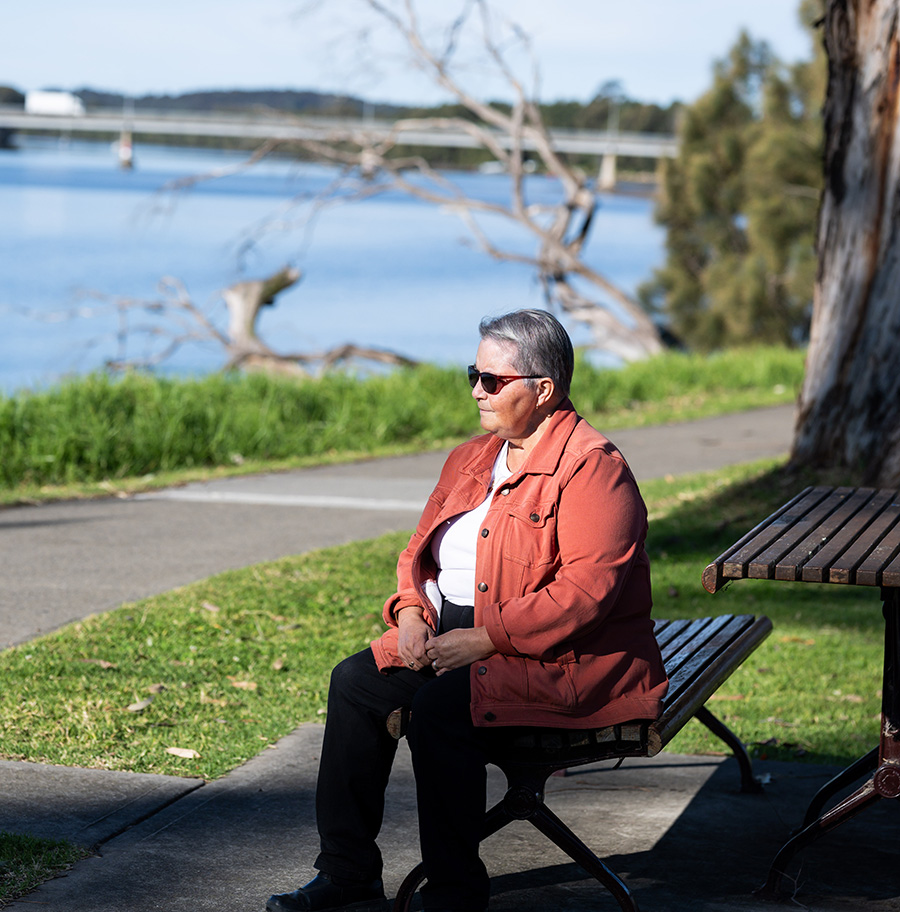
When physiotherapist and mum of three Julie Allen was diagnosed with lymphoma, a type of blood cancer, she thought, ‘right, I’ll have chemo, get better, and go back to work’. But after completing treatment, cancer related fatigue and other longer-term side effects meant she literally felt “stripped bare”.
It took her “a good two years” to get back her “mojo”, despite the skills and experience she had from her profession.
Her lived experience and expertise as a physiotherapist shaped Julie’s passion for supporting people facing cancer.
Julie’s blood cancer diagnosis

Julie was busy juggling work in private practice, chronic pain research at the University of Queensland and being the mum to three young children when she experienced a long period of getting sick. Ultimately, she was diagnosed with non-Hodgkin lymphoma after nearly a year of having symptoms.
When finally diagnosed, she was told, “if you hadn’t come in today, you had three weeks to live.”
“My systems were shutting down. I had a lymphoma the size of a football in my chest and had somehow been functioning, but very poorly,” says Julie.
“I couldn’t lie flat and was sitting upright in bed at night. I couldn’t finish a sentence without coughing and spluttering. I had recurrent colds and I had a rash all over me.”
Life after treatment
After going through chemotherapy, Julie found herself facing a new set of challenges.
For me, the most difficult phase was post-treatment. I felt more unwell, overwhelmed, and affected by the treatment after treatment than when I was on treatment.
“While you’re on treatment, you’re working towards a goal, then all of a sudden that’s all gone, but you’re left with the aftermath. That was particularly challenging because of the cognitive deficits, the physical deficits, the physiological changes that have occurred,” explains Julie.
“Your body doesn’t look like your body anymore. I looked like Bert Newton… big moon face, no hair, huge abdomen from all the steroids, and I’d put on a considerable amount of weight, most of which was fluid.
“So there was that sense that my identity had changed as well, and it took two years for me to start looking like myself again, for my energy levels to be a little bit more normal again, and cognitively, for me to be able to function like I had before.”
Helping others navigate fatigue and other side effects

Julie’s return to work in 2010 saw her starting her own private physiotherapy practice to “provide help, guidance, support and encouragement for cancer survivors to regain their physical, psychological and social health and wellbeing, and a better sense of self.”
“Over the last 12 years, I’ve worked with people at any stage along the cancer continuum, from pre-diagnosis, through diagnosis, treatment, post-treatment, and even palliative care.”
Julie emphasises the importance of being aware that the physical effects of having had treatment – cancer related fatigue, sleep, pain, peripheral neuropathy, nausea, general deconditioning and muscle atrophy, and nausea – are also impacted by the psychological effects.
“For some people, especially if they are on treatment, the priority is, ‘I just need to be able to get out of bed’,” says Julie.
Cancer related fatigue
To explain the complexity of cancer related fatigue, Julie’s best analogy is:
It’s like I’m lying on a beach on a king tide. I know the king tide is coming in and I know I have to move, but I don’t have the energy or the motivation to get up and get out of the way, because it’s just too much.
“It’s very different from the person without cancer who says, ‘oh, I feel so tired’, or the young mum with a new, young baby who is feeling overwhelmed and tired,” she said.
Why people experience fatigue on their cancer journey is due to cancer related fatigue being complex, multi-faceted, and caused by several factors:
- the cancer itself can contribute to the fatigue – the process of the cancer
- the cancer and cancer treatment can cause increased inflammatory levels – so the levels of cytokines within the body start to increase, and lower cortisol levels also can affect cytokine levels
- the cancer treatment itself has a huge impact on how much fatigue a person experiences and how their body metabolises and responds to that
- people may go into cancer treatment with anaemia or other illnesses in the background, which may also contribute to fatigue
- added to the above is a sleep cycle that’s thrown out of kilter by treatment, especially if people are on steroids, and
- other predisposing factors include poor nutrition, being sedentary and lacking physical fitness, or having high levels of stress or pain.
Julie’s advice on exercising to treat cancer related fatigue
According to research over the last 10 to 15 years, Julie said the gold standard to treating fatigue with exercise is 150 minutes of moderate to vigorous intensity a week – that’s five 30-minute sessions. And “you want to add some strength training” (at least three sessions a week) and “some range of motion or flexibility work as well that incorporates balance activities”.
“But if you write that people will go, ‘I can’t do that. I’m just going to be stuck with my fatigue because I’m so incapable of doing that’.
“So, what I spend a lot of time with people doing is saying, ‘look, this is the gold standard but let’s break it down for you’.
“For some people, they start doing a couple of lots of five to 10 minutes of something, but throughout the day. So, they’re still trying to get towards their 30 minutes, but it might not be in one hit.
It’s looking at what it is you want to do, working out how we’re going to do that, and working slowly and incrementally towards increasing the amount of time and effort that you can put in to doing that.
Understanding energy levels and fatigue
“To manage fatigue, you have to be aware of fatigue” and Julie says a good analogy is a bucket of water that represents the amount of energy we have to use in a day.
“Looking at our control list, to fill the bucket we know we can exercise, have a good diet, and sleep – these increase the amount of energy available to us. What takes energy out of the bucket is going to doctor’s appointments, experiencing stress, being around negative people, and not getting enough sleep.
It’s working out for each person, and for each person to work that out themselves, how much energy they have to use within a day and not pushing beyond that because then if they do, the next day or two they’ll be able to do nothing because they’ll be completely wiped out.
“That’s pacing – working out that tightrope of ‘what is it that I can do today that’s going to leave me with enough energy to do the other things I need to do in the day, and that leaves me with enough energy so that tomorrow I can reproduce it by doing the same again, or maybe do a little bit more.”
To do this is “very easy” says Julie, “once they start focusing on that prioritising, planning, and pacing to work out their fatigue management and get the idea that our bodies have a certain load that we can adapt to, and not to push beyond that”.
“When you push beyond that, people either have no energy left or they end up with an injury, and that’s not uncommon when people finish treatment. They think, ‘oh, I’ve finished treatment, now I’m going to go straight back to the gym’.
“Then I’ll see them because, A, they’ve fallen apart and all of a sudden have completely depleted their energy, or B, they’ve overused or torn muscles because their body was deconditioned and can’t accept the loads it once could,” said Julie.
“What’s needed is education and respect for your body, and listening to the body, then working out an incremental way to slowly and gently increase activities again, working towards that gold standard of 150 minutes of moderate to vigorous intensity exercise throughout the week.
“For people, particularly post-cancer treatment, we know that’s the level we’d love to get them to, to keep their cancers in remission, and if we can attain and maintain that level of exercise, we’re preventing other chronic diseases from coming along.”
Julie’s support of the Online support service and energy coach

In 2021, Julie kindly assisted in the development of the learn module – cancer related fatigue and the digital energy coach. Her lived experience as both a healthcare professional and consumer has been invaluable. Her personal insight into cancer related fatigue has helped countless people living with blood cancer.
To identify your energy levels and help manage your cancer related fatigue, read more about the Blood Cancer Online Support tool’s energy coach.