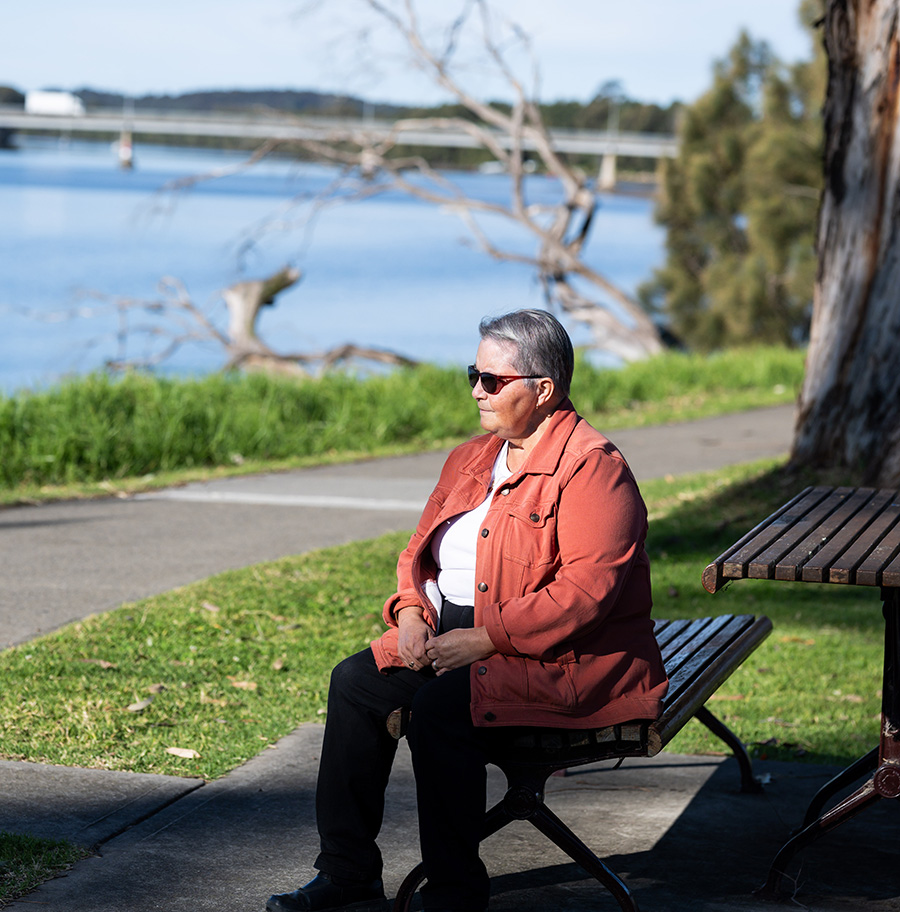
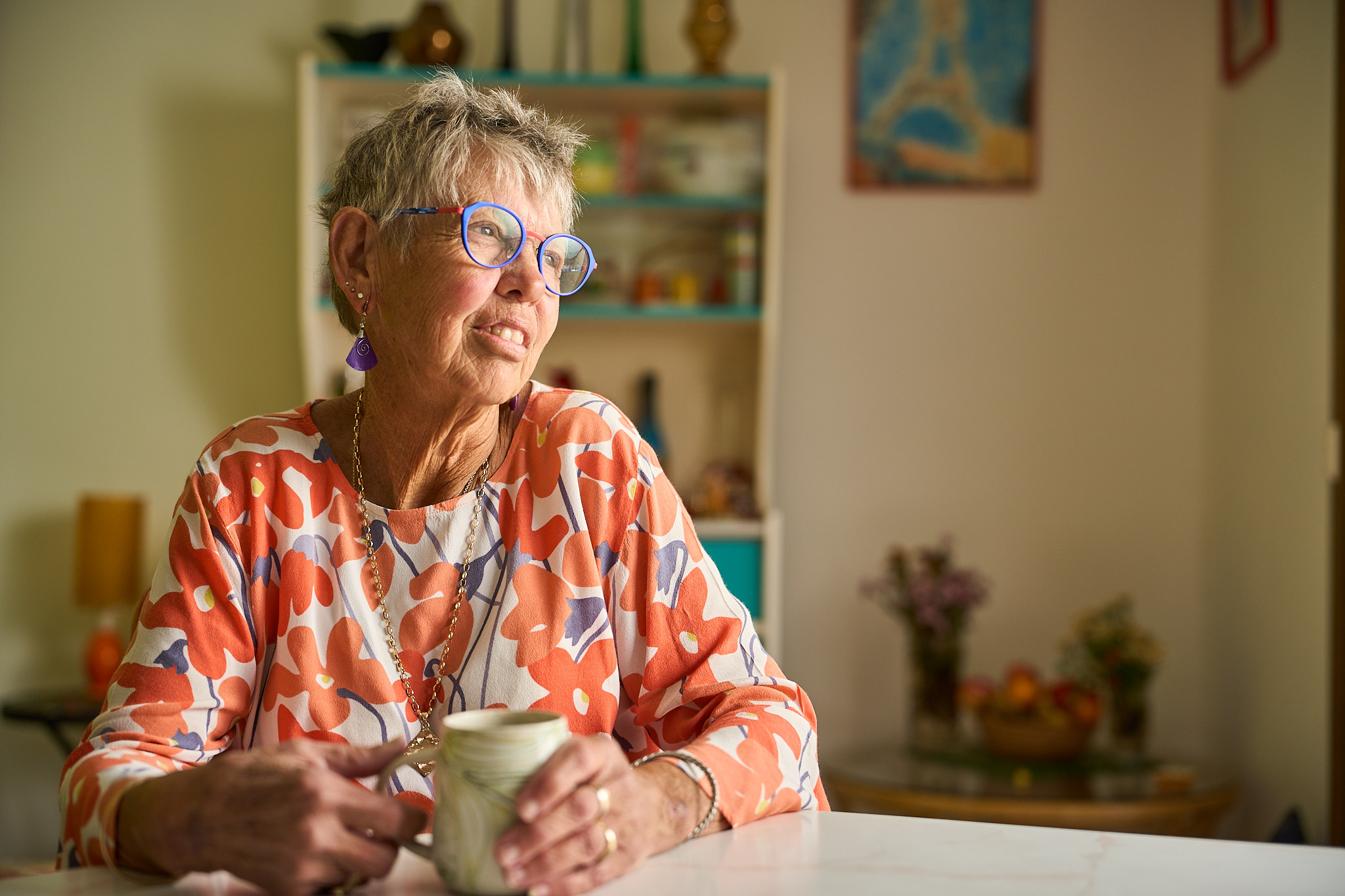
Heather Jenkins was one of the first Australians to go on a clinical trial for the first targeted therapy for chronic myeloid leukaemia (CML).
That was 21 years ago, when imatinib (Glivec®) was called STI-571 and it was yet to be listed on the Pharmaceutical Benefits Scheme (PBS).
These days, Heather is CML drug-free. She stopped taking imatinib six years ago and remains in treatment-free remission (TFR).

The long road to a CML diagnosis
During the 12 months before her CML diagnosis, Heather Jenkins repeatedly complained to her GP, saying, “I’m just so tired”.
“That was in 1999, when our son got married in the April and our daughter got married in the September,” Heather explained.
“But he kept saying, ‘it’s the preparations for the weddings, and running a business, and everything’.”
Heather and her husband of 50 years, Wal, were running their motel in Orange – a 24/7 mum and dad operation – and they’d recently bought a house at Wollongong, where they planned to retire to and where their son and daughter-in-law lived.
The following February, the Jenkins travelled overseas.
“We went to England for four weeks to see our daughter and her husband, and I was still tired.”
Then, in May 2000, the Jenkins went overseas again, to a wedding in Norway.
“I was still very, very tired up there. Just extremely tired,” said Heather.
After the wedding they travelled on to Spain with Heather’s brother and his wife.
“That’s where I took very sick. I had a gall bladder attack and in Portugal I got to see a doctor. She did a lot of blood tests and asked, ‘when are you going home?’.
Heather said she was flying out of Paris in four days and the doctor said, ‘as soon as you get home, get to your doctor for ultrasounds and blood tests’.
“She must have known, because she was absolutely beside herself with what she’d seen,” said Heather.
“She put me on a strict diet – just steamed vegetables – and gave me tablets for the gall bladder.
“We flew to Perth, where we were going to a conference, but I was too sick to attend.”
Back in New South Wales, Heather and Wal went to Wollongong, to see their son, before heading home to Orange and going to the doctor there. Heather was sent for an ultrasound and blood tests, then went shopping.
So when her husband got a call from her GP, asking, ‘where’s Heather?’, Wal didn’t know. The doctor explained that the pathology lab felt Heather had leukaemia, ‘but please don’t tell her’.
“When I got home, Wal said I needed to go back because they didn’t get enough blood. When I got there, all the girls, who I knew, put their arms around me and said, ‘oh you poor girl’. So I knew it was something really serious,” said Heather.
Heather’s diagnosis with chronic myeloid leukaemia
That afternoon, Heather got a home visit from her GP and he spent a lot of time with her.
“He gave me the good news that I had CML,” said Heather.
She’d never heard of this type of leukaemia.
I thought there was just one leukaemia… so I’ve learned a lot in the 20 years, I can tell you.
Heather was “absolutely devastated” by her diagnosis.
“I was from a very strong, healthy family, and nobody in my family had ever had cancer. I was a hard worker and just didn’t believe that it could happen to me,” she explained.
Heather was referred by her GP to Westmead Hospital, four hours away in Sydney, and she was “lucky enough” to see Professor Mark Hertzberg, who arranged a bone marrow biopsy.
“They said I was very lucky they got it [CML] at an early stage, even though I’d been so sick and tired for so long.”
Her white blood cell count was 160,000, and she felt “everything was trying to push out of my bones”.
At the time, Heather was 57. She’s 78 now and when she spoke to CML News, it was 21 years to the day – July 23 – when she’d seen that doctor in Portugal.
“It’s been a long journey,” she said.
Starting CML treatment
Heather had hydroxyurea for around 10 days and when she went back to her haematologist, she was offered a clinical trial for a Phase III study of a new medication, known then as STI-571, and later called imatinib.
“It was described as the silver bullet,” said Heather.
STI-571 was the experimental arm of the randomised trial, and this new therapy was being compared to interferon-alpha, the standard frontline treatment for CML at the time.
Heather’s decision to join the trial was based on her faith in Prof. Hertzberg and her GP, who she talked it over with a lot, and the support of her family who she said, “helped me to decide to try the trial”.
On 7 September 2000, Heather started the multinational IRIS trial, and she was pleased to hear she was on the experimental arm.
“There were only three or four of us at the start and my number at Westmead was one,” said Heather.
“I couldn’t have gone on the trial if I’d stayed at Orange,” said Heather, so she and Wal moved to their house at Wollongong, an hour from Sydney.
But, for the first few weeks, Heather stayed near the hospital so she could have a blood test prior to taking the oral treatment each day and be closely monitored. After that, she went to Westmead two or three times a week for ongoing tests.
For the first six months Heather suffered severe leg cramps as a side effect.
“My daughter is a physio, and she and my husband had to basically hold me down of a night when I went to bed because my legs would just cramp right up. It was absolutely shocking,” said Heather.
“And I had to stop a lot of other medication. I couldn’t take cholesterol tablets while I was on Glivec because it caused too many joint pains.
You have to have a good GP to work with on what’s causing some of the side effects.
“That’s when I started exercising more. Once I started moving, I was better. It was probably a lot to do with the brain too. You’ve got to tell your brain what to do,” said Heather.
“I’m a positive person, that’s why I don’t dwell and ask that many questions of doctors. If they tell me I’m fine, I’m fine.”

Heather continued to participate in imatinib studies
Glivec was listed on the PBS in September 2002, when it was described as ‘a wonder drug’, but Heather stayed on the clinical trial until 2005, then she went on another trial for imatinib. Ten years ago, she was transferred to the hospital in Wollongong, so she no longer had to travel to and from Sydney.
“Being on the trials [meant] I had to keep having bone marrow biopsies, which I didn’t mind doing because I thought I was giving back to people by providing information,” she said.
There was only the one time when Heather didn’t take her four tablets religiously at the same time every day, after breakfast. It was in 2003, when she had a nine-day break while her stem cells were harvested so they could be stored, as insurance, in case the imatinib didn’t work for her and she needed to have a stem cell transplant.
“I had to give myself [daily] injections and that was terrible, but I got through that, and by the time of the harvest, I was very, very sick because going off Glivec for nine days really put me back a long way,” she said.
“I went downhill that quick. But when I got back on it, I picked up very quickly.”
Heather stopped her CML treatment six years ago
Heather stayed on Glivec until 2015 when she got very sick with pancreatitis.
“They had to take me off the Glivec to see if that would help, and within a few days I was a lot better.
“I was quite pleased because I felt I’d been on it too long. I was having a lot of joint pains and was allergic to a lot of things. I had put up with all of that to try and get over the leukaemia.
“I’ve just stayed off it ever since, and that’s good, because I don’t need it,” said Heather who never quite felt 100% on imatinib.
“I felt my stomach was always sick. I had to watch how much food I ate before I could take the drug, because it upset my stomach.
“It’s now nice to be able to get up and have my breakfast and not think that I’m having enough, or I’m having too much, because I had to have so much food before the drug would start eating into my stomach.”
Heather couldn’t go on a treatment-free remission trial when she stopped imatinib because she was taken off so quickly, so she was monitored by her oncologist at Wollongong.
“I used to go to her every two months, but now it’s every six months,” she said.
“I’m under the impression that it [CML] could come back at any time, seeing I have to have regular blood tests.
“I just go along with what they tell me. I trust my doctors and if they say everything’s right, I just leave it be. I don’t dwell on it. I used to when I first was diagnosed.”
Heather has high blood pressure and osteoarthritis, “but I’m 78 and you’ve got to expect that, so I just get on with living”.
“We live right in Wollongong now, in an apartment. We go out for coffee, we go walking, when we can… we’re locked down now.
“We’ve got four grandchildren and I’m lucky that both my children live 10 minutes on either side of us, so that’s nice.
“And up until the last two years, my husband and I have been fortunate enough to travel overseas every 12 to 18 months.
“It took me about two years on Glivec before I was allowed to go out of Australia, but as soon as I could, we’ve travelled as much as we could, to Europe, South Africa, you name it, we’ve been everywhere,” said Heather.
Her taste for travel began, aged 17, when she went overseas with her parents in 1960, and in 1966.
“The first time we took our children overseas was when they were nine and 12. We went to America, and then later, to Europe with them, and Wal and I have been travelling ever since.
“We worked very hard at the motel for 22 years and didn’t take weekends off, so we’d go overseas for three or four weeks at a time.”
Their last trip was in 2019, when they travelled from Germany down through to Croatia, then up to Vienna, Prague, Budapest, Helsinki, across to St Petersburg and back, “all by train, boat, and plane”.
“I didn’t want to go because we’d had a big trip the year before, for my 75th. We took most of our family to Singapore for a week, and then my husband and I went on to South Africa.
“I said, ‘no, we’ve spent too much, we can’t go this year’, and he said, ‘we don’t know what’s around the corner!’
“So we just went, and thought, ‘well, we’ll put the numbers back on the credit card when we get home’,” said Heather.
“We’ve been hard workers, and when we sold the motel business, that was our superannuation.
“And we’ve been very lucky. We’ve shifted three times in Wollongong, and each time we’ve sold we’ve made good money, and we’ve been able to buy this beautiful apartment a block and a half from the beach.”
How COVID-19 has affected Heather
“I haven’t coped very well because there are [COVID] cases here in Wollongong,” said Heather, who is fully vaccinated, having just had her second shot.
“I only go out once a day, to go walking. I have our groceries delivered. My husband will duck out and buy us a coffee and come back with it, but I’m just not happy to go out.
“We keep in touch with our friends by phone, but it’s not the same as going out for lunches and coffee with them.”
Support and the Leukaemia Foundation
“When I first got CML and went on the trial, I had the most wonderful trial nurses and they kept in touch with me sometimes twice a week, so I never needed support from the Leukaemia Foundation then,” explained Heather.
“Although I did donate money to the Foundation, in the second year, when I got such a good response to the Glivec, to help other people who needed it.
“We were fortunate enough that we didn’t need help with accommodation or anything,” said Heather, and over the years, she has taken part in a couple of Light the Night events.
Advice to others living with CML
It wasn’t until after she stopped going to Sydney on the clinical trials, that Heather joined the Leukaemia Foundation’s support groups on a Saturday at Wollongong.
“I’ve helped others there who had just started on the drug and who’ve said they don’t like the leg cramps and pain, and they’re not taking the tablets all the time,” said Heather.
“I help by telling them, ‘you must drink at least two litres of water a day, and you must exercise, and it will get better as you go along,’ because that’s what helped me.
“The trial nurses used to say to me, ‘you must drink a lot of water to keep your kidneys flushed and you must keep up your exercise’.”
Heather also stressed the importance of not missing any tablets; the tyrosine kinase inhibitors, such as imatinib, nilotinib, dasatinib, etc.
“Make sure you eat healthy food and have enough food before you take the tablet, so that it doesn’t upset your body,” she said.
“Drink plenty of water, and exercise as much as possible, and also have family support.
“My daughter and her husband were living in England when I was diagnosed. They came straight back to Australia to be with us.
“It was the support of my husband and family that helped me through it, because in those days we didn’t know anything about the trials. It was very, very new.
“When I was diagnosed with leukemia, they told me to get my life into order because I didn’t know how long I’d have to live. That gives you a hell of a shock.
“It’s turned out that here I am, 21 years later. I’ve seen my eldest grandson get to 20 and my youngest grandson get to 11. It all makes it worthwhile.”