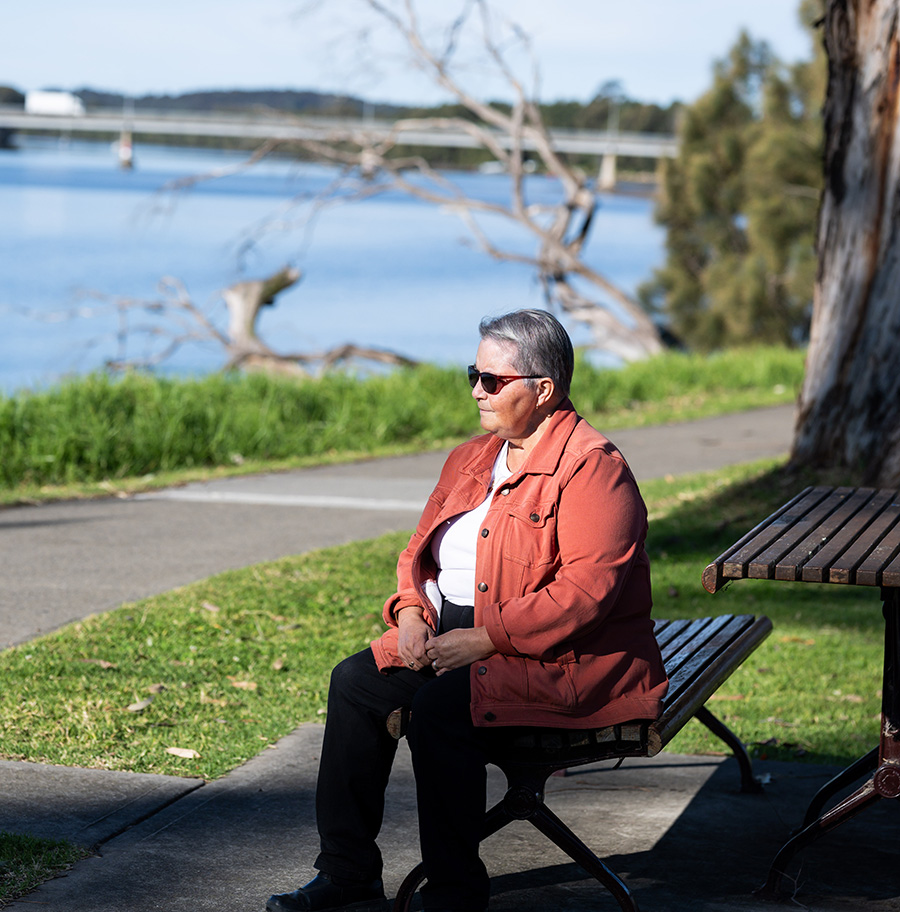
Trish Wilson was inspired to study a counselling degree when she was working as a nurse and midwife at Brisbane’s Mater Mothers’ Hospital with families who had lost a baby. She then completed a Master of Health Studies, majoring in loss and grief. Her broad view of loss comes from the concept of loss being the universal principle that people experience in adversity. Trish has provided training for the Leukaemia Foundation’s team of Blood Cancer Support Coordinators in their support of people living with blood cancers.
Loss and grief sometimes chooses a person rather than you choosing this area of work, says Trish Wilson, and that certainly was the case for her.
“I worked out that I was actually comfortable sitting with people in distress,” said the counsellor who has specialised in loss and grief for 15+ years.

“My counselling degree gave me some of the skills to be able to do that.
“But I’ve also found that people experiencing loss often feel so alone and lost, and when you have a helping nature, the willingness to be able to sit with someone in that experience and do whatever you can to support their healing is an absolute privilege.
“That’s one of the lovely things about doing this work – the privilege of being invited into the experience of loss of another,” said Trish, who deeply respects that invitation.
“To have witnessed so many incredible stories, and to see the incredible strength and tenacity as well as the vulnerability that people have in their lives, is incredibly humbling as a clinician in this field.”
Grief is normal
“Loss and grief is actually a normal experience,” explained Trish, “and it’s really important as a community for us to understand that.
“We live in a society that is quite averse to talking about death and dying and grief and sadness, so there’s a potential risk that if we don’t normalise grief, then we start to alienate people and they can’t get the support they need.
We need to be able to talk to our friends and our family and our colleagues when we’ve had some experience with grief and loss.
There’s a grieving process that most people who go through loss experience. It’s a healing process that takes people different lengths of time and is very individualised, and many factors contribute to that process being different for different people.
“It’s important for us to understand the difference between that normal grieving process and someone who might be experiencing more ‘complicated grief’, so they can access the supports that are available for them,” said Trish.
“About 15% of people will experience ‘complicated grief’ in some form.”
Complicated grief is an official term and in 2013 the American Psychological Society included it as a diagnosis of mental illness in the DSM-5 diagnostic tool, and being a recognised condition, it gives people access to counselling and support.
“In Australia, it means you can get a Medicare referral to see a psychologist,” said Trish.
“Complicated grief usually happens when there are really specific factors, such as when a parent loses a child they had spent years caring for and who was so central in their lives.
“Or it might be complicated because the experience of loss is traumatic.”
If a family member witnesses a loved one’s death during an unexpected medical emergency, they may be dealing with trauma as well as grief.
“People who are exposed to particular traumas often go through experiences of having flashbacks and feeling unsafe in the world, or they’ll have panic attacks that are associated with the trauma,” said Trish.
“We know that grief responds well to people talking about what happened, but with trauma, people want it subdued or pushed down because as soon as you start talking about it, they start to re-experience it.
“It’s a bit tricky then for people to know – do I talk about it or not talk about it? That’s where people really need professional support to help them to navigate those two challenging sides of how they can heal over time,” said Trish.

Grief is individual and unique to each person
Despite lots of different grief models, understanding, and research in this area, the way each person will grieve the loss of a loved one will be uniquely different, says Trish.
“That’s because we’re human beings… we’re all uniquely different.
“Often the grief is linked to the relationship with the person that’s lost, or to one’s coping mechanisms, also to past losses a person has experienced before, that influences how they grieve a new loss and also losses in the future when the time comes.
“So it’s important for us all to just remember that there’s no one way to grieve.”
Men and women grieve differently
“There are certain differences in the way that men and women experience grief, how they express their grief, and how they heal from grief.
“This is often based on two different grieving styles – intuitive grieving and instrumental grieving,” said Trish about the work done by Dr Kenneth Doka 15 years ago.
“Intuitive grieving is more likely to be a style that women experience, but not always, some men may also grieve intuitively.
“Intuitive grievers experience and express grief mostly through their emotions, so they need to talk about their feelings, to express those feelings, and they often go over and over the events leading up to or following the death.
“That grief process often is highly emotive and completely exhausting, and they can experience other side effects like anxiety and sicknesses. But over time, they do heal by going through that process.
“On the other hand, instrumental grievers are often more linked to a masculine style of grieving, and that’s more of an active grief. They do stuff rather than talk about stuff, which fits with men much more often.
“They’re often problem-solvers, so when you talk to a man who might be an instrumental griever, he’ll often talk about the problems rather than the emotion, and he’ll be trying to solve those problems,” said Trish.
“One of the things I’ve done, working with families, is to give men a list of jobs to do, particularly in early grief, because that’s one of the things they can do. Things like organising the funeral, contacting people, and making arrangements.
“In ancient cultures, men used to dig the grave by hand. They’d gather together to do that hard, physical work. That was the way the men processed grief; they didn’t necessarily talk a lot about how they felt, but they had the support of other men.
“And in a lot of our cultures today, such as the Islamic culture, the women congregate together and there’s lots of expression of emotion.”
Consequential or secondary losses

Often there are consequential, or secondary losses, in addition to the primary or significant loss that a person experiences and has to grieve. The primary loss is the family member, loved one, spouse or child who is no longer physically in one’s life.
“But there are so many consequential losses that might happen,” said Trish. “You may lose the person who used to mow the lawn, changed the light bulbs, or knew the pin code for the bank account.
“They’re very day-to-day things that people have to adjust to in their grief.
“And when someone is diagnosed with blood cancer, and we’re not talking about a death here but the experience of diagnosis, the primary loss is the loss of health and wellbeing… the loss of capacity.
“The secondary losses are prolonged periods of time in hospital, the loss of finances, the loss of work, and the loss of control of their lives because it’s being dictated by their blood counts or their medical team’s decisions about them.
“Understanding grief from that perspective, sometimes people need support to deal with those secondary losses.
“There are times, as a clinician, when people want to feel confident that I can support them in those secondary losses before they’re ready to talk about the biggest loss that’s sitting there heavily on their heart.
“If I can be useful to help them with some practical things while we build a relationship, then they’re more inclined, when the time’s right, to be able to open their heart and talk about the things that are weighing heavily.”
Walking alongside the grieving
“For those of us who, for whatever reason, have been called to walk along the path with those people who are grieving, this is an invitation into something that’s incredibly personal and private and often lonely, and we have to walk with great humility, and with a sense sometimes of unknowing, because each story is different.
“And with the ability to be able to hold, and to resist the urge to try and fix something because you don’t fix grief. The only way we can fix grief would be to bring a person back to life and we can’t do that.
“It is learning to sit in the rubble, in the brokenness with people, in a way that they don’t feel alone, and to be very non-judgemental about how that person’s actually going, and to invite them to find ways that work for them.
“The skill of working in grief and loss is to be very creative in how you can work with each individual person as you sit there and journey with them.
“Some people will just want coping strategies. They will be those very pragmatic, instrumental grievers, and they just want to solve those problems.
“Others will be completely overwhelmed by their emotion, unable to get out of bed and not able to go to work or to even communicate with family members.
“Each person needs something very different,” she said.
Trish’s key piece of advice
“It’s not to give up hope,” said Trish.
“That belief, that hope… that things will get better, and that’s the reality for most people. Their grief and bereavement is actually a healing process, and many, many people are transformed through the experience of grief.
“People experience a lot of helplessness and hopelessness at times, but not everyone. Some people find grieving actually quite easy, and they’re often people who have grieved before or have incredible support networks around them.
“We often think of grief and loss only of what’s lost, what’s taken away, and what’s not there anymore. And yet, many, many people I have worked with, they grow, and they change,” said Trish.
“They think through life differently. Their priorities are often very different, and they often have a very special connection to someone who’s passed. That becomes a real central point of meaning-making in their lives.
“We know many people set up particular foundations or trusts, but even people who don’t do it on that large scale will often have a real sense of connection to someone who’s died.
“I always remember one of the dads who would say to me, ‘my son was such a little fighter, so therefore, every day, I invite myself into my best dad that I can be for the other kids’.
“It’s that real higher order stuff that people want to step into.
I think grieving people change the world – their own little worlds and sometimes the bigger world as well.
The timeline of grief
“People often want to know ‘how long this [grief] will last’ and my answer is, ‘as long as a piece of string’, which I know isn’t particularly helpful but it relates back to that idea that grief is very individual and different people will experience grief over different lengths of time,” explained Trish.
“We know the initial weeks and months of grief often are marked by a sense of shock and disbelief. It’s a bit surreal. People are going through the motions, and often say they can’t think straight and they can’t organise their lives.
“It takes them a while to accept the reality, not just in their head, but in their heart. Once that’s accepted, at around six months, people are back into their day-to-day routines. The grief is still very much there but most people will say they’re beginning to function a little bit better.”
The next six months or so is often the time of real longing and wishing and missing, and as a person gets back into life so many experiences remind them that person isn’t there, like automatically picking up the phone to ring your mum and realising she passed away six months ago, or setting the table for yourself only when you used to set it for two.
“That longing often continues for quite a period of time,” said Trish.
At 12 months, the first anniversary of a loved one’s death can be double-sided.
“People get a sense of relief that they’ve survived the first year and all its firsts – their birthday, Christmas, New Year, an anniversary, or other significant times are so often associated with family, and that person is noticeably absent,” said Trish.
“Around the first anniversary is also when people can experience grief almost as intensely as they did in the early days, but that intensity might only last for a day or two.
“What we often see, as people move into their second year of grief, it’s a little easier emotionally and practically. But for many people, grief continues on for up to three or four years, which is not uncommon particularly after the loss of a spouse or child.
“We wouldn’t think about that as abnormal grief, as long as that person feels that there’s progress, and they are the best judge of whether or not the grief is actually getting struck,” Trish said.
“Anniversaries and Christmas time are key times when people might walk back into support services, when they are thinking about how they will get through that time without someone.”
Rituals can help people
“We know from a lot of the research that rituals in grief can really help with the healing,” said Trish about the importance of grief rituals.
“Everywhere I’ve worked in a grief capacity, we usually have a memorial service once a year, often a few weeks before Christmas because a person’s first Christmas without a loved one is a challenging time.
“The opportunity to come to a place that feels really safe, where people can participate, like the Leukaemia Foundation’s Light the Night, helps people, because every year there’s that opportunity to ritualise the remembering and join others in some sense of solidarity,” said Trish.
She has taken part in Light the Night. She went with a couple of girlfriends in memory of someone they knew.
“When I saw it advertised, I just thought, ‘yeah, this is a lovely thing to do’ and it was absolutely beautiful.
“Talking helps with healing, but actually doing something – lighting a candle, having a roll call where we call out the names of people that we’ve lost throughout the year, going to the cemetery which can give a sense of connection by visiting the grave, even having a tattoo which is a constant reminder on their body – can be quite healing,” said Trish.
Trish Wilson answers the top five questions people ask about grief and loss.
Need to talk? We encourage you to call the Leukaemia Foundation on 1800 620 420 or email [email protected] to be put in touch with one of our grief support team staff.