Blood is the fluid that runs in your veins and arteries. It delivers oxygen and nutrients to your tissues and organs and takes away waste. It protects you from infection and can stop bleeding when you’re injured.
Your blood is made up of 4 components:
- red blood cells
- white blood cells
- platelets
- plasma.
How much blood do I have?
- The average male has about 5 litres of blood.
- The average female has about 4 litres of blood.
Blood and your bone marrow
Blood is made in your bone marrow from stem cells. This process is called haematopoiesis. Stem cells are the youngest type of blood cell in the body. As stem cells divide and grow, they mature into:
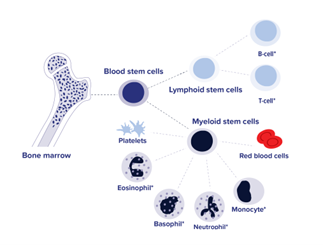
- lymphoid stem cells
- myeloid stem cells.
Lymphoid stem cells then mature into:
- T ymphocytes (T cell)
- B lymphocytes (B cell).
Myeloid stem cells then mature into:
- platelets
- red blood cells
- eosinophils
- basophils
- neutrophils
- monocytes.
Once the blood cells are made in the bone marrow they enter your blood stream.
What does blood do?
- Carries oxygen and nutrients to your cells, tissues, and organs.
- Takes waste away from your cells and tissues.
- Protects you from infection.
- Makes clots that stop you from bleeding.
- Helps regulate your body temperature and blood pressure.
Types of blood cells
- Plasma transports blood cells, proteins, and salts throughout your body.
- It takes waste to the kidneys and liver to remove it.
- It is made up of 90% water.
- It makes up about 55% of your total blood volume.
- Red blood cells make up about 44% of your total blood volume.
- Red blood cells (RBCs) are also called erythrocytes.
- They get their red colour from the protein, haemaglobin.
- Haemaglobin helps deliver oxygen to the rest of your body.
- Red blood cells carry carbon dioxide to the lungs for you to breathe out.
- Red blood cells live for about 120 days.
- The normal range for red blood cells on a blood test is; male – 130-170g/l, female – 120-160 g/l.
- The space in the blood that red blood cells take up is called the haematocrit. The normal range for an adult male is 40-54%.
The normal range for an adult female is 37-47%.
- Also called thrombocytes.
- Platelets are fragments of cells.
- They help your blood clot in a process called coagulation.
- A normal platelet count is 150-400×109/L.
- A platelet count of more than 450×109/L is called thrombocytosis.
- A platelet count less than 150×109/L is called thrombocytopenia. This puts you at risk of prolonged bleeding.
- White blood cells (WBCs) make up about 1% of your total blood volume.
- They are also called leukocytes.
- They are part of your immune system.
- They can fight infections.
- They are 5 types of white blood cells. Neutrophils are the most common type.
- Different types of white blood cells have different lifespans. Some live for hours, others live for years.
White blood cell ranges
- The normal range for white blood cells is 4.0-11.0×10⁹/L.
- A white blood cell count over 11.0×10⁹/L is called leukocytosis.
- A white blood cell count less than 4.0×10⁹/L is called leukopenia.
Types of white blood cells
- The most common white blood cell.
- They are the first immune cell to attack an infection.
- Neutrophils live for hours to days.
- The normal range for neutrophils is 1.5-8.0×10⁹/L.
- A neutrophil count less than 1.5×10⁹/L is called neutropenia and puts you at increased risk of infection.
- Also called T cells.
- They help regulate the function of other immune cells.
- They can directly attack infected cells and tumours.
There are 3 types of T cells:
- Helper T cells help activate other immune cells to fight infection.
- Regulatory T cells help turn off the immune system when there is no longer a threat.
- Cytotoxic T cells, also known as killer T cells, can destroy foreign cells.
- Also called B cells.
- Act as alarm bells for the immune system.
- They detect invaders and let other immune cells know there is an invader.
- Make proteins called antibodies that can target antigens to help destroy viruses and bacteria.
- Work with neutrophils and lymphocytes to help fight infection.
- Help with antibody production.
- Help remove dead tissues.
- They are called monocytes when they are in the blood, and macrophages when they move to the tissue to fight infection.
- A white blood cells whose main job is to kill parasites – like worms, fleas, lice.
- Work with neutrophils to fight infection.
- Help stop unwanted clots in the blood vessels.